What is Litecoin?
Imagine a world where sending money is as seamless as sending a text message—instant, borderless, and without the hidden fees of traditional banking. This is the vision that gave birth to Litecoin. Often described as the “silver to Bitcoin’s gold,” Litecoin was designed to complement Bitcoin by offering faster transactions and a more accessible entry point into the world of digital currency. It’s not just a clone of Bitcoin, but a deliberate experiment in speed, scalability, and everyday usability. For anyone curious about how crypto could evolve into a practical tool for daily life, Litecoin provides a fascinating case study: familiar enough to build trust, yet innovative enough to challenge our assumptions about money.
What is Litecoin?
Litecoin is a peer-to-peer cryptocurrency, kind of like digital cash you can send and receive directly, without any banks or middlemen. It's built on a technology called blockchain, a fancy way of saying it's a secure, public ledger that keeps track of all transactions. Think of it as a giant, transparent spreadsheet everyone can see, but no one can tamper with.
Litecoin is a fork of Bitcoin, which means it took Bitcoin's code and made some tweaks. The most important tweak? A faster confirmation time.
While Bitcoin transactions can take up to 10 minutes, Litecoin can confirm them in a blazing 2.5 seconds! That's like waiting for a snail mail reply vs. getting an instant text back. This speed makes Litecoin ideal for say, transferring your crypto from one exchange to another, and even buying coffee, flight tickets or movie tickets at an increasing number of merchants worldwide.
Since its launch in 2011, Litecoin has come a long way. Its price has seen ups and downs, like any cryptocurrency, but it has consistently ranked among the top 20 cryptocurrencies by market capitalization.
Litecoin vs. Bitcoin
As a fork of Bitcoin, Litecoin aims at solving the following issues:
- Transaction speed: Bitcoin's transaction speed, averaging around 10 minutes, can be cumbersome for everyday use. Litecoin addresses this by utilizing a different hashing algorithm ("scrypt" instead of SHA-256) and generating blocks four times faster, leading to near-instant confirmation times (2.5 seconds). This makes Litecoin significantly more convenient for microtransactions and everyday purchases.
- Transaction fees: Bitcoin transaction fees can fluctuate significantly, especially during periods of high network congestion. This can become a barrier to entry for users making smaller transactions. Litecoin, with its faster block generation and larger supply, generally boasts lower transaction fees, making it more practical for everyday use.
- Scalability: As Bitcoin's user base grows, concerns about its scalability arise. The limited block size (and slow block generation) can lead to network congestion and transaction delays. Litecoin's larger block size and faster block generation offer a potential solution to this issue, improving the network's ability to handle a larger volume of transactions.
| FEATURE | LITECOIN (LTC) | BITCOIN (BTC) |
| Total supply | 84 million | 21 million |
| Transaction speed | 2.5 seconds | 10 minutes |
| Mining algorithm | Scrypt (more efficient) | SHA-256 (energy-intensive) |
| Focus | Medium of exchange, small payments | Store of value, digital gold |
How to Mine Litecoin
Mining Litecoin involves using specialized hardware to solve complex mathematical puzzles and verify transactions on the Litecoin blockchain. In return for your efforts, you're rewarded with Litecoin tokens.
Here's a breakdown of the process:
1. Choose your mining method:
There are three main ways to mine Litecoin:
- Solo mining: You mine alone and keep all the rewards, but the chances of success are incredibly low. It's like searching for a specific grain of sand on a beach.
- Mining pool: You join a group of miners, combining your hashing power to increase your chances of finding a block and sharing the rewards proportionally. Think of it like sifting the sand together to find the grain faster.
- Cloud mining: You rent hashing power from a cloud provider, eliminating the need for hardware and maintenance. It's like hiring someone to sift the sand for you, but you pay a fee for their service.
2. Get the right hardware:
Solo mining is almost impossible without specialized hardware called ASIC miners. They're powerful and energy-intensive, so be prepared for high electricity bills.
For mining pools, you can use GPUs (graphics cards) which are less powerful but more affordable. However, profitability can be lower due to higher competition.
Cloud mining eliminates the need for hardware, but you'll pay a rental fee and have less control over the process.
3. Set up your mining software:
Choose mining software compatible with your hardware and chosen method. Popular options include CGMiner, EasyMiner, and NiceHash. Each software has its own setup instructions, so follow them carefully.
4. Join a mining pool (optional):
If you choose pool mining, research and select a reputable pool with low fees and a good track record. Then, configure your software to connect to the pool's server.
5. Start mining:
Once everything is set up, launch your mining software and let it do its job. You can monitor your progress, hashrate, and potential rewards through the software interface.
Important considerations:
- Profitability: Litecoin mining can be profitable, but it depends on various factors like electricity costs, hardware efficiency, pool fees, and Litecoin's price. Do your research and calculations beforehand.
- Volatility: Cryptocurrency prices are highly volatile, so your earnings can fluctuate significantly.
Remember: Mining involves technical knowledge, financial risks, and ongoing maintenance. This guide is a starting point, and thorough research is crucial before investing in mining equipment or services.
Buy Litecoin safely and securely at CoinW.
Is Litecoin A Good Investment? The Future of Litecoin
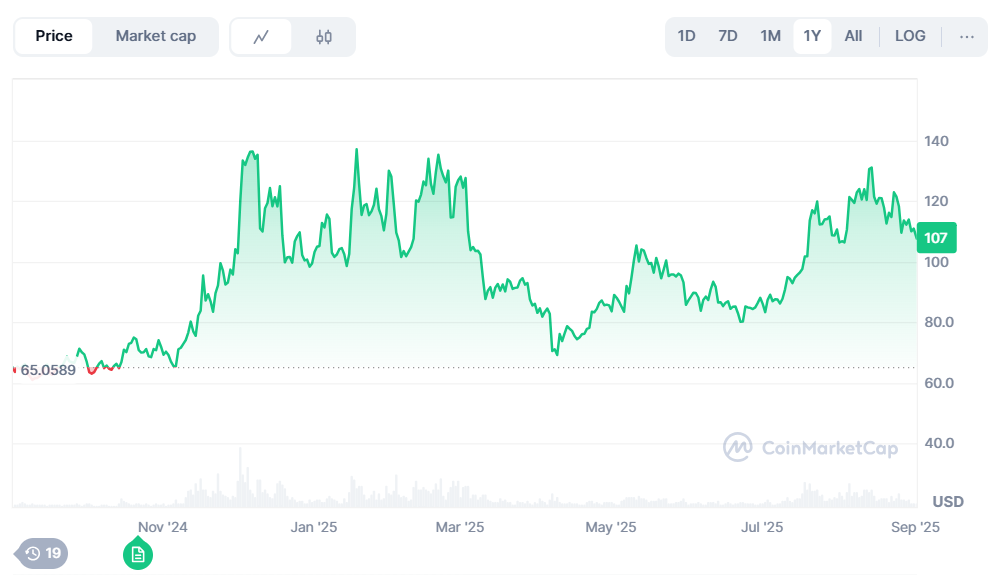
Litecoin price history (Source: CoinMarketCap)
Litecoin's price history has been a rollercoaster ride, mirroring the wider cryptocurrency market. Its first major bull run came in late 2013, when prices surged from just a few dollars to over $40 before falling back during the broader crypto winter. Still, this early rise cemented Litecoin’s status as a pioneering altcoin and a reliable “testnet” of sorts for new features later adopted by Bitcoin, such as SegWit and the Lightning Network.
The coin’s true peak arrived during the 2017 bull market, when Litecoin skyrocketed alongside Bitcoin and Ethereum, reaching its all-time high near $410–420. Like the rest of the crypto market, it tumbled sharply after 2018, but remained in the spotlight as one of the most widely recognized and actively traded cryptocurrencies. Another major rally came in 2021, fueled by renewed retail and institutional interest, though it failed to surpass its 2017 highs. This underscored both its resilience and its limitations in keeping pace with newer, more utility-driven projects.
As of September 1, 2025, Litecoin stands at approximately $108.9, showing a ~67% increase over the past year (i.e., compared to this time in 2024). Recent fluctuations include a dip to $108.6, a rise to $110–$113, and then a stabilization near $109 by early September.
In 2025, Litecoin continues to trade far below its all-time highs, hovering around $107–110, yet showing steady year-over-year growth of about 67% compared to 2024. Its role has shifted from being a frontrunner in innovation to a dependable “digital silver” — less flashy than newer tokens but still valued for its stability, liquidity, and simplicity. While it no longer commands the same excitement it once did, Litecoin’s history reflects the broader cycles of the crypto market: periods of explosive growth, deep corrections, and enduring relevance as one of the longest-standing cryptocurrencies in circulation.
You May Also Like

What Is Avail (AVAIL)? Data Availability, Tokenomics & Uses
Learn how Avail (AVAIL) uses Avail DA, Nexus and multi-chain infrastructure for data availability and chain abstraction, plus AVAIL tokenomics, staking, uses and risks.

What Is Audius (AUDIO)? Decentralized Music Streaming Explained
Learn how Audius (AUDIO) uses the Open Audio Protocol for decentralized music streaming, including AUDIO staking, governance, tokenomics, use cases, and risks.

What Is Cosmos (ATOM)? Cosmos Hub, IBC, Staking & Use Cases
Learn how Cosmos (ATOM), Cosmos Hub, IBC and the Cosmos SDK work, and explore ATOM staking, governance, tokenomics, use cases and key risks.