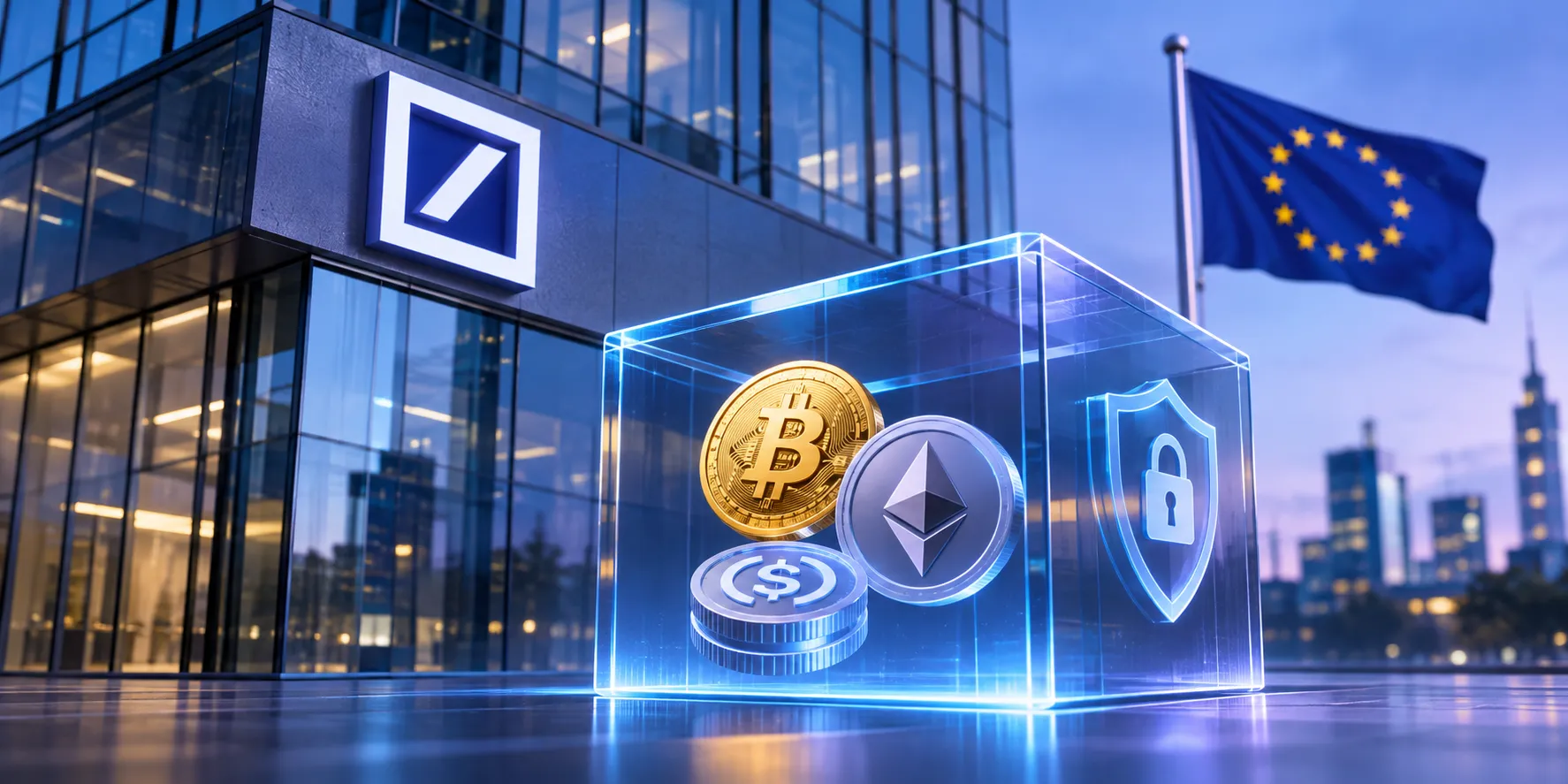
Deutsche Bank Launches Digital Asset Custody Services in Europe Following BaFin Approval
Deutsche Bank has officially launched its digital asset custody service for institutional and corporate clients in Europe, marking a significant development in the integration of cryptocurrency and traditional banking infrastructure. Announced in November 2026, the service follows regulatory approval from Germany's Federal Financial Supervisory Authority (BaFin) and initially supports Bitcoin (BTC), Ether (ETH), and selected stablecoins.
The launch represents a move beyond experimental blockchain projects toward operational cryptocurrency services within a major European banking institution. Deutsche Bank will manage digital wallets and private keys on behalf of eligible clients, allowing them to hold and transfer supported crypto assets without operating their own custody infrastructure.
According to Deutsche Bank's official launch announcement, the initiative reflects increasing institutional demand for regulated digital asset services and the growing importance of blockchain-based financial infrastructure.
Quick Summary
Official launch: Deutsche Bank launched its digital asset custody solution in November 2026 following BaFin regulatory approval.
Target customers: Institutional and corporate clients, including asset managers, hedge funds, brokers, custodians, and sovereign institutions.
Supported cryptocurrencies: Bitcoin (BTC) and Ether (ETH), alongside selected stablecoins and e-money tokens, including USDC, EURC, and EURAU.
Core services: Secure digital asset custody, private key management, wallet administration, and transfers.
Regulatory framework: German financial supervision and applicable European crypto-asset regulations, including MiCA.
Future developments: Potential expansion into tokenized financial instruments and additional digital asset services.
Background: Deutsche Bank's Entry Into Digital Asset Custody
Deutsche Bank's entry into cryptocurrency custody reflects the financial industry's increasing interest in digital assets as part of institutional investment, treasury management, and financial settlement infrastructure.
On September 16, 2026, Deutsche Bank announced plans to introduce institutional digital asset custody services, subject to regulatory requirements. The bank outlined a model designed to combine cryptocurrency infrastructure with the governance and operational controls expected of regulated financial institutions.
Following the completion of the applicable regulatory process, Deutsche Bank confirmed the service's launch in November 2026.
The bank's decision comes as financial institutions explore the use of blockchain technology for cryptocurrency custody, tokenized securities, stablecoin transactions, and more efficient settlement systems.
For investors following these developments, major cryptocurrencies such as Bitcoin (BTC) and Ethereum (ETH) remain central to institutional digital asset adoption.
How Does Deutsche Bank's Digital Asset Custody Service Work?
Digital asset custody involves safeguarding the cryptographic private keys used to access and transfer blockchain-based assets. Unlike traditional bank accounts, cryptocurrency ownership and transaction authorization depend on cryptographic credentials.
Deutsche Bank's solution allows eligible institutions to delegate the technical management of these credentials to the bank.
Private Key Management and Secure Storage
Deutsche Bank's custody infrastructure incorporates several security mechanisms intended to protect institutional holdings.
Hardware-based key protection: Private keys are generated and protected using dedicated security hardware.
Warm and cold storage: Different storage environments balance operational accessibility and protection from online threats.
Multi-person authorization: Important operations require approval from multiple authorized individuals.
Segregation of duties: Operational responsibilities are divided to reduce unauthorized activity and internal control risks.
Backup and recovery: Redundant infrastructure and controlled recovery procedures support business continuity.
These capabilities are described on Deutsche Bank's official Digital Asset Custody platform.
Institutional Wallets and Transfers
Clients can hold supported digital assets and authorize transfers to third parties while Deutsche Bank manages the underlying wallets and private keys.
The platform is accessible through Deutsche Bank's institutional banking infrastructure, including its Autobahn and Corporate Bank channels.
This approach can reduce the operational burden associated with maintaining proprietary cryptocurrency custody systems, although clients remain exposed to digital asset market and operational risks.
Which Cryptocurrencies Does Deutsche Bank Support?
Deutsche Bank's initial digital asset custody offering focuses on established cryptocurrencies and selected stablecoins or e-money tokens.
| Digital Asset | Symbol | Asset Category | Primary Function |
|---|---|---|---|
| Bitcoin | BTC | Cryptocurrency | Digital value storage and transfers |
| Ether | ETH | Native blockchain asset | Network fees and blockchain applications |
| USD Coin | USDC | US dollar stablecoin | Dollar-denominated digital transfers |
| EURC | EURC | Euro stablecoin | Euro-denominated digital transfers |
| EURAU | EURAU | Euro stablecoin | Institutional euro-denominated transactions |
The bank has indicated that additional cryptocurrencies and tokenized financial instruments may be introduced over time, depending on regulatory requirements, customer demand, and internal risk management procedures.
Market participants can monitor crypto live prices to follow broader cryptocurrency market developments, including changes in the valuation and trading activity of major digital assets.
Why Is BaFin Approval Important for Deutsche Bank's Crypto Custody Launch?
The approval of Deutsche Bank's custody offering by Germany's Federal Financial Supervisory Authority, BaFin, is a significant regulatory milestone for institutional cryptocurrency services in Europe.
Regulated financial institutions must implement appropriate governance, operational safeguards, risk management procedures, and customer due diligence when providing digital asset services.
Deutsche Bank's custody offering also operates within the European Union's evolving digital asset regulatory environment.
The Role of MiCA in European Crypto Custody
The Markets in Crypto-Assets Regulation (MiCA) establishes a harmonized regulatory framework for many cryptocurrency-related activities across the European Union.
MiCA addresses areas including crypto-asset service providers, custody and administration, transparency, consumer protection, and certain stablecoin arrangements.
For an explanation of the framework, see CoinW Academy's guide to MiCA regulation.
Regulatory authorization can provide institutions with greater clarity regarding service providers' responsibilities. However, authorization does not eliminate investment losses, cybersecurity threats, or other cryptocurrency risks.
Major Contributions and Impact on Institutional Cryptocurrency Adoption
Deutsche Bank's launch contributes to the development of regulated cryptocurrency infrastructure by connecting traditional banking services with blockchain-based assets.
Reducing Institutional Custody Barriers
Institutional investors typically require controls covering transaction authorization, asset protection, internal accountability, and business continuity.
By providing managed custody, Deutsche Bank offers an alternative to institutions developing and maintaining their own cryptocurrency wallet infrastructure.
Supporting Stablecoin Adoption
The inclusion of USDC, EURC, and EURAU demonstrates the growing importance of stablecoins within institutional financial services.
Stablecoins can support blockchain-based transfers denominated in conventional currencies, potentially improving the efficiency of certain payment and settlement workflows.
Nevertheless, stablecoins introduce issuer, reserve, redemption, operational, and regulatory risks that institutions must evaluate.
Preparing for Tokenized Financial Instruments
Deutsche Bank has identified tokenized financial instruments as a future area of development.
Tokenization involves representing financial assets or associated rights through digital tokens recorded on blockchain or distributed ledger infrastructure.
Potential applications include tokenized securities, investment funds, and other financial instruments. Their practical adoption depends on legal enforceability, reliable settlement arrangements, interoperability, and regulatory compliance.
Deutsche Bank's Role in the Future of European Digital Finance
Deutsche Bank's custody platform positions the institution as a provider of digital asset infrastructure for professional market participants.
Its role differs from that of a cryptocurrency trading platform. Custody primarily focuses on safeguarding assets and administering authorized transfers, while exchanges facilitate transactions between buyers and sellers.
| Feature | Deutsche Bank Digital Asset Custody | Cryptocurrency Exchange |
|---|---|---|
| Primary purpose | Asset safekeeping and transfers | Cryptocurrency trading |
| Target audience | Eligible institutions and corporations | Retail and/or institutional traders |
| Core infrastructure | Managed wallets and private key security | Trading engines, order books, and asset services |
| Asset selection | Limited institutional custody range | Varies by exchange and jurisdiction |
| Principal objective | Secure institutional asset administration | Market access and trading liquidity |
These services can complement one another within the broader digital asset ecosystem, although their operational and regulatory responsibilities differ.
Notable Quotes From Deutsche Bank Executives
Gerald Podobnik, Co-Head of Deutsche Bank Corporate Bank, described the bank's approach to digital assets in its September 2026 announcement:
"Digital assets are not a replacement for the traditional financial system but an important complement to it."
The statement reflects Deutsche Bank's position that blockchain-based services can coexist with established banking infrastructure.
Paul Maley, Deutsche Bank's Global Head of Trust and Securities Services, also emphasized the importance of trusted infrastructure in supporting institutional participation in digital assets.
These statements highlight the bank's focus on integrating custody, governance, and operational safeguards into the development of institutional cryptocurrency services.
Risks and Challenges of Institutional Digital Asset Custody
Although regulated custody infrastructure can reduce certain operational risks, institutional digital asset services still face several important challenges.
Market volatility: Bitcoin, Ether, and other cryptocurrencies can experience significant price fluctuations.
Cybersecurity threats: Custodians must protect systems, private keys, and transaction authorization processes against attacks.
Operational failures: Technology disruptions, human error, and infrastructure failures may affect asset accessibility or transfers.
Stablecoin risks: Stablecoin arrangements may be exposed to issuer, reserve, redemption, or liquidity problems.
Regulatory complexity: Cross-border services must comply with applicable legal and supervisory requirements.
Custodial concentration: Relying on a third-party institution creates dependencies on its systems, controls, and financial resilience.
Deutsche Bank explicitly warns that cryptocurrency holdings are not covered by deposit-guarantee protections comparable to those available for eligible traditional bank deposits.
Future Outlook: Tokenization, Stablecoins, and Institutional Blockchain Services
The launch of Deutsche Bank's custody service provides a foundation for potential expansion into additional digital asset products and financial infrastructure.
Future developments could include broader asset support, tokenized financial instruments, and greater integration between digital asset custody and conventional banking operations.
The bank's institutional custody infrastructure may also support the development of more sophisticated blockchain-based financial services, although the timing and availability of additional products remain dependent on regulatory approvals, market demand, and internal assessments.
For the cryptocurrency industry, the development illustrates how established financial institutions are increasingly participating in digital asset infrastructure rather than limiting their involvement to research and pilot projects.
Investors interested in the broader market can explore CoinW Academy's cryptocurrency educational articles to learn more about blockchain technology, digital assets, and cryptocurrency market developments.
Frequently Asked Questions About Deutsche Bank's Crypto Custody Service
Has Deutsche Bank officially launched cryptocurrency custody services?
Yes. Deutsche Bank confirmed the launch of its digital asset custody solution in November 2026 following regulatory approval from Germany's BaFin.
Which cryptocurrencies can Deutsche Bank custody?
The initial supported assets include Bitcoin (BTC), Ether (ETH), and selected stablecoins or e-money tokens, including USDC, EURC, and EURAU.
Can retail customers use Deutsche Bank's crypto custody service?
The service is initially designed for eligible institutional and corporate customers rather than retail investors.
Does Deutsche Bank manage customers' private keys?
Yes. Deutsche Bank manages digital wallets and private keys on behalf of custody clients, using security controls including hardware-based key protection and multi-person authorization.
Is Deutsche Bank's crypto custody service regulated under MiCA?
Deutsche Bank's service operates under applicable German and European regulatory requirements. The bank confirms that its digital asset custody solution received BaFin approval and identifies MiCA compliance as part of its regulatory approach.
Will Deutsche Bank support tokenized securities?
Tokenized financial instruments are included in Deutsche Bank's future product roadmap. Their availability will depend on additional development, internal approvals, and applicable regulatory requirements.
Conclusion
Deutsche Bank's November 2026 digital asset custody launch marks an important step in the institutional adoption of cryptocurrency infrastructure in Europe. By introducing regulated custody for Bitcoin, Ether, and selected stablecoins, the bank is expanding the role of traditional financial institutions in blockchain-based asset management.
The service demonstrates growing demand for secure, professionally managed digital asset infrastructure while highlighting the importance of regulatory compliance, operational resilience, and institutional risk management.
As digital finance continues to develop, custody solutions may become an increasingly important connection between traditional banking, cryptocurrency markets, and tokenized financial instruments.
References / Sources
Deutsche Bank — Official Digital Asset Custody Launch Announcement, November 2026
Deutsche Bank — Initial Digital Asset Custody Announcement, September 16, 2026
Deutsche Bank — Official Digital Asset Custody Platform
CoinW Academy — Learn About MiCA Regulation
CoinW — Bitcoin (BTC) Market Information
CoinW — Ethereum (ETH) Market Information