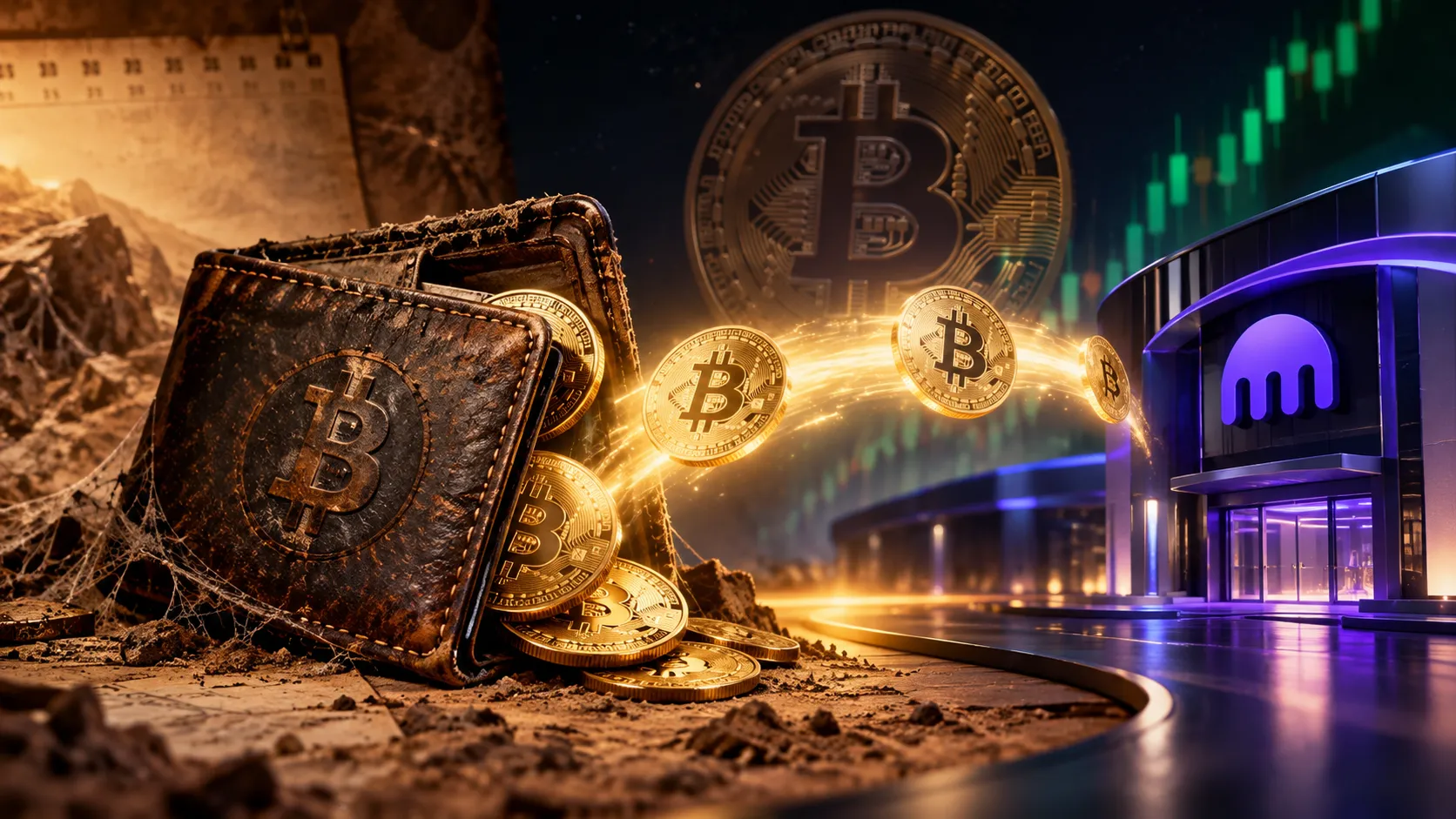
Satoshi-Era Bitcoin Wallet Awakens After 15 Years With Reported 582,198% Gain
A long-dormant Bitcoin (BTC) wallet dating back to June 2011 has reportedly become active after more than 15 years, transferring approximately 28.46 BTC worth around $2.43 million. The transaction, identified by Galaxy Research, has attracted attention across the cryptocurrency industry because of its extraordinary holding period and estimated 582,198% appreciation.
According to blockchain tracking information shared by Galaxy Research, the Bitcoin moved on October 7, 2026, in block 970281. The receiving address was attributed to cryptocurrency exchange Kraken, although the identity of the original wallet owner remains unknown.
The movement highlights one of Bitcoin's most remarkable characteristics: the ability to hold and transfer digital assets across decades without relying on traditional financial intermediaries. Investors can monitor the latest Bitcoin price (BTC) and compare its current valuation with historical market performance.
Quick Summary
Transaction date: October 7, 2026, at approximately 03:33 UTC.
Bitcoin transferred: Approximately 28.46 BTC.
Reported valuation: Approximately $2.43 million at the time of the transfer.
Original holding date: June 12, 2011.
Dormancy period: Approximately 15.2 years.
Reported appreciation: 582,198%, according to Galaxy Research's estimate.
Bitcoin block: 970281.
Receiving address attribution: Kraken, according to Galaxy Research.
Wallet owner: Unknown.
Confirmed sale: No publicly established sale has been identified from the reported transfer alone.
What Happened to the Dormant Bitcoin Wallet?
On October 7, 2026, blockchain researchers identified activity involving Bitcoin that had reportedly remained untouched since June 12, 2011. The movement involved approximately 28.46 BTC, representing an estimated $2.43 million at the valuation cited in the report.
Galaxy Research identified the originating Bitcoin address as 1EmiMJfyBYNYfeFZWEoXxJ9cZ7pF9xTWVt. The reported transaction was included in Bitcoin block 970281, which was confirmed on October 7, 2026.
The transaction identifier provided in the report was 30f99aba54cee38157c9c1d4ceafded4eb914d79ced89bb347efef137c02dd84. Readers can examine the transaction through the Bitcoin blockchain explorer.
Although Galaxy Research associated the receiving address with Kraken, this attribution does not establish the identity of the sender or confirm that the Bitcoin was liquidated. The transaction could represent an exchange deposit, a custody change, a portfolio adjustment, or preparation for a future sale.
How Much Did the Satoshi-Era Bitcoin Increase in Value?
One of the most widely discussed aspects of the transaction is the extraordinary appreciation associated with the dormant Bitcoin holdings.
Galaxy Research reported an estimated gain of 582,198%, reflecting the enormous difference between Bitcoin's early market valuations and its price more than 15 years later.
In June 2011, Bitcoin was still an emerging digital currency with limited mainstream recognition, relatively low liquidity, and a much smaller user base than today.
Using the approximate historical acquisition value of $15 per BTC cited in the report, 28.46 BTC would have represented around $427 in June 2011. At the reported October 2026 valuation of $2.43 million, the same quantity of Bitcoin would be worth several million dollars.
However, the rounded historical and current valuations do not reproduce the exact 582,198% figure. That percentage should therefore be understood as Galaxy Research's reported estimate rather than an independently verified return calculated from those rounded amounts.
| Metric | June 2011 | October 2026 |
|---|---|---|
| Bitcoin holdings | 28.46 BTC | 28.46 BTC |
| Approximate BTC valuation | $15 per BTC | $85,000+ per BTC |
| Approximate total value | $427 | $2.43 million |
| Holding period | Starting point | 15.2 years |
These valuations illustrate Bitcoin's historical price appreciation, but they should not be interpreted as evidence of a completed sale or confirmed realized profit. The actual acquisition cost, ownership history, transaction fees, and tax circumstances of the holder are not publicly established.
What Is Satoshi-Era Bitcoin?
Satoshi-era Bitcoin is an informal term describing BTC associated with the earliest years of the Bitcoin network, particularly the period when its pseudonymous creator, Satoshi Nakamoto, was still publicly involved in the project's development.
Bitcoin was introduced through the publication of the Bitcoin whitepaper in October 2008. Its network officially launched on January 3, 2009, when the genesis block was mined.
During Bitcoin's earliest years, participation was largely concentrated among cryptographers, software developers, technology enthusiasts, and early cryptocurrency adopters.
Coins associated with this period attract particular attention because they represent some of the earliest activity recorded on Bitcoin's public blockchain.
However, describing Bitcoin as Satoshi-era does not mean the coins belonged to Satoshi Nakamoto. There is no verified evidence connecting the unidentified owner of the 28.46 BTC involved in this transaction to Bitcoin's creator.
Why Do Dormant Bitcoin Wallets Suddenly Become Active?
Bitcoin wallets can remain inactive for years or even decades before their holdings are transferred. Because Bitcoin transactions are publicly recorded, the movement of long-dormant coins can be detected through blockchain analytics.
Several possible explanations exist for the reactivation of an old Bitcoin wallet.
1. Long-Term Holders Taking Profits
Some early Bitcoin adopters accumulated BTC when its market price was considerably lower. After many years of appreciation, they may decide to transfer part or all of their holdings to an exchange to prepare for a potential sale.
Nevertheless, depositing Bitcoin into an exchange does not automatically mean the assets have been sold.
2. Wallet Security Upgrades
Long-term holders may transfer Bitcoin from older wallets into newer storage systems with updated security features, improved backup procedures, or institutional custody arrangements.
Such transfers can occur without changing the beneficial ownership of the assets.
3. Estate Planning and Ownership Transfers
Bitcoin acquired more than a decade ago may eventually be transferred as part of inheritance arrangements, estate administration, business restructuring, or private ownership agreements.
Blockchain records alone generally cannot establish whether these circumstances apply to a particular transaction.
4. Recovery of Previously Inaccessible Wallets
Some cryptocurrency holders lose access to their wallets because of misplaced private keys, damaged hardware, or forgotten credentials.
In certain cases, previously inaccessible holdings may become transferable again after the owner successfully restores access.
There is currently no verified evidence identifying which, if any, of these explanations applies to the October 2026 transfer.
Does Moving Bitcoin to Kraken Mean the Owner Is Selling?
No. A transfer to an address associated with a cryptocurrency exchange is not sufficient evidence that Bitcoin has been sold.
Galaxy Research's attribution of the receiving address to Kraken suggests a possible connection to exchange infrastructure. However, address attribution is based on blockchain analysis and does not independently reveal the owner's intentions.
There are several important distinctions between a Bitcoin transfer, an exchange deposit, and an executed trade.
| Activity | What It Indicates | Confirms a Sale? |
|---|---|---|
| Wallet-to-wallet transfer | BTC moved between addresses | No |
| Exchange deposit | BTC transferred to exchange-associated infrastructure | No |
| Custody transfer | BTC moved to another storage arrangement | No |
| Executed spot sale | BTC exchanged for another asset or currency | Yes |
In the case of the 28.46 BTC transferred in October 2026, publicly reported information establishes a blockchain movement and an exchange-address attribution, but not a confirmed sale.
How Do Satoshi-Era Bitcoin Movements Affect the Crypto Market?
The movement of Bitcoin that has remained dormant for many years can influence market sentiment, especially when large holdings are transferred to addresses associated with exchanges.
Blockchain analysts and traders often monitor these transactions because they may provide clues about the behavior of long-term Bitcoin holders.
Potential Selling Pressure
If a long-term holder transfers BTC to an exchange and subsequently sells it, the additional supply can contribute to selling pressure. The impact depends on the size of the transaction, available market liquidity, and broader trading conditions.
However, the movement of 28.46 BTC does not, by itself, establish a meaningful change in Bitcoin's overall supply dynamics.
Long-Term Holder Behavior
Bitcoin investors frequently analyze the activity of long-term holders to understand whether older coins are being accumulated, redistributed, or transferred between storage arrangements.
Metrics such as coin age, spent output age bands, and long-term holder supply can provide additional context, although no single indicator can reliably predict future Bitcoin prices.
Market Psychology
Headlines about dormant Bitcoin wallets can generate speculation about early adopters selling their holdings. However, distinguishing between confirmed transactions and assumptions about investor intentions is essential for accurate market analysis.
Traders can follow crypto live prices to monitor Bitcoin and other digital assets alongside developments in blockchain activity.
How Does Bitcoin's Limited Supply Relate to Satoshi-Era Holdings?
Bitcoin's monetary policy is one of the fundamental reasons its historical price performance attracts attention.
The Bitcoin protocol limits total issuance to approximately 21 million BTC. New Bitcoin enters circulation through mining rewards, which are reduced periodically through events known as Bitcoin halvings.
The April 2024 halving reduced the block subsidy from 6.25 BTC to 3.125 BTC, continuing the network's predetermined issuance schedule.
When previously dormant Bitcoin moves, the transaction does not create new coins. Instead, it transfers existing BTC that may have been economically inactive for many years.
This distinction is important because the reactivation of old wallets can influence the amount of Bitcoin potentially available for trading without changing Bitcoin's maximum supply.
Bitcoin's fixed issuance schedule, decentralized verification, and transparent transaction history are among the core characteristics described in its original technical design.
How Can Investors Track Bitcoin Whale Transactions?
Bitcoin's public blockchain allows anyone to examine confirmed transactions, wallet balances, and historical movements without requiring permission from a centralized authority.
Blockchain explorers and analytics platforms provide tools for identifying unusual activity, including transactions involving coins that have remained inactive for extended periods.
Investors interested in monitoring Bitcoin whale activity can examine several indicators:
Transaction history: identifies when Bitcoin was received and subsequently spent.
Coin age: measures how long a particular unspent transaction output remained inactive.
Exchange inflows: tracks transfers to addresses attributed to cryptocurrency trading platforms.
Wallet balances: provides information about Bitcoin held at publicly visible addresses.
Transaction size: helps identify large movements that may attract institutional or market attention.
For the October 2026 transaction, the relevant block can be examined through Bitcoin block 970281 on mempool.space.
While blockchain records can verify transaction details, identifying the individuals or organizations controlling particular addresses often requires additional evidence.
What Does the 15-Year Bitcoin Holding Period Tell Us?
The reported movement of Bitcoin originally received in 2011 illustrates the scale of changes in the cryptocurrency industry over the past 15 years.
In 2011, Bitcoin was still an experimental financial technology with limited institutional participation. Cryptocurrency exchanges, custody services, and blockchain analytics were far less developed than they are today.
Since then, Bitcoin has evolved into a globally traded digital asset supported by a broad ecosystem of exchanges, miners, payment infrastructure, financial products, and institutional investors.
The reactivation of early Bitcoin holdings demonstrates the persistence of blockchain records across multiple market cycles. Coins received during the network's formative years can remain transferable decades later, provided their controlling private keys remain accessible.
However, historical appreciation should not be interpreted as a guarantee of future returns. Bitcoin has experienced substantial volatility, prolonged downturns, and significant changes in market conditions throughout its history.
How to Trade Bitcoin on CoinW
Investors interested in Bitcoin can access cryptocurrency trading markets through CoinW, which provides spot and derivatives trading services.
For users seeking direct exposure to BTC, the BTC/USDT spot trading pair allows Bitcoin to be traded against Tether (USDT).
Experienced traders can also explore BTC/USDT perpetual futures, which provide derivatives exposure to Bitcoin price movements. Futures trading involves additional risks, including leverage and potential liquidation.
Before making trading decisions, users should consider market volatility, liquidity, risk tolerance, and the difference between long-term Bitcoin ownership and short-term speculative trading.
FAQs About the Satoshi-Era Bitcoin Wallet
How much Bitcoin moved after 15 years of inactivity?
Galaxy Research reported that approximately 28.46 BTC, valued at around $2.43 million, moved on October 7, 2026, after remaining dormant since June 12, 2011.
What was the reported return on the dormant Bitcoin?
Galaxy Research estimated appreciation of 582,198%. However, this figure has not been independently reproduced from the rounded historical and current valuations, and it does not establish a completed sale.
Who owns the Satoshi-era Bitcoin wallet?
The identity of the wallet owner has not been publicly established. There is no verified evidence linking the wallet to Satoshi Nakamoto.
Did the Bitcoin owner sell the coins on Kraken?
There is no confirmed public evidence that the Bitcoin was sold. Galaxy Research attributed the receiving address to Kraken, but an exchange-associated transfer does not necessarily indicate a completed trade.
What is a dormant Bitcoin wallet?
A dormant Bitcoin wallet is generally understood as an address or collection of addresses whose holdings have remained inactive for an extended period. Blockchain analysts often examine the age of unspent transaction outputs to identify long-held Bitcoin.
Does Satoshi-era Bitcoin belong to Satoshi Nakamoto?
Not necessarily. The term refers broadly to Bitcoin associated with the network's earliest years. It does not establish that the coins were mined, purchased, or controlled by Bitcoin's pseudonymous creator.
Can dormant Bitcoin affect the BTC price?
Large movements of previously inactive BTC can influence market sentiment and potentially contribute to selling pressure if the coins are subsequently sold. However, wallet transfers alone cannot reliably predict future Bitcoin price movements.
Conclusion
The reported reactivation of 28.46 BTC after more than 15 years highlights Bitcoin's remarkable history and the continued relevance of its earliest holders.
With an estimated valuation of $2.43 million and a reported appreciation of 582,198%, the transaction illustrates the enormous changes in Bitcoin's market value since 2011.
Nevertheless, several important questions remain unanswered. The wallet owner has not been identified, the receiving address attribution does not confirm a sale, and the precise financial return cannot be independently established from the rounded figures reported.
For investors, the event provides another example of why blockchain transparency, long-term holder activity, and careful interpretation of on-chain data remain important when evaluating cryptocurrency markets.
References / Sources
Galaxy Research — Official Research Account. Source of the reported dormant Bitcoin movement, transaction details, and return estimate.
BSC News — Satoshi-Era Bitcoin Awakening Report. Original news post highlighting the 28.46 BTC transaction.
Mempool.space — Reported Bitcoin Transaction. Primary blockchain record for independent examination.
Mempool.space — Bitcoin Address History. Reported originating address and its publicly visible transaction activity.
Satoshi Nakamoto — Bitcoin: A Peer-to-Peer Electronic Cash System. Original Bitcoin whitepaper published in 2008.
Galaxy — Official Research Portal. Blockchain and digital asset research.