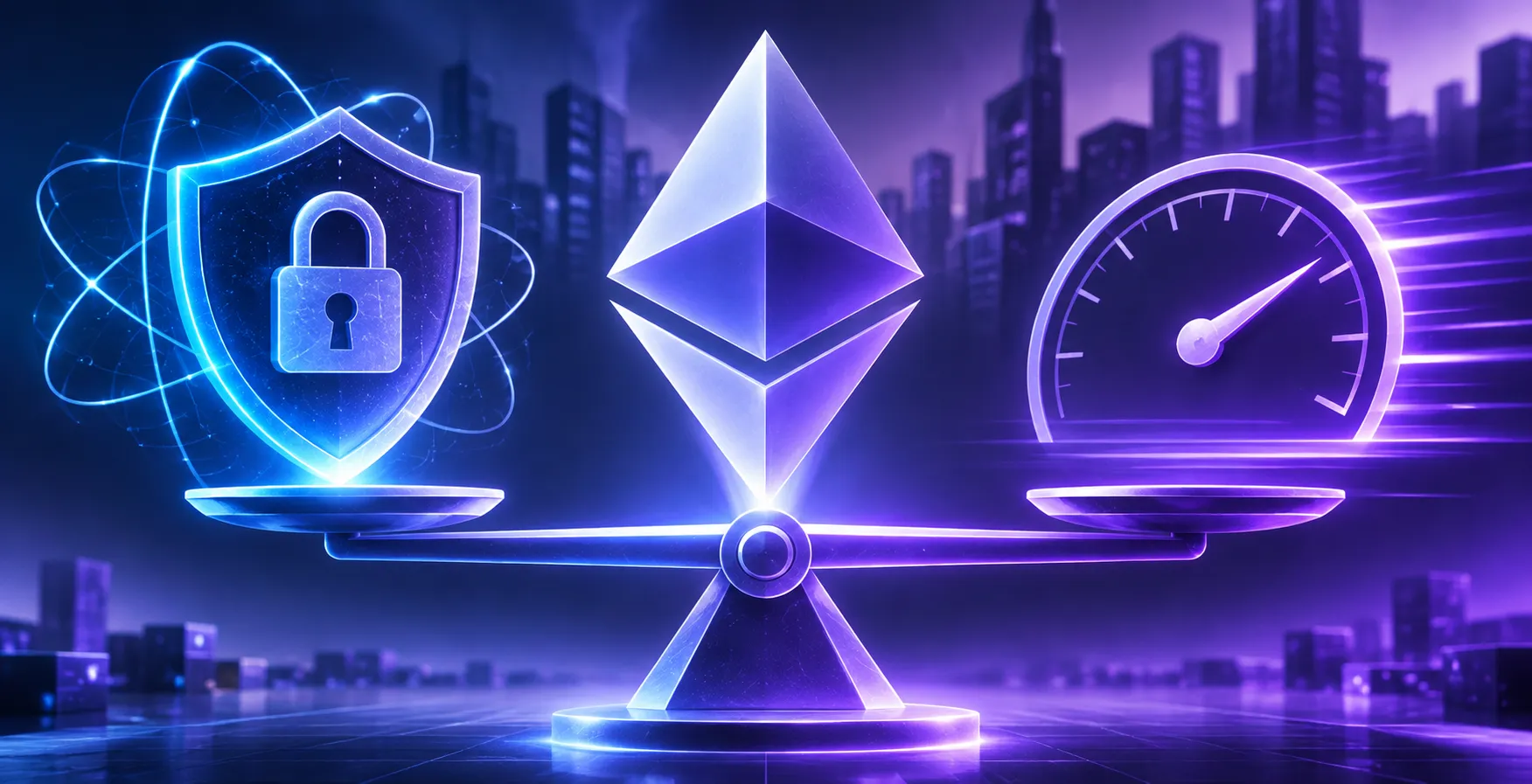
Ethereum's Security vs. Speed Debate: Why Developers Want Post-Quantum Protection by 2027
Ethereum developers face a major strategic decision as researchers propose prioritizing post-quantum cryptography and AI-resistant security over faster block production. On November 11, 2026, Ethereum research organization Ethlabs published a proposal calling for the network to achieve post-quantum and AI-resilient readiness by 2027, potentially reshaping the Hegotá upgrade.
The initiative, called pqai27, would accelerate Ethereum's security roadmap while postponing certain performance improvements. Ethlabs has withdrawn its Quick Slots proposal, which aimed to reduce Ethereum's slot time from 12 seconds to 10 seconds, from consideration for Hegotá.
However, the wider roadmap changes remain proposals rather than confirmed decisions by Ethereum's core developers. The debate highlights an important question for the world's leading smart contract ecosystem: should Ethereum prioritize faster transactions today or strengthen its defenses against emerging technological threats?
For background on the network, readers can explore CoinW Academy's guide to Ethereum and follow the Ethereum (ETH) price.
Quick Summary
Security-first proposal: Ethlabs wants Ethereum to prioritize post-quantum and AI-resilient security by 2027.
Quick Slots withdrawn: EIP-8198, which proposed reducing slot times from 12 to 10 seconds, will no longer be pursued by Ethlabs for Hegotá.
Two security milestones: The proposal distinguishes between pqai-ready Ethereum and the more ambitious pqai-scaled Ethereum.
Hegotá reconsideration: Researchers suggest reviewing the timing of FOCIL, account abstraction and consensus upgrades.
No confirmed roadmap change: Ethereum's core developers must still evaluate and agree on any broader changes.
Market implications: The decisions could influence Ethereum's long-term infrastructure development, Layer-2 scaling and institutional adoption.
Why Is Ethereum Prioritizing Security Over Speed?
Ethereum has spent years improving scalability, transaction efficiency and network accessibility. However, emerging developments in quantum computing and artificial intelligence have introduced additional considerations for blockchain security.
In its November 11 proposal, Ethlabs outlined its pqai27 initiative, arguing that Ethereum should accelerate preparations for cryptographic and software security threats.
The organization identifies two major concerns:
Quantum computing: Future sufficiently powerful quantum computers could undermine cryptographic systems used to protect blockchain accounts and consensus mechanisms.
AI-assisted attacks: Advanced artificial intelligence could accelerate vulnerability discovery and potentially reveal weaknesses in cryptographic assumptions.
These concerns do not mean Ethereum's existing cryptography has already been compromised. According to Ethereum's official security roadmap, quantum computers capable of breaking the network's current cryptography do not yet exist at the required scale.
Nevertheless, migrating a decentralized network to new cryptographic standards involves extensive research, implementation, testing and coordination. Ethlabs argues that beginning this transition earlier could reduce future security risks.
What Is Ethereum's pqai27 Proposal?
pqai27 is an Ethlabs proposal to make Ethereum ready for post-quantum cryptography and stronger AI-era security defenses during 2027.
The initiative builds on existing research by the Ethereum Foundation, including work on hash-based cryptography, account abstraction, consensus redesign and formal verification.
Ethlabs separates the objective into two development milestones.
1. pqai-ready: Ethereum prepared for cryptographic migration
The first milestone would establish the technical foundations needed for Ethereum to continue operating if existing cryptographic assumptions became unsafe.
Its proposed capabilities include:
Post-quantum-resistant consensus mechanisms.
A migration route allowing Ethereum accounts to adopt post-quantum security.
Continued normal operation at the capacity enabled by Glamsterdam while existing cryptography remains safe.
An emergency transition path that would allow the network to continue operating at reduced capacity if necessary.
This milestone does not require every wallet or user to complete migration by 2027. Protocol readiness and ecosystem-wide adoption are separate challenges.
2. pqai-scaled: Full-capacity post-quantum Ethereum
The second milestone would allow Ethereum to operate with post-quantum transactions and data availability at full intended capacity.
Ethlabs identifies technologies such as signature aggregation under EIP-8288 and post-quantum data availability under EIP-8479 as important components.
Unlike pqai-ready, pqai-scaled is a stretch goal for 2027, rather than the minimum target. It could require a subsequent network upgrade.
| Feature | pqai-ready | pqai-scaled |
|---|---|---|
| Primary objective | Cryptographic readiness | Full-capacity post-quantum operation |
| Consensus security | Post-quantum consensus | Post-quantum consensus |
| Account migration | Migration route available | Efficient post-quantum transactions |
| Data availability | Calldata fallback if required | Post-quantum-secure blobs |
| 2027 status | Primary proposed target | Stretch goal |
Why Did Ethlabs Withdraw Ethereum's Quick Slots Proposal?
One of the most immediate consequences of the security-first proposal is Ethlabs' decision to withdraw Quick Slots (EIP-8198) from Hegotá consideration.
Quick Slots aimed to reduce Ethereum's slot duration from 12 seconds to 10 seconds, creating more frequent opportunities for validators to propose blocks.
At 12 seconds per slot, Ethereum has approximately five slots per minute. A reduction to 10 seconds would increase that number to six, representing a 20% increase in slot frequency.
However, this would not automatically increase Ethereum's transaction throughput by 20%. The proposal was designed to adjust per-block resource limits to maintain approximately the same gas and blob throughput per second.
The main intended benefit was improved responsiveness, particularly for decentralized exchanges, DeFi applications and other services sensitive to transaction inclusion delays.
Ethlabs had previously gathered feedback from 20 ecosystem participants supporting faster slots, as described in its Quick Slots ecosystem research.
Nevertheless, the organization now considers post-quantum readiness a more urgent priority and intends to revisit faster slots in 2028.
Importantly, shorter slots and faster finality are different improvements. Shorter slots create more frequent opportunities to include transactions, whereas finality determines when transactions receive Ethereum's stronger settlement guarantees.
How Could the Proposal Change Ethereum's Hegotá Upgrade?
Hegotá is Ethereum's planned upgrade following Glamsterdam. Under the existing development process, the upgrade includes work on transaction programmability and censorship resistance.
Ethlabs proposes reconsidering the order of certain features so that post-quantum readiness can receive priority.
Frame Transactions and EIP-8141
EIP-8141, also known as Frame Transactions, would introduce more flexible transaction validation and fee-payment mechanisms.
One important security benefit is the potential to support new cryptographic signature schemes without requiring a separate hard fork for every future change.
This could allow Ethereum accounts to migrate away from vulnerable cryptographic methods while introducing additional features such as key rotation, recovery mechanisms and more restricted account permissions.
Ethlabs considers Frames essential to its proposed security roadmap.
FOCIL and EIP-7805
Fork-Choice Enforced Inclusion Lists (FOCIL) are intended to strengthen Ethereum's censorship resistance by limiting the ability of block builders to exclude eligible transactions.
FOCIL is an important component of Ethereum's decentralization strategy, but Ethlabs argues that its timing should be reconsidered if implementation would delay post-quantum readiness.
The proposal does not call for permanently abandoning censorship resistance. Instead, it suggests adjusting development priorities and potentially moving FOCIL to a later upgrade.
Whether Ethereum's core developers agree with this recommendation remains unresolved.
Post-Quantum Consensus
Another major decision concerns Ethereum's consensus architecture.
Researchers are considering whether to adapt the existing Gasper consensus protocol for post-quantum security or accelerate development of a newer decoupled consensus architecture.
Each approach presents different implementation challenges. Modifying Gasper may involve a smaller architectural change, while moving directly to decoupled consensus could better align with Ethereum's longer-term finality research.
The Ethereum Foundation has separately published research on decoupled consensus and faster finality.
What Does the Security Debate Mean for Ethereum Layer-2 Networks?
Ethereum's Layer-2 ecosystem depends on the underlying network for settlement, data availability and security-related functions.
Networks such as Arbitrum (ARB), Optimism (OP) and Starknet (STRK) are part of the wider Ethereum scaling landscape.
Post-quantum migration could affect how rollups publish transaction data and interact with Ethereum's settlement infrastructure.
Ethlabs suggests that a pqai-ready Ethereum could provide a fallback in which Layer-2 networks publish data through post-quantum-compatible transactions using calldata rather than relying on existing blobs.
However, this approach would be more expensive and less efficient than a fully scaled post-quantum data availability system.
The proposed pqai-scaled milestone would address that limitation by introducing post-quantum-compatible blobs and more efficient signature aggregation.
Layer-2 developers would still need to assess their own cryptographic systems, smart contracts, infrastructure and migration requirements. An Ethereum protocol upgrade alone would not automatically make every application quantum-resistant.
How Does the Proposal Compare With Ethereum's Existing Security Roadmap?
Ethereum's post-quantum research predates the Ethlabs proposal. The Ethereum Foundation has established dedicated research efforts covering cryptographic signatures, account security, consensus and data availability.
In its September 2026 protocol priorities update, the Ethereum Foundation described a broader multi-upgrade strategy and a December 2029 commitment for minimum viable post-quantum readiness.
Ethlabs' November proposal advocates a more aggressive 2027 target, arguing that the network should concentrate development resources on the critical security components.
These dates reflect different planning proposals and milestones rather than guaranteed implementation schedules.
Meanwhile, Glamsterdam development continues. On November 6, the Ethereum Foundation reported that testing had identified compatibility concerns involving gas-related changes under EIP-8037 and EIP-8038. Developers decided to delay the Hoodi testnet fork until those issues could be addressed, while Hegotá work continued in parallel.
This illustrates why Ethereum's upgrade process requires extensive testing before changes reach the main network.
What Could Ethereum's Security-First Strategy Mean for ETH?
The debate has implications for Ethereum's long-term development, although it does not establish a direct or predictable effect on the price of ETH.
ETH remains the native asset used to pay transaction fees, support staking and secure Ethereum's Proof-of-Stake network.
A successful transition to stronger cryptographic security could reinforce Ethereum's long-term infrastructure proposition, particularly for applications that require durable settlement guarantees.
However, delaying performance improvements could also create trade-offs for developers and users seeking faster transaction inclusion and lower operational costs.
Potential considerations include:
Long-term confidence: Stronger security preparations may support Ethereum's credibility as infrastructure for digital assets.
Development complexity: Introducing new cryptographic systems requires coordination across clients, validators, wallets and applications.
Network performance: Delaying Quick Slots may postpone improvements in transaction responsiveness.
Layer-2 economics: Emergency post-quantum data publication could involve higher costs until more efficient solutions become available.
Execution uncertainty: Aggressive security deadlines may increase pressure on testing and implementation resources.
Investors evaluating Ethereum can also consult CoinW Academy's Ethereum investment guide for a broader discussion of network fundamentals and risks.
For market monitoring, CoinW provides crypto live prices covering major digital assets, including Bitcoin (BTC) and Ethereum ecosystem tokens.
What Happens Next for Ethereum Developers?
The next stage depends on whether Ethereum's core developers adopt Ethlabs' proposed priorities and how they evaluate the engineering requirements.
Several developments will be particularly important:
Roadmap discussions: Core developers must decide whether to adopt pqai27 as a shared development objective.
Hegotá scope: Developers must determine whether FOCIL and other features remain scheduled or move to later upgrades.
Consensus architecture: Researchers must assess the relative feasibility of post-quantum Gasper and decoupled consensus.
Implementation and testing: Client teams will need working specifications, prototypes, interoperability testing and security reviews.
Ecosystem migration: Wallet providers, validators and infrastructure operators will need practical tools for adopting new cryptographic standards.
Ethlabs has indicated that it remains committed to faster Ethereum slots over the longer term, with 2028 proposed as the next development horizon for that work.
The central uncertainty is whether the broader Ethereum developer community will accept the proposed acceleration of post-quantum security at the expense of other planned features.
FAQs
Is Ethereum switching to post-quantum cryptography in 2027?
Not necessarily. Ethlabs has proposed 2027 as a target for post-quantum and AI-resilient readiness, but the broader plan has not been formally adopted by Ethereum's core developers.
What is Ethereum's pqai27 initiative?
pqai27 is an Ethlabs proposal to prioritize post-quantum cryptography and AI-era software security, with protocol readiness targeted for 2027 and full-capacity post-quantum operation treated as a stretch goal.
Why were Ethereum's 10-second slots withdrawn?
Ethlabs withdrew Quick Slots from Hegotá consideration to redirect research and development resources toward its proposed security objectives. The organization still supports faster slots in the future.
Could quantum computers hack Ethereum today?
According to Ethereum's official security documentation, no existing quantum computer can currently break the network's cryptography at the required scale. The proposed upgrades are intended to prepare for future threats rather than respond to a confirmed present-day cryptographic break.
Will Ethereum transactions become slower?
Withdrawing Quick Slots does not itself make existing transactions slower. It means the proposed reduction from 12-second to 10-second slots is no longer being pursued for Hegotá by Ethlabs. Other network improvements remain under development.
Will Ethereum's security changes affect ETH holders?
Future post-quantum upgrades could require wallet providers and ETH holders to migrate to new cryptographic account systems. However, no universal migration procedure or mandatory deadline has been established by the Ethlabs proposal.
Conclusion
Ethereum's latest security debate illustrates the challenges of maintaining a decentralized blockchain while preparing for technological developments that could reshape digital security.
Ethlabs' decision to withdraw Quick Slots from Hegotá represents a concrete shift in its own development priorities. Its broader proposal to achieve post-quantum and AI-resilient readiness by 2027, however, remains subject to Ethereum's established developer decision-making process.
The outcome could influence how Ethereum balances transaction responsiveness, censorship resistance, cryptographic security and long-term scalability.
For developers, the priority is establishing a technically feasible and thoroughly tested roadmap. For ETH holders and the wider crypto industry, the central question is whether Ethereum can strengthen its future security without compromising the reliability and accessibility of its existing ecosystem.
References / Sources
Ethlabs — An Ethlabs View on Post-Quantum and Post-AI Timelines: pqai27 (November 11, 2026)
Ethereum Foundation — Current and Emerging Protocol Priorities (September 7, 2026)
Ethereum.org — A More Secure Ethereum
Ethlabs — It's Time for a Faster Ethereum: EIP-8198 Ecosystem Research
Ethlabs — Tracking the Glamsterdam Discussion (November 10, 2026)
Ethereum Foundation — Upgrading Finality: Decoupling Consensus
CoinW Academy — What Is Ethereum?
CoinW — Ethereum (ETH) Price and Market Information