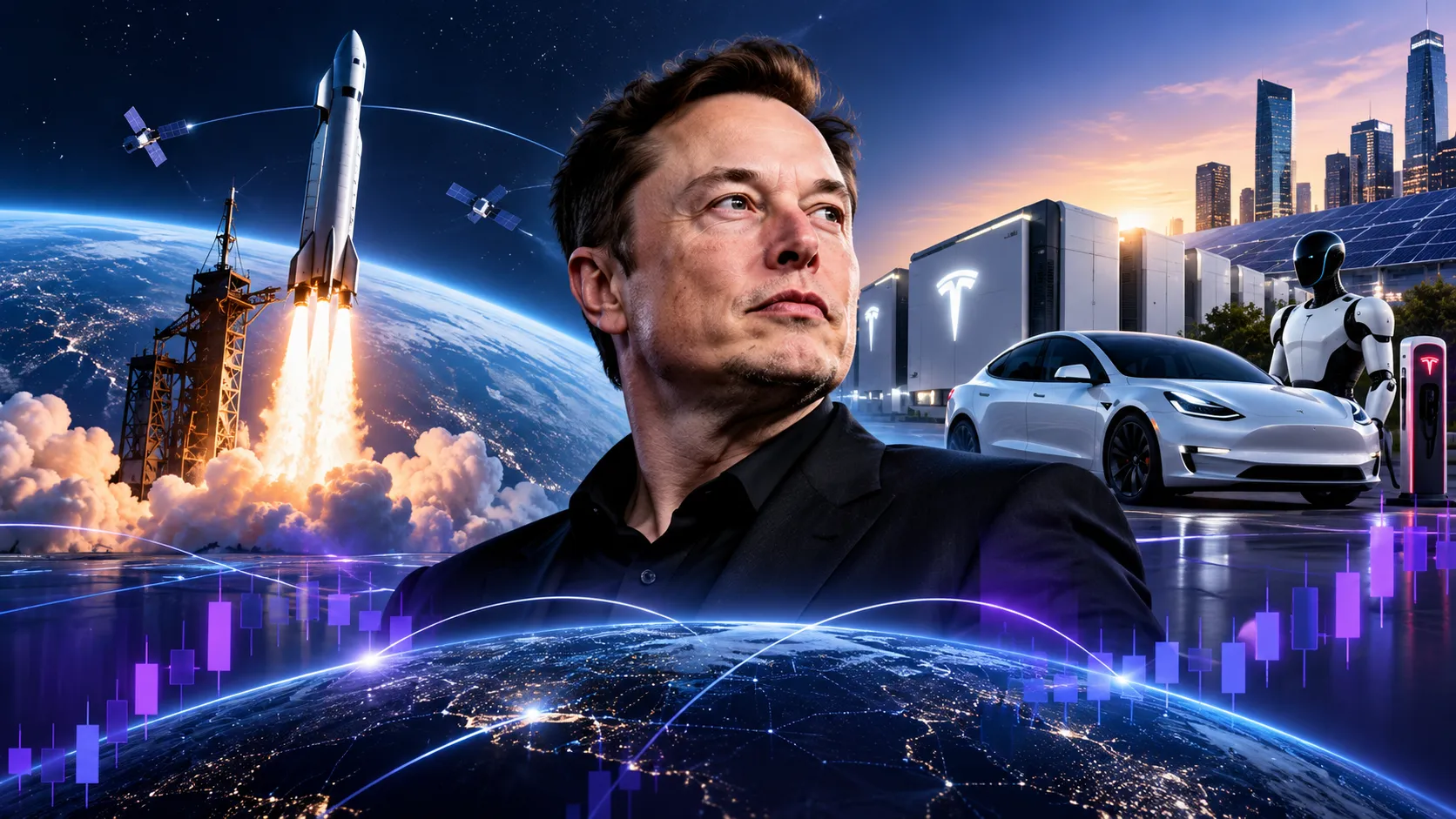
What Is the Proposed $3.5 Trillion SpaceX–Tesla Merger?
Elon Musk's proposed SpaceX–Tesla merger could create one of the world's largest technology and industrial companies, combining electric vehicles, robotics, artificial intelligence, satellite communications, and space infrastructure. However, the potential $3.5 trillion transaction is already facing questions about corporate governance, shareholder protections, and Musk's influence over negotiations.
On October 22, 2026, Reuters reported that Musk's public endorsement of the merger had concerned individuals involved in the negotiations. His comments could complicate the work of independent board committees responsible for evaluating whether the transaction serves shareholders' interests.
The proposed merger remains at an early stage. Neither company has announced a definitive merger agreement, final transaction structure, or completion date.
For investors following traditional equities and blockchain-based financial products, the negotiations also highlight the relationship between major corporate developments and tokenized equity, an emerging category of digital assets designed to provide exposure to conventional stock markets.
Quick Summary
Potential valuation: Approximately $3.5 trillion, although no final transaction valuation has been agreed.
Companies involved: Tesla (NASDAQ: TSLA) and SpaceX (NASDAQ: SPCX).
Current status: Preliminary merger negotiations involving independent committees and external advisers.
Elon Musk's position: CEO and major shareholder of both companies, creating potential conflicts of interest.
Possible structures: SpaceX acquiring Tesla, a combination under a new holding company, or an all-stock transaction.
Principal concerns: Shareholder fairness, independent governance, valuation, litigation, and regulatory approval.
Crypto market relevance: Tesla and SpaceX tokenized stock products could attract attention as investors evaluate the transaction.
Background: Why Are SpaceX and Tesla Considering a Merger?
SpaceX and Tesla operate in different industries, but their activities increasingly overlap in artificial intelligence, advanced manufacturing, computing infrastructure, robotics, and energy technology.
Tesla has expanded beyond electric vehicles into energy storage, autonomous driving, and humanoid robotics. SpaceX combines aerospace engineering, satellite communications, launch services, and artificial intelligence infrastructure.
The potential merger could consolidate technological capabilities and reduce organizational barriers between businesses already connected through commercial agreements and common leadership.
Existing Financial and Commercial Relationships
The companies already maintain significant financial relationships.
According to Tesla's 2026 proxy statement filed with the SEC, Tesla completed an approximately $2 billion investment in SpaceX Class A common stock on March 12, 2026.
The filing also documents commercial arrangements involving Tesla, SpaceX, and xAI, including vehicle sales, infrastructure services, and energy products.
These relationships demonstrate that the proposed combination would not involve two entirely independent business ecosystems.
SpaceX's Expanding Artificial Intelligence Business
SpaceX's financial results provide additional context for the merger discussions.
In its third-quarter 2026 earnings release filed with the SEC, SpaceX reported revenue of $14.6 billion, representing 161% year-over-year growth.
The company also reported $4.4 billion in net income and $8.8 billion in adjusted EBITDA. Its Super Intelligence segment generated $7.6 billion in quarterly revenue.
These figures illustrate SpaceX's growing exposure to AI infrastructure alongside its established aerospace and connectivity operations.
Combining these capabilities with Tesla's robotics, manufacturing, and energy businesses could create opportunities for operational integration, although the financial benefits remain uncertain.
What Did Elon Musk Say About the SpaceX–Tesla Merger?
During SpaceX's October 20, 2026 investor conference call, Musk publicly supported the idea of combining the two companies.
He described the merger as a potentially beneficial transaction while emphasizing that independent special committees would determine whether an agreement could be reached.
Musk also acknowledged that his financial interests in both companies prevent him from participating directly in the committees' negotiations.
His comments brought the potential transaction into the public spotlight before the companies had finalized terms.
According to Reuters' October 22 reporting, people familiar with the process expressed concerns that this public endorsement could increase shareholder scrutiny and complicate negotiations.
Why Could Musk's Public Endorsement Complicate the Merger?
The principal issue is a potential conflict of interest.
Musk serves as chief executive of both companies and owns substantial equity stakes in each. Tesla's October 2026 proxy statement reports his beneficial ownership at approximately 19.8% of Tesla, while Reuters describes his SpaceX ownership as just under half.
These positions create a situation in which Musk could benefit from the transaction in ways that differ from the interests of other shareholders.
The Importance of Independent Special Committees
Independent board committees are commonly used to evaluate transactions involving related parties.
Their responsibilities may include:
Assessing whether the proposed transaction benefits their company's shareholders.
Negotiating valuation, exchange ratios, and other financial terms.
Reviewing potential conflicts involving executives and major shareholders.
Obtaining independent financial and legal advice.
Evaluating alternatives, including remaining independent.
Musk's public endorsement does not automatically invalidate the process. However, it could become relevant if shareholders later argue that independent directors were improperly influenced.
How Does Tesla's SolarCity Acquisition Affect the Proposed Deal?
Tesla's 2016 acquisition of SolarCity provides an important historical precedent.
Musk held substantial ownership interests in both Tesla and SolarCity, while family and business relationships raised questions about whether the acquisition process adequately protected Tesla shareholders.
The transaction resulted in years of litigation involving allegations that Musk exercised excessive influence over the acquisition.
Although the courts ultimately upheld the acquisition as fair, the proceedings demonstrated the legal complexity of transactions involving companies connected through common ownership and leadership.
The proposed SpaceX–Tesla merger raises comparable governance questions, although its circumstances, corporate structures, and applicable legal framework differ.
What Are the Possible Structures of the SpaceX–Tesla Merger?
Several potential transaction structures are reportedly under consideration. Each would have different implications for shareholders, governance, and valuation.
| Structure |
How It Works |
Key Consideration |
|---|---|---|
| SpaceX acquires Tesla |
SpaceX becomes the acquiring company. |
Fair compensation for Tesla shareholders. |
| New holding company |
Both companies combine under a new corporate parent. |
Ownership allocation and corporate governance. |
| All-stock consideration |
Shareholders receive equity rather than cash. |
Exchange ratios, dilution, and valuation. |
These structures are not necessarily mutually exclusive. For example, an acquisition or holding-company merger could use stock as its principal form of consideration.
No final structure has been publicly confirmed.
What Are the Main Legal and Regulatory Risks?
A transaction of this magnitude could attract extensive legal and regulatory scrutiny.
Shareholder Litigation
Investors could challenge the merger if they believe the transaction undervalues their shares, improperly benefits insiders, or fails to satisfy applicable corporate governance requirements.
The independence of special committees and the fairness of negotiated terms would likely become central considerations.
Texas Corporate Law
Tesla's incorporation in Texas introduces an additional legal consideration.
Unlike Delaware, which has extensive judicial precedent involving controlling shareholders and related-party transactions, Texas has a less developed body of case law addressing comparable disputes.
This could create uncertainty regarding how future litigation would be evaluated.
National Security and Regulatory Review
SpaceX's involvement in US government contracts, defense-related technology, and satellite infrastructure could introduce national security considerations.
Tesla's international manufacturing operations and significant exposure to China could add further complexity.
Depending on the final structure, the transaction could require review under applicable antitrust, securities, foreign investment, and national security frameworks.
Regulatory scrutiny would not necessarily prevent the merger, but it could influence its structure, timing, and conditions.
How Could the SpaceX–Tesla Merger Affect Stock Markets?
The merger could significantly affect the market valuations of Tesla and SpaceX, although the direction and magnitude of any price movements remain uncertain.
Investors would need to evaluate several factors, including the proposed exchange ratio, ownership distribution, financial synergies, regulatory requirements, and potential dilution.
An all-stock transaction could make the relative valuation of the two companies particularly important.
Because both companies are associated with major technology trends, developments could also influence sentiment toward artificial intelligence, robotics, aerospace, energy infrastructure, and related equities.
However, market enthusiasm about potential technological integration should be distinguished from the financial value that a completed transaction might actually create.
How Could the Merger Affect Tokenized Tesla and SpaceX Stocks?
The potential merger is also relevant to the emerging market for tokenized stocks.
Tokenized equity products use blockchain infrastructure to provide economic exposure linked to conventional securities. Their legal rights, collateral arrangements, and settlement mechanisms depend on the issuer and product structure.
CoinW has introduced tokenized stock products linked to both Tesla and SpaceX, allowing eligible users to access these market themes through digital assets.
Tesla Tokenized Stock (TSLAON)
TSLAON is a tokenized stock product associated with Tesla's publicly traded shares.
CoinW announced the introduction of TSLAON spot trading in September 2026 as part of its expansion into tokenized US equities.
Investors can explore the Tesla tokenized stock (TSLAON) price to follow the product's market performance.
Potential merger announcements, valuation changes, and shareholder decisions could affect the underlying Tesla stock and consequently influence related tokenized products.
SpaceX Tokenized Stock (SPCXON)
SPCXON provides a blockchain-based market product associated with SpaceX equity exposure.
SpaceX's expanding operations in satellite connectivity, aerospace, and artificial intelligence make its equity valuation particularly relevant to the proposed merger.
Users can explore the SpaceX tokenized stock (SPCXON) price for information about the digital asset.
Tokenized stock products do not necessarily grant the same voting rights, dividend entitlements, or corporate action protections as directly owning the underlying shares.
Any merger-related treatment would depend on the applicable token documentation, issuer arrangements, and trading platform policies.
What Does the SpaceX–Tesla Merger Mean for Cryptocurrency Markets?
The proposed merger is not itself a cryptocurrency transaction. Nevertheless, it could influence several areas of the digital asset industry.
Growth of Real-World Asset Tokenization
Tokenized stocks form part of the broader real-world asset (RWA) tokenization sector, which seeks to represent conventional financial assets using blockchain technology.
Major corporate transactions can demonstrate the importance of corporate action processing, transparent pricing, and reliable settlement mechanisms for tokenized financial products.
As tokenization develops, infrastructure associated with networks such as Ethereum (ETH) may remain relevant to the issuance and transfer of blockchain-based financial assets.
However, the merger would not automatically increase demand for any particular cryptocurrency.
Artificial Intelligence and Blockchain Narratives
SpaceX's expansion into AI infrastructure and Tesla's investment in robotics could reinforce investor interest in technologies associated with artificial intelligence.
Crypto investors may consequently monitor AI-related digital assets, although their economic connection to the companies involved in the merger is generally indirect.
Market Sentiment and Volatility
Major corporate announcements can influence broader risk appetite, particularly when they involve high-profile technology companies.
Traders can monitor crypto live prices alongside equity market developments to evaluate changing market conditions.
However, correlations between cryptocurrency prices and technology stocks can change over time and should not be assumed to remain stable.
What Are the Main Risks for Investors?
Transaction uncertainty: Negotiations could end without an agreement.
Valuation risk: The proposed exchange ratio may favor one shareholder group over another.
Governance risk: Musk's interests in both companies could complicate independent decision-making.
Litigation risk: Shareholders could challenge the transaction or its approval process.
Regulatory risk: Government reviews could delay, modify, or prevent the transaction.
Integration risk: Combining large businesses across multiple industries could introduce operational and financial challenges.
Tokenization risk: Tokenized stock products may involve issuer, liquidity, custody, counterparty, and corporate action risks.
Volatility risk: Speculation surrounding merger negotiations could cause substantial price fluctuations.
What Happens Next in the SpaceX–Tesla Merger Talks?
The immediate focus will be on the independent committees responsible for evaluating the transaction.
Investors should monitor whether the companies announce a definitive agreement, provide formal valuation terms, establish an exchange ratio, or disclose additional governance protections.
Other important developments could include shareholder voting requirements, regulatory filings, and potential legal challenges.
The companies' official disclosures remain the most authoritative sources for confirming material changes in the negotiations.
Investors can consult Tesla Investor Relations and the SEC EDGAR database for corporate filings and financial disclosures.
FAQs About the SpaceX–Tesla Merger
Is SpaceX merging with Tesla?
SpaceX and Tesla are evaluating a potential merger, but no definitive agreement has been announced as of October 22, 2026.
How much could the SpaceX–Tesla merger be worth?
The proposed combination has been discussed at approximately $3.5 trillion. This is not a confirmed final transaction valuation.
Why is Elon Musk excluded from merger negotiations?
Musk is a major shareholder and CEO of both companies. His overlapping financial interests create conflicts that independent committees must address.
Could the merger face legal challenges?
Yes. Shareholders could challenge the fairness of the transaction, particularly if concerns arise about valuation, governance, or the independence of the approval process.
Will Tesla shareholders automatically receive SpaceX shares?
Not necessarily. The treatment of existing shares would depend on the final transaction structure and negotiated terms.
Can investors access Tesla and SpaceX tokenized stocks on CoinW?
CoinW has announced tokenized stock products associated with both companies, including TSLAON and SPCXON. Availability depends on the applicable product and regional restrictions.
Will the merger affect Bitcoin or Ethereum?
There is no established direct effect. Any influence on Bitcoin, Ethereum, or other cryptocurrencies would likely arise through broader market sentiment or developments in asset tokenization.
When could the SpaceX–Tesla merger be completed?
No completion date has been confirmed. Negotiations, shareholder approvals, regulatory reviews, and possible litigation could influence the timeline.
Conclusion
The potential $3.5 trillion SpaceX–Tesla merger represents an ambitious attempt to combine two major technology companies under a more integrated corporate structure.
While the transaction could offer opportunities in artificial intelligence, robotics, aerospace, and energy infrastructure, significant governance and regulatory questions remain unresolved.
Elon Musk's public endorsement has added scrutiny to a negotiation process in which independent directors must protect shareholder interests.
For digital asset investors, the developments also highlight the growing intersection between traditional equity markets and blockchain-based financial products.
Ultimately, the merger's implications will depend on whether the companies reach an agreement, how the transaction is structured, and whether it receives the necessary approvals.
References / Sources
Reuters: Musk's Public Endorsement of SpaceX–Tesla Deal May Complicate Talks (October 22, 2026)
SEC: Tesla 2026 Definitive Proxy Statement
SEC: SpaceX October 20, 2026 Form 8-K
Tesla: Third-Quarter 2026 Financial Update
CoinW: TSLAON Tokenized Stock Listing Announcement
CoinW Academy: What Is Tokenized Equity?
Sign up with CoinW to explore cryptocurrency markets, tokenized assets, and trading opportunities.
About CoinW: Founded in 2017, CoinW is a global cryptocurrency trading platform offering spot, futures, and additional digital asset trading products.
Risk Disclaimer: This article is for informational and educational purposes only and does not constitute investment advice. Stock tokens and other digital assets involve substantial risks, including price volatility, liquidity limitations, and possible loss of capital. Product availability varies by jurisdiction.