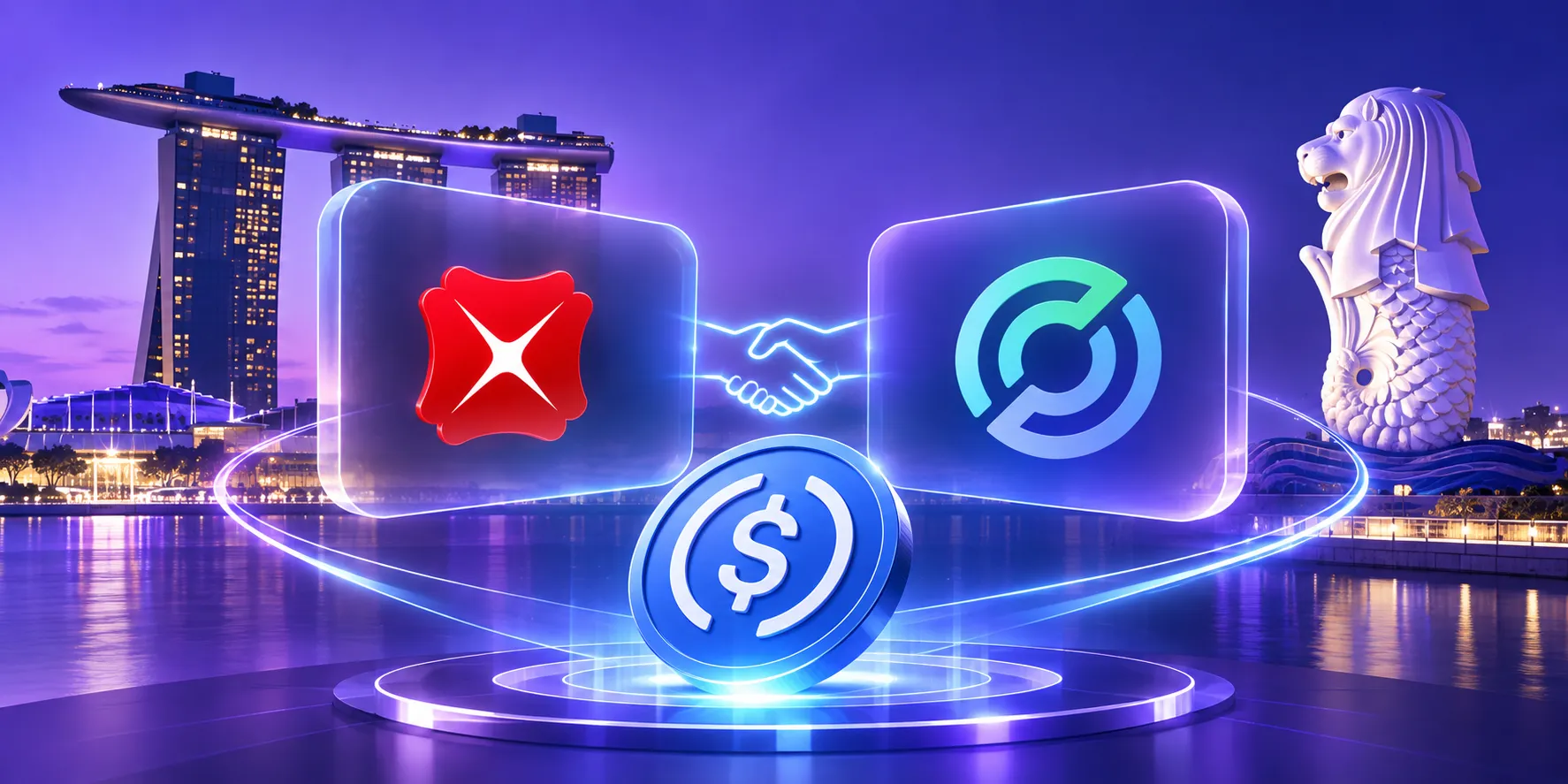
DBS and Circle Partner to Enable 24/7 USDC Minting and Redemption for Institutional Clients
DBS Bank, Southeast Asia's largest bank by assets, and Circle, the issuer of USD Coin (USDC), announced a partnership on November 18, 2026, to expand institutional access to stablecoins across Asia. The collaboration will allow eligible institutional clients to mint and redeem USDC directly through DBS, supported by near-instant, 24/7 settlement between US dollars and USDC.
The initiative connects traditional banking infrastructure with blockchain-based financial services, giving institutions an alternative to relying exclusively on secondary-market liquidity when obtaining or redeeming USDC.
According to the official DBS announcement, the partnership is designed to support institutional treasury management, financial settlements and liquidity operations. It also builds on both companies' participation in the Monetary Authority of Singapore's (MAS) Project BLOOM, which focuses on interoperability between different forms of tokenized money.
Quick Summary
Partnership: DBS Bank and Circle announced a collaboration on November 18, 2026, to strengthen institutional stablecoin infrastructure in Asia.
Direct USDC access: Eligible institutional clients will be able to mint and redeem USDC through DBS.
24/7 settlement: The arrangement supports near-instant USD-USDC settlement without traditional banking-hour restrictions.
Institutional applications: Treasury operations, payment settlement and liquidity management are the primary use cases.
Reduced secondary-market dependence: Direct issuance and redemption provide another way to obtain or convert USDC without depending entirely on exchange order books.
Project BLOOM: Both companies are participating in Singapore's initiative to improve interoperability between tokenized money and financial networks.
How Does the DBS and Circle USDC Partnership Work?
The partnership establishes a bank-integrated route for eligible institutions to access USDC issuance and redemption.
USDC is a US dollar-denominated stablecoin issued by regulated Circle affiliates. According to Circle's official USDC documentation, the stablecoin is backed by cash and highly liquid cash-equivalent assets and is designed to be redeemable at a 1:1 ratio for US dollars.
Under the DBS arrangement, institutional clients can access the process through the bank rather than relying exclusively on exchanges or over-the-counter trading desks.
Direct USDC Minting
Minting refers to the creation of new USDC against eligible US dollar funding. Institutions seeking USDC can use the bank-integrated service to access newly issued stablecoins instead of purchasing their entire required amount from existing holders in secondary markets.
This can be particularly useful for companies managing substantial digital asset balances or preparing blockchain-based settlements.
Direct USDC Redemption
Redemption reverses the process by converting eligible USDC holdings into US dollars through the issuer's redemption infrastructure.
For institutional treasury teams, direct redemption provides another liquidity channel when moving funds from blockchain-based environments into traditional banking systems.
The partnership does not eliminate the need for secondary markets. Instead, it diversifies the channels available to institutions for obtaining and redeeming USDC.
Near-Instant Settlement Around the Clock
One of the most significant features of the arrangement is its support for 24/7 USD-USDC settlement when minting and redeeming USDC through DBS.
Traditional banking transactions frequently depend on operating hours, settlement windows and payment-system availability. The announced service is intended to reduce these timing constraints, allowing eligible institutions to manage liquidity between fiat currency and stablecoins more continuously.
Actual processing remains subject to applicable onboarding, compliance and operational requirements. The announcement does not establish that every transaction will settle instantaneously under all circumstances.
Why Is Direct USDC Minting and Redemption Important for Institutions?
The partnership addresses an important challenge in institutional digital asset operations: moving large amounts of capital efficiently between traditional currencies and blockchain-based financial systems.
Institutions using stablecoins may otherwise need to obtain liquidity through cryptocurrency exchanges, market makers or over-the-counter providers. Those channels remain important, but execution can depend on available market depth, spreads and counterparty arrangements.
Direct issuance and redemption can provide an additional operational pathway for managing large stablecoin balances.
Institutional Treasury Management
Corporate treasury departments are responsible for managing liquidity, payment obligations and capital allocation across accounts and markets.
With continuous USD-USDC settlement capabilities, eligible institutions could manage digital dollar liquidity outside conventional banking hours, potentially improving the coordination of international financial operations.
Payment Settlement
Stablecoins can support blockchain-based transfers between counterparties operating across different jurisdictions and time zones.
Integrating stablecoin issuance and redemption into institutional banking services may reduce operational friction between onchain settlement and traditional payment infrastructure.
Liquidity Management
Access to primary issuance and redemption gives institutions an alternative to sourcing or selling USDC exclusively through secondary-market transactions.
This may help institutions manage liquidity during periods when exchange order-book depth, trading spreads or conventional banking schedules create additional constraints.
DBS and Circle Build on Singapore's Project BLOOM
The partnership also strengthens the relationship between DBS and Circle through their participation in Project BLOOM, an initiative led by the Monetary Authority of Singapore.
BLOOM stands for Borderless, Liquid, Open, Online, Multi-currency. It is a public-private initiative focused on developing next-generation settlement infrastructure for domestic and cross-border financial transactions.
The initiative examines how regulated stablecoins, tokenized commercial bank money and other forms of digital money can operate across financial institutions, payment networks and jurisdictions.
Its major areas of focus include:
Cross-border settlement: Improving how different forms of digital money are accepted, exchanged and settled between financial institutions.
Interoperability: Enabling different tokenized money systems and financial networks to interact.
Programmable controls: Incorporating identity verification, sanctions screening and transaction safeguards into digital money arrangements.
Institutional applications: Supporting corporate treasury operations, trade finance and emerging automated payment use cases.
The initiative also includes major financial institutions and payment companies such as J.P. Morgan, Mastercard, Visa, Standard Chartered and Ripple.
In an October 23, 2026 announcement, MAS confirmed that Bank Negara Malaysia and the Bank of Thailand had joined BLOOM as policymaker members, expanding regional cooperation on cross-border digital money settlement.
DBS and Circle's collaboration therefore fits into a wider effort to connect stablecoins with established financial infrastructure rather than treating blockchain-based money as an isolated financial system.
What Does the Partnership Mean for USDC and the Stablecoin Market?
The DBS-Circle agreement reflects growing institutional interest in using stablecoins for financial operations beyond cryptocurrency trading.
DBS cited findings from its report, The Great Rewiring: Money in a New Order, indicating that 88% of large corporations surveyed were already deploying or piloting tokenized money use cases. More than three in five were adopting or planning to adopt stablecoins.
These findings suggest that tokenized money is increasingly being evaluated for practical corporate applications, including liquidity management and settlement.
The agreement could strengthen USDC's institutional distribution in Asia by connecting Circle's issuance infrastructure with DBS's established banking relationships.
However, the announcement does not disclose projected issuance volumes, expected transaction values or guaranteed increases in USDC adoption.
USDC and USDT in the Broader Stablecoin Ecosystem
USDC and Tether's USDT are two major US dollar-denominated stablecoins used throughout cryptocurrency markets.
Although both seek to maintain a stable value relative to the US dollar, their issuers, reserve arrangements, redemption conditions and institutional infrastructure differ.
Circle's expanding banking partnerships may increase the availability of direct USDC issuance and redemption services for eligible institutional customers.
For cryptocurrency market participants, stablecoin liquidity remains an important part of trading activity. Users can monitor crypto live prices on CoinW to follow major digital assets and market movements.
How Does This Compare With Traditional Stablecoin Trading?
Direct institutional minting and redemption operate differently from purchasing or selling stablecoins through cryptocurrency exchanges.
| Feature | DBS-Circle Institutional Service | Secondary-Market Stablecoin Trading |
|---|---|---|
| Access | Eligible institutional clients | Eligible exchange or OTC customers |
| Mechanism | Direct USDC issuance and redemption | Buying and selling existing stablecoins |
| Liquidity | Issuer-backed minting and redemption infrastructure | Exchange order books or OTC counterparties |
| Settlement | Near-instant, 24/7 USD-USDC settlement capability | Depends on venue, payment rails and withdrawal arrangements |
| Primary purpose | Institutional treasury, settlement and liquidity management | Trading, portfolio allocation and liquidity access |
The two models are complementary. Exchanges provide secondary-market liquidity, while direct minting and redemption connect eligible institutions to the stablecoin's issuance and redemption infrastructure.
What Are the Risks and Limitations?
Although the DBS-Circle partnership introduces additional institutional capabilities, several considerations remain important.
Eligibility restrictions: The announced service is intended for eligible institutional clients, not general retail banking customers.
Operational dependencies: Continuous settlement capabilities remain dependent on the availability of relevant banking, technical and blockchain infrastructure.
Compliance requirements: Institutional access may be subject to onboarding, anti-money laundering, sanctions screening and other regulatory requirements.
Stablecoin risks: USDC remains exposed to issuer, reserve, operational and blockchain-related risks despite its intended 1:1 dollar redemption mechanism.
Undisclosed commercial terms: The partnership announcement does not specify all eligibility requirements, transaction fees or operational limits.
Institutions considering stablecoin settlement should evaluate these factors alongside their own liquidity, regulatory and operational requirements.
What Comes Next for Institutional Stablecoin Adoption in Asia?
The partnership represents another development in the integration of regulated stablecoin infrastructure with established banking services.
Circle has also worked with other international financial institutions to expand institutional access to USDC. In July 2026, Standard Chartered and Circle announced an integrated USDC minting and redemption service for eligible institutional customers.
These arrangements indicate a broader industry direction in which banks increasingly serve as access points between traditional financial accounts and blockchain-based settlement infrastructure.
For DBS and Circle, future developments may include wider institutional adoption, additional integrations and further work on interoperability through Project BLOOM. Such developments remain potential outcomes rather than confirmed expansion plans.
The partnership's longer-term significance will depend on institutional participation, transaction activity, operational reliability and the ability of tokenized money systems to interact across financial networks.
FAQs
What did DBS and Circle announce?
On November 18, 2026, DBS and Circle announced a partnership allowing eligible institutional clients to mint and redeem USDC directly through DBS, supported by near-instant, 24/7 USD-USDC settlement capabilities.
Can retail customers mint USDC directly through DBS?
The announced service specifically targets eligible institutional clients. DBS and Circle have not announced general retail access under this partnership.
What is the advantage of direct USDC redemption?
Direct redemption allows eligible institutions to convert USDC into US dollars through issuance and redemption infrastructure instead of relying exclusively on secondary-market buyers.
Does the DBS partnership guarantee instant USDC transactions?
No. The partnership supports near-instant, round-the-clock settlement capabilities, but actual processing can remain subject to operational and compliance requirements.
What is Project BLOOM?
Project BLOOM is a Monetary Authority of Singapore initiative designed to advance interoperable settlement infrastructure for tokenized money, including stablecoins and tokenized bank deposits.
Where can users trade stablecoins?
Cryptocurrency exchanges provide secondary-market access to stablecoins. For example, CoinW offers the USDC/USDT spot trading pair, allowing eligible users to exchange USDC and USDT through its trading platform. This service is separate from the institutional DBS-Circle minting and redemption arrangement.
Conclusion
The DBS and Circle partnership marks an important step toward integrating stablecoin issuance and redemption into institutional banking infrastructure in Asia. By enabling eligible clients to mint and redeem USDC directly through DBS, the arrangement provides an additional channel for managing digital dollar liquidity.
Its near-instant, 24/7 settlement capabilities could help institutions manage treasury operations and financial settlements across traditional and blockchain-based environments with fewer timing constraints.
Combined with the companies' participation in Singapore's Project BLOOM, the initiative highlights the growing importance of interoperability between regulated stablecoins, tokenized bank money and established financial networks.
While adoption volumes and commercial outcomes remain to be seen, the agreement illustrates how traditional financial institutions are increasingly incorporating blockchain-based money into their service offerings.
References / Sources
DBS Bank — DBS and Circle Expand Institutional Access to USDC in Asia (November 18, 2026)
-
Circle — Official USDC Documentation
Monetary Authority of Singapore — BLOOM Initiative
MAS — Cross-Border Settlement in Digital Money Through BLOOM (October 23, 2026)
Circle — Standard Chartered and Circle Institutional USDC Partnership (July 2, 2026)
CoinW — Live Cryptocurrency Prices