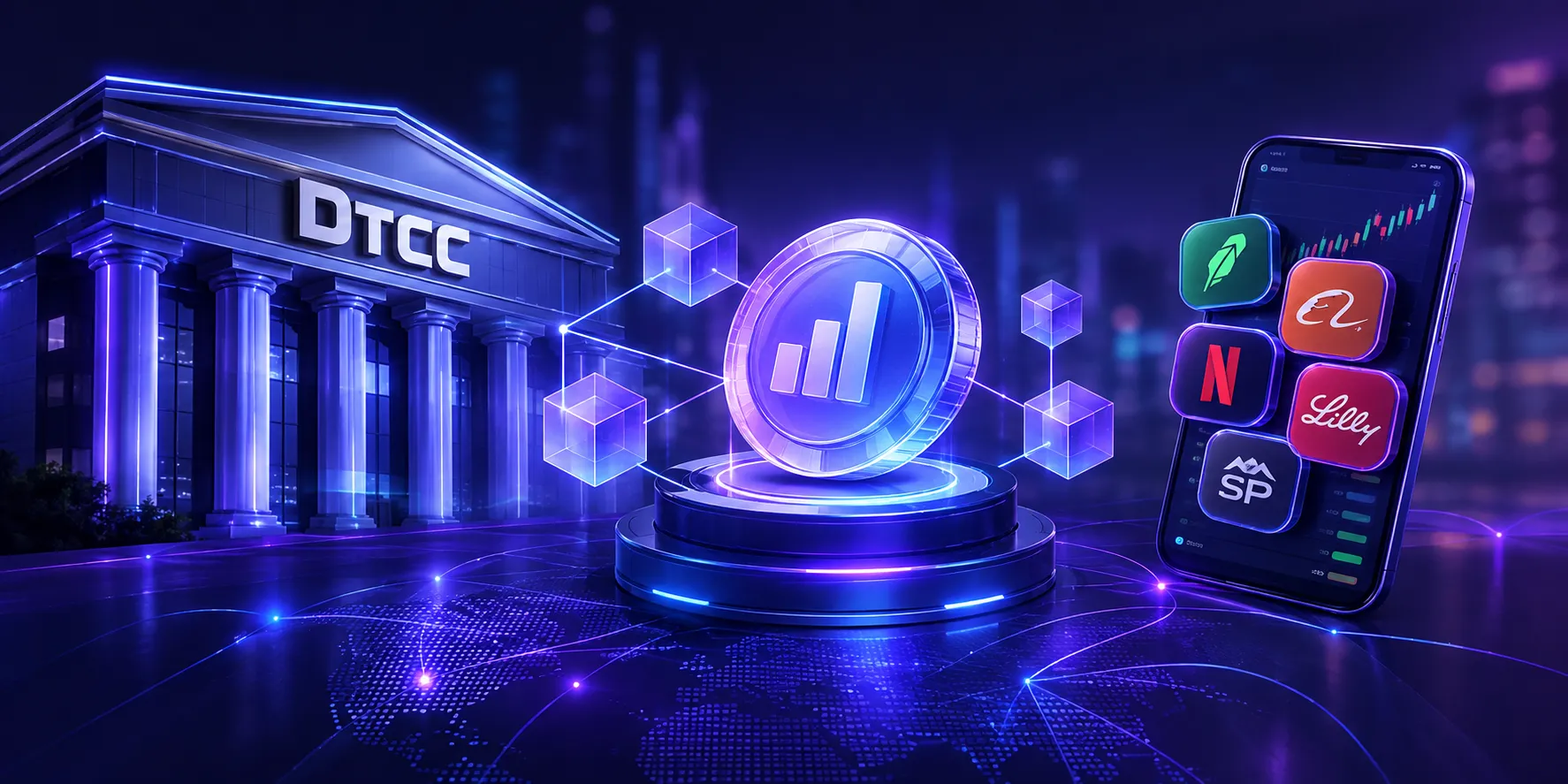
DTCC Tokenization Service Goes Live: What It Means for Tokenized Stocks and CoinW Traders
The DTCC Tokenization Service launched on 28 October 2026, bringing tokenized representations of securities held at The Depository Trust Company (DTC) into a regulated institutional framework. However, its launch does not mean retail investors can buy DTCC-issued stock tokens on a crypto exchange. CoinW offers separate tokenized-stock trading products, which should not be confused with DTC tokenized security entitlements.
Quick Summary
Launch: DTCC began operating its Tokenization Service on 28 October 2026.
Access: DTC tokenized entitlements are transferred within a system of eligible participants and registered wallets, not freely traded by retail users.
Regulatory basis: a December 2025 SEC staff no-action letter covers a defined pilot, not unrestricted retail token trading.
CoinW: HOODON, BABAON, NFLXON, SPCXON and LLYON were announced for spot trading on 8 September 2026.
Important distinction: trading a stock-linked token is not necessarily equivalent to owning the underlying company’s shares.
Key Facts About DTCC Tokenization
| Event | Date | Details | Source |
|---|---|---|---|
| Service launch | 28 October 2026 | DTCC confirmed production launch | DTCC launch announcement |
| Regulatory authorization | 11 December 2025 | SEC staff no-action letter for the preliminary service | SEC statement |
| Blockchain infrastructure | October 2026 | Supported networks and registered-wallet framework; consult DTCC for current network eligibility | DTCC Tokenization Hub |
| Retail access | November 2026 | No general retail exchange access through the DTC service | SEC statement |
| CoinW stock-token listing | 8 September 2026 | HOODON, BABAON, NFLXON, SPCXON and LLYON | CoinW stock-token listing announcement |
What Happened: The $30 Trillion Headline vs. Actual Tokenization
Headlines about DTCC tokenizing tens of trillions of dollars can confuse securities eligible for tokenization with securities already converted into tokens. An eligible asset universe is a potential scope, not a measure of completed issuance. The amount converted through the new service should not be presented as $30 trillion without evidence.
The DTCC launch announcement describes a service that creates tokenized representations of DTC-custodied assets. These are recorded and managed through DTC’s institutional infrastructure. DTCC’s public launch announcement should be used for operational figures; the number of distinct securities or participants alone does not establish the total dollar value tokenized.
The wider real-world asset (RWA) market also includes tokenized government bonds, credit instruments and other assets. These figures are separate from the value processed by DTCC. Readers can consult RWA.xyz for updated sector data rather than relying on an undated market snapshot.
How Does the DTCC Tokenization Service Work?
The service allows eligible DTC participants to tokenize certain security entitlements associated with securities held in DTC custody. A tokenized entitlement is linked to the underlying custody and recordkeeping arrangements; it should not be described as a new, independently issued common share.
Eligibility: participation is limited to firms and assets meeting DTC requirements.
Registered wallets: transfers take place within the DTC-approved wallet framework.
Tokenization and detokenization: the service manages the conversion between conventional book-entry positions and tokenized entitlements.
Asset servicing: corporate actions and other entitlements remain subject to the applicable DTC framework.
Transferability: token transfers may operate around the clock between registered wallets, while creation and redemption have separate operational constraints.
For current technical specifications, supported networks and servicing rules, refer to the DTCC Tokenization Service FAQs.
Can Retail Investors Buy DTCC Tokenized Stocks?
No general retail purchasing route is available through DTCC’s service. The SEC statement explains that eligible DTC participants can transfer tokenized entitlements between registered wallets. The letter does not, by itself, authorize an open retail secondary market for these tokens.
This distinction matters: an institutional tokenization and custody system can be operational without offering tokens directly to individual crypto traders. Any third party claiming to sell official DTCC tokens should be assessed carefully against DTCC’s published rules.
DTCC Tokenized Securities vs. CoinW Stock Tokens
CoinW’s stock-linked tokens are a separate category of product. Its CoinW stock-token listing announcement identifies the stock-token pairs announced for spot trading on 8 September 2026. They should not be represented as DTCC tokens, nor should their market exposure be confused with directly holding shares in a brokerage account.
| Feature | DTCC service | CoinW stock tokens |
|---|---|---|
| Purpose | Institutional tokenization of DTC-held security entitlements | Crypto-exchange trading exposure to stock-linked tokens |
| Who can access | Eligible DTC participants and registered-wallet arrangements | Eligible CoinW users, subject to product and regional restrictions |
| Relationship to shares | Entitlements recorded within DTC’s custody and servicing system | Rights depend on the token issuer’s legal terms; do not assume share ownership |
| Transfers | DTC-approved wallet environment | Supported CoinW markets and product rules |
| Dividends and voting | Governed by underlying security entitlement and DTC servicing rules | Do not assume direct voting or dividend rights; verify product disclosures |
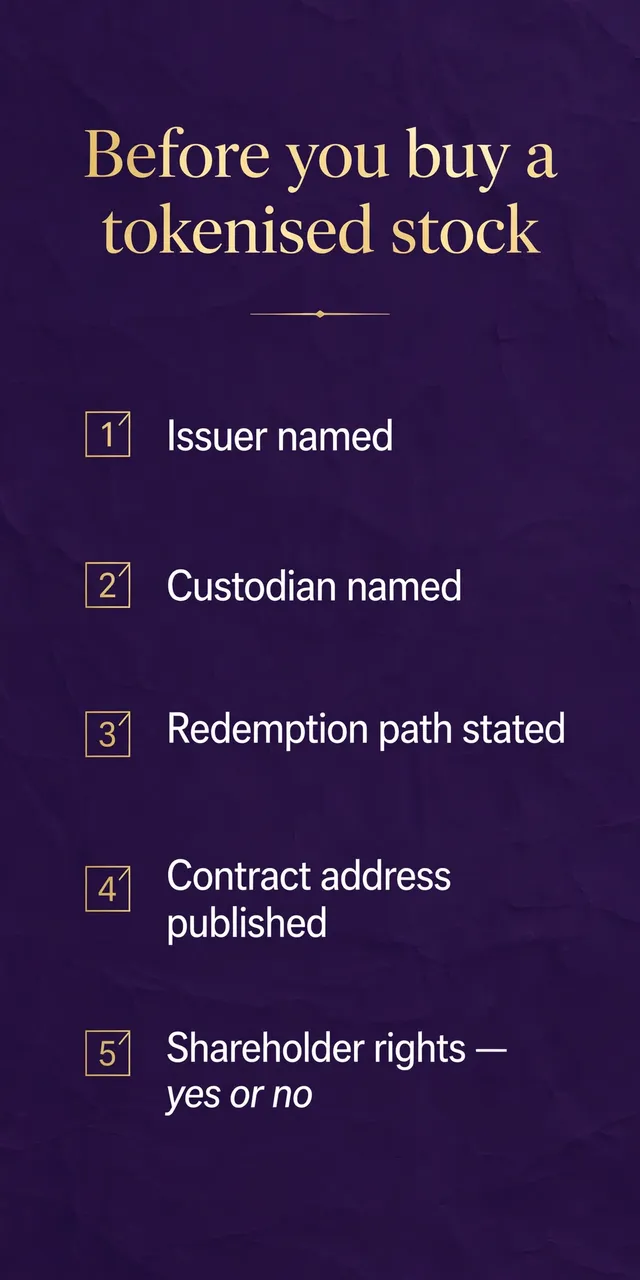
Five Checks Before Trading a Tokenized Stock
Issuer: identify the legal entity responsible for issuing the token.
Custody and backing: determine whether real shares are held, who holds them and whether independent evidence exists.
Redemption: verify whether holders can redeem for shares, cash or neither.
Token identification: check official token details and contract addresses where applicable; do not rely on social-media posts.
Legal rights: review dividend, voting, corporate-action, counterparty and insolvency provisions.
A product can be legitimate without providing direct shareholder rights, but its legal structure must be clear. A published contract address or exchange listing alone does not prove that a token is backed one-for-one by shares.
Which Tokenized Stocks Are Available on CoinW?
CoinW announced the following five spot trading pairs for 8 September 2026. Availability, prices and trading status may change; always check the current market page and CoinW stock-token listing announcement.
HOODON — linked to Robinhood Markets (HOOD).
BABAON — linked to Alibaba Group.
NFLXON — linked to Netflix.
SPCXON — stock-linked token; consult the listing notice for the precise underlying exposure.
LLYON — linked to Eli Lilly.
You can also explore other stock-linked assets such as NVDAON, AMDON and MSFTON, and compare them with broader crypto live prices. These are separate market products, not proof of participation in the DTCC Tokenization Service.
Risks of Trading Tokenized Stocks
Stock-linked tokens combine market risk with token-specific risks. Prices can diverge from the referenced shares, particularly outside stock-exchange hours or during periods of limited liquidity. Additional considerations include issuer and custodian risk, counterparty exposure, contract risk, redemption limitations, regulatory restrictions and differences in corporate-action treatment.
Trading a token that references a stock does not automatically confer ownership of that stock, voting rights or dividends. Review the relevant issuer documentation and CoinW’s current product disclosures before trading. Never assume that a 24/7 crypto market offers the same protections as a regulated securities brokerage account.
Frequently Asked Questions
Can I buy a DTCC tokenized stock?
Not through a generally available retail exchange market under the DTCC service described here. The service is designed for eligible DTC participants and registered wallets.
What is the difference between a DTCC token and a CoinW stock token?
A DTCC tokenized entitlement is part of institutional custody and recordkeeping infrastructure. A CoinW stock-linked token is a separate exchange-traded product; its legal rights depend on its issuer and terms.
Does one token always equal one share?
No. Tokenization structures differ. A token may represent an entitlement, a contractual claim, a synthetic exposure or another arrangement. Check the exact terms rather than assuming one-to-one share ownership.
How do I verify a tokenized stock?
Check the issuer, custodian or backing evidence, redemption terms, official token identifiers and the legal rights provided to holders.
When will DTCC tokens become available to retail investors?
No general retail launch date is established by the December 2025 no-action letter. Future access would depend on market structure, regulation and participating firms.
Do CoinW stock tokens pay dividends or provide voting rights?
Do not assume they do. Review the relevant token documentation and exchange disclosures; trading a stock-linked token is not the same as being a registered shareholder.
Conclusion
DTCC’s October 2026 launch is a milestone for institutional securities tokenization, but it is not the same as putting trillions of dollars of publicly tradable shares on a blockchain. CoinW provides a separate route for trading stock-linked crypto products. Understanding the issuer, custody arrangement, redemption mechanism and shareholder rights is essential before comparing the two.
References / Sources
-
DTCC Tokenization Hub and FAQs
-
December 2025 SEC staff no-action letter
CoinW stock-token listing announcement
-
Disclaimer: This article is provided by CoinW Blog for information sharing and investor education only. It does not constitute investment advice, an offer, or a recommendation of any specific product. Any parameters, available products, features, and rules are subject to the actual pages on the CoinW platform. Trading crypto assets and derivatives involves substantial risk and may result in loss of principal. Make independent decisions after understanding the relevant risks.