Announcement Center
CoinW Research Institute
Abstract
Gradients is a decentralized AI training subnet (SN56) built on Bittensor, with its core mechanism transforming model training from a complex technical process into a market-driven network collaboration process through "task publishing, miner competition, verification, and filtering." Architecturally, it combines AutoML with distributed computing power to form a training market centered on incentive mechanisms, which not only lowers the entry barrier for AI use but also improves computing power utilization efficiency. From the perspective of ecology and data performance, Gradients has completed the basic network setup, but currently, incentive weights and capital inflows are relatively limited. Gradients complements the training infrastructure within the TAO ecosystem and explores a new paradigm of "market-driven AI optimization," with long-term potential to develop into an important entry layer for decentralized AI training.
1.Starting from Web2 AutoML: The Current Situation and Limitations of AI Training
1.1 What is AutoML
In traditional understanding, training an AI model is a high-threshold task that requires engineers to handle data, select models, repeatedly adjust parameters, and evaluate performance, making the whole process complex and time-consuming. The emergence of AutoML (automated machine learning) essentially packages these tedious steps into automation. It can be understood as a 'tool that automatically creates models': users only need to provide data and tell the system the goal they want to achieve, such as classification, prediction, or recognition. The remaining processes, including model selection, parameter tuning, training, and optimization, are all automatically handled by the system. This transforms AI from a tool used by a few specialized engineers into a capability that ordinary developers and even businesses can utilize, representing an important step towards the widespread adoption of AI.
1.2 The core limitations of traditional AutoML
Currently, mainstream implementations of AutoML are concentrated on cloud vendor platforms, such as Google Vertex AI and AWS SageMaker, which offer 'AI training as a service.' Although Web2 AutoML significantly lowers the barrier to AI usage, its underlying model still has obvious limitations. First is the centralization issue: computing power, pricing, and rules are all controlled by the platform, making users highly dependent on a single service provider and lacking bargaining power. Second, the costs are high and non-transparent; the GPU resources relied on for AI training are mainly held by cloud vendors, and the pricing mechanism lacks market competition. More importantly, there is a limit to optimization efficiency. Traditional AutoML essentially remains 'one system helping you find the optimal solution.' No matter how complex this system is, it fundamentally belongs to the optimization of a single technological path. Its exploration space is limited, making it difficult to simultaneously try multiple completely different approaches. Therefore, current Web2 AI training is a 'closed system,' where model training, optimization, and resource scheduling all occur in an environment controlled by a single platform. Although this model is efficient, its limitations are gradually becoming apparent as demand grows.
2.Gradients: Using 'Networks' to Reconstruct AI Training
2.1 What is Gradients: A decentralized AutoML platform
In the previous chapter, we mentioned that the core problem of traditional Web2 AutoML lies in the "closed system," where model training depends on the platform, optimization paths are limited, and resource flow is restricted. Gradients is precisely a reconstruction of this model. Gradients originated from a decentralized engineer community initiated by WanderingWeights, built on the Bittensor network, and operates on Subnet 56 as an AI training subnetwork. Unlike traditional platforms, it does not provide centralized services but breaks down the training process and delegates it to an open network. Users only need to define task objectives, such as model type and data, while the remaining processes, including training execution, parameter optimization, and result filtration, are automatically handled by the network. In this model, AI training is abstracted from a complex engineering process into a simple "submit request, obtain results" procedure, making it closer to a general capability rather than a highly specialized technical task.
2.2 From Closed Systems to Open Collaboration: What Problems Gradients Solves
The core change of Gradients lies in transforming the training process, which was originally confined to a single platform, into an open and collaborative network process. Training tasks are no longer completed by a single system; instead, they are distributed to multiple participants for parallel attempts, and the best results are selected through a unified evaluation mechanism. This structure first reduces dependence on centralized service providers, allowing training to be built on distributed computing power; at the same time, scattered GPU resources are integrated into the same network, forming a more market-oriented resource allocation method through competition. More importantly, model optimization is no longer limited to a single path, but continuously approaches better solutions through parallel exploration of multiple methods, thereby improving the overall optimization ceiling.
2.3 Essential change: from a tool to a 'training market'
In traditional AutoML, the platform acts more like a tool, assisting users in finding the optimal solution through internal algorithms. In Gradients, however, this process is closer to a continuously operating "market": users publish requirements, various participants compete around the same task, and results are filtered through an evaluation mechanism. As a result, model performance no longer depends on the capability of a single system but comes from ongoing competition and iteration among multiple parties. AutoML also transforms from a relatively closed technical optimization problem into a dynamic, incentive-driven process, allowing optimization capabilities to continuously expand as more participants join. This change enables AI training to begin exhibiting self-evolving characteristics similar to a market.
2.4 Role in the TAO Ecosystem: AI Training Infrastructure Layer
在 Bittensor 的子网体系中,不同 Subnet 承担着推理、数据处理与训练等不同功能,而 Gradients 所处的位置是训练层。它负责将分散的算力转化为实际模型产出,并通过任务分发与评估机制,使这些资源能够被持续调度与优化。同时它连接了算力供给与模型需求,使训练从单纯的资源消耗过程,转变为一个可以被组织和优化的网络协作过程。在这一体系中,Gradients 更像是一个中枢环节,将分布式资源转化为可用的 AI 能力,并支撑上层应用的发展。
3.Core Architecture: How AI Training is Completed in the Network
In the previous chapter, we mentioned that Gradients transforms AI training from being 'completed within a platform' to being 'completed through network collaboration.' So, how exactly does this network operate? The core of this chapter is to break down this process in a more intuitive way.
3.1 Distributed Training: How a Single Task Is 'Completed by Multiple People'
You can think of Gradients as a continuously running 'collaborative training network.' When a user submits a training task, the task is not handed over to a single system to complete; instead, it is simultaneously distributed to multiple participants in the network. These participants attempt different training methods based on the same data and objectives and submit their results within a specified time frame. The system then evaluates these results uniformly and selects the best-performing solutions. Ultimately, the better-performing results are rewarded, while other solutions are eliminated. From the user's perspective, this process only requires initiating one task, which is equivalent to simultaneously 'invoking' multiple optimization approaches and automatically selecting the best solution. The key to this method is not how powerful a single node is, but the continuous approximation of the optimal result through parallel attempts by multiple participants plus automatic selection.
In this network, there are mainly three types of participants: users, miners, and validators. Users are responsible for proposing training requirements; miners provide computing power and try different training methods; validators evaluate the results and select the best models. This division of labor allows the training process to run continuously and continuously filter out better solutions. Overall, it constitutes a collaborative network driven by 'demand, supply, and evaluation.'
3.2 Market-driven AutoML
From the previous analysis of the mechanism, it can be seen that Gradients does not simply move AutoML onto the chain, but changes the underlying logic of model optimization by introducing multi-party participation and incentive mechanisms. Traditional AutoML relies on a single system to search for the optimal solution within limited paths, whereas in Gradients, this process is extended across the entire network: different participants continuously try different methods around the same task and iteratively select and refine them through unified evaluation. This makes model optimization no longer a one-time computational process, but a dynamic process that can evolve repeatedly. Under this mechanism, better-performing results receive higher rewards, thereby continuously attracting participants to optimize strategies and promoting continuous improvement of overall performance.
4.Incentive and Competition Mechanisms: How AI Training Forms a 'Positive Cycle'
4.1 Incentive Mechanism (TAO-Driven): From Training Behavior to Reward Returns
The key to Gradients being able to operate sustainably lies in the underlying incentive mechanism. This depends on the native incentive system provided by Bittensor. In this system, TAO is the native token of the Bittensor network and serves as a 'value carrier' throughout the network: on one hand, it is used to reward participants who provide computing power and contribute models, and on the other hand, it is used in staking and other ways to participate in the allocation of subnet weights, influencing how resources flow between different subnets.
The Bittensor mainnet continuously generates new incentives, known as Emission, i.e., TAO (currently an appropriate amount is about 3600 TAO per day), and distributes them to different subnets according to certain rules. How much each subnet receives depends on its 'performance' in the entire network, such as activity level, quality of contributions, and financial support. For the subnet where Gradients is located, the allocated TAO is further distributed internally to participants. The core basis for distribution is whose model contributes better, as those participants will earn more rewards.
Specifically, miners submit training results, and validators are responsible for testing and scoring these results. The system calculates each participant's 'contribution weight' based on the scores and then distributes rewards according to this weight. Better-performing models (for example, those with stronger generalization ability and more stable performance) will receive higher rewards, and validators who score more accurately and reflect actual quality will also receive more incentives. This design makes 'performing better' directly correspond to 'earning more,' thus motivating participants to continuously optimize their models.
4.2 Competition between subnets: not only internal competition, but also external ranking
In addition to internal competition within the subnet, Gradients also face "lateral competition" across the entire Bittensor network. Since the allocation of TAO is dynamic, different subnets compete for higher weights. Only those subnets that consistently produce high-quality results and attract more participants can obtain a larger share of rewards. Therefore, the incentives for Gradients depend not only on internal model performance but also on their relative competitiveness within the entire ecosystem. The whole system forms a multi-level cycle: there is competition among models within subnets, and there is overall performance competition between subnets. Ultimately, computing power investment, model performance, and economic returns are tied together, forming a self-sustaining positive feedback mechanism.
4.3 Gradients 5.0: From Competition to the 'Tournament Mechanism'
Building on early continuous competition, Gradients further evolved into a more structured mechanism called 'tournament-style training.' It can be understood as a periodic competition: each round of training sets a time window, during which multiple participants compete on the same task and are gradually eliminated through multiple selection rounds, ultimately identifying the optimal solution. This format emphasizes phased comparison and concentrated evaluation. An important change is that miners no longer directly submit training results but instead submit the 'training method' (code), which is then executed uniformly by validation nodes. This approach, on the one hand, improves fairness by avoiding interference from different computing environments and, on the other hand, better protects the privacy of data and the training process. Additionally, the winning solutions are often preserved and become reusable methods, similar to an ever-growing collection of 'best practices.' In the long term, this mechanism not only selects the best models but also builds a continuously evolving repository of training methods.
5.Ecological Status
5.1 Participant structure: a collaborative network composed of demand, supply, and evaluation
The Gradients ecosystem is composed of three core roles: users (demand side), miners (supply side), and validators (evaluation side). Users mainly include AI developers, small and medium-sized enterprises, and Web3 builders. This group usually has a certain technical foundation but lacks computing power or complete model training capabilities, and therefore prefers to complete model building through Gradients at a lower cost. Miners provide GPU computing power and participate in training task competitions, with their core motivation being to earn TAO rewards. Validators are responsible for evaluating and ranking training results, playing a key role in ensuring model quality and the effective operation of the mechanism.
From a more segmented user perspective, the actual user base of Gradients shows a clear 'semi-developer' characteristic: they are neither top AI labs nor completely non-technical ordinary users, but are mainly developers and Web3 technology users with certain engineering capabilities. This is also reflected in its community structure. The current ecosystem is dominated by English, with core users mainly distributed among developers in North America and Europe, while also covering some Southeast Asian miners and global GPU resource providers. Overall, it resembles a technology-driven developer community.
5.2 Current State of Ecological Operation
As of April 1, the price of Gradients' alpha token is approximately 0.0255 TAO, with about 4,890 addresses holding the token, 243 miners, 12 validators, and an emission ratio of 1.61%. At the same time, in its liquidity pool, TAO accounts for 2.19% and Alpha accounts for 97.81%. Judging from the price and the number of holders, Gradients already has a certain user base and attention, but overall it is still in the early diffusion stage. By comparison, in the TAO ecosystem's leading project Chutes, the alpha token price was 0.0877 TAO on that day, with 13,409 addresses holding the token.
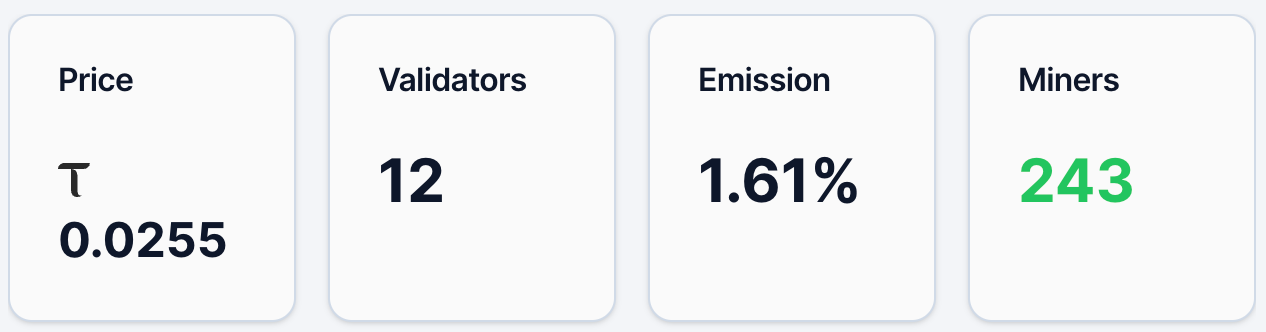
Figure 1. Gradients data. Source: https://bittensormarketcap.com/subnets/56
Next is the Emission incentive mechanism. In the Bittensor system, Emission refers to the real-time distribution weight of a subnet in the network's newly added rewards. The Bittensor network continuously generates new TAO and distributes it to various subnets according to weight. Gradients currently at 1.61% means it only receives a small portion of the network's newly added incentives. This metric essentially reflects the "voting result" of the market through capital flows (such as staking) on different subnets. Therefore, a 1.61% level usually indicates relatively limited market recognition and capital inflow at present, while on the other hand, it also implies that there is room to increase its weight in the future. From the perspective of capital structure (liquidity pool), TAO accounts for only 2.19%, while Alpha reaches 97.81%, indicating that external capital inflow is still limited and currently the supply is mainly driven internally within the subnet. The price is relatively sensitive to new capital; once more TAO flows in, it may bring a more noticeable amplification effect.
6.Competitive Landscape and Advantages and Disadvantages
6.1 Industry Positioning: Decentralized AutoML Training Infrastructure
Gradients is positioned in the niche sector of 'AI training infrastructure + decentralized AutoML.' It aims to free model training from centralized platforms and achieve more efficient resource utilization and model optimization through networked mechanisms. In the Web2 system, this sector is already relatively mature, with typical examples including Google Vertex AI and AWS SageMaker. These platforms provide developers with one-stop model training and deployment services through cloud computing, but their essence remains a centralized architecture. In contrast, the difference of Gradients lies not in 'having more features,' but in its underlying logic: it transforms training from a 'platform service' into 'network collaboration,' and selects the best results through a competitive mechanism, making it closer to a market-driven training system.
6.2 Horizontal Comparison: Differences Between Web2 and Web3 AutoML
From a more macro perspective, the differences between Web2 and Web3 in the field of AutoML essentially represent a comparison of two different paradigms. The Web2 model emphasizes efficiency and stability, providing a controllable and mature service experience through centralized resources and engineering optimization; whereas the Web3 model emphasizes openness and incentive mechanisms, allowing models to continuously evolve through competition by involving multiple participants. Specifically, Web2 AutoML is more like 'a powerful tool,' where users submit tasks to the platform and the system internally completes the search for optimal solutions; while Web3 AutoML, represented by Gradients, is more like 'an open market,' where users publish their requirements, different participants provide solutions, and results are filtered through an evaluation mechanism. The direct impact of this difference is that the former is more stable and controllable but has limited optimization paths; the latter has a larger exploration space and higher potential ceiling, but still has room for improvement in stability and maturity.
6.3 Differentiation of Gradients in Web3
In the current Web3 AI track, most projects still focus on the inference layer or AI Agent direction, while projects concentrating on 'training infrastructure' are relatively few. Some projects attempt to provide training capabilities by combining computing power networks or data networks, but overall, most still remain at the level of resource scheduling or computing power markets. The difference with Gradients is that it does not merely offer computing power matching; it extends further to the 'model optimization mechanism' itself. By introducing an evaluation and competition system, it enables the training process to continuously evolve. This means it not only addresses 'where the computing power comes from' but also 'how to use this computing power more efficiently.' In terms of positioning, Gradients is closer to a 'training outcome-oriented' network rather than a pure computing power market or tool platform, which is also its core distinction from most Web3 AI projects.
6.4 Core Advantage: Mechanism-Driven Efficiency Improvement
Overall, the advantages of Gradients are mainly reflected in its mechanism design. Firstly, it lowers the threshold for use through task abstraction, allowing users to obtain model results without deeply participating in complex training processes, thereby expanding the potential user base. Secondly, in terms of resources, the introduction of distributed computing power means that training is no longer dependent on a single cloud provider, and theoretically, competition could create a more flexible cost structure. More importantly, there is a change in the optimization approach. By enabling multiple participants to explore in parallel combined with a screening mechanism, Gradients offers a solution different from traditional single-path optimization, giving models the opportunity to achieve better performance in a shorter time. This 'competition-driven optimization' model is its core advantage.
6.5 Potential Challenges
The quality of the model may have stability issues. Decentralized training relies on the participation of multiple parties, which can improve the upper limit but may also lead to result fluctuations. Compared to a centralized system, there is a certain degree of uncertainty in controllability. Next is the issue of enterprise-level trust. For enterprise users, data security and the verifiability of the training process are crucial, and how to ensure data is not misused and results can be audited in a decentralized environment remains a key challenge. Finally, there is the dependence on the token economy. The operation of Gradients relies heavily on incentive mechanisms. If TAO returns become less attractive, it may affect miner participation and overall network activity. Therefore, its long-term sustainability depends to some extent on whether the economic model can form a stable positive cycle.
7.Future Outlook: Can Decentralized AutoML Succeed?
From the current stage, Gradients is still in its early phase, and whether it can truly succeed in the future depends on several key factors. The most critical is whether it can continuously attract genuine training demand, rather than just participation driven by incentives; secondly, the quality of the model—whether the decentralized approach can consistently produce usable, or even superior, results; and finally, whether the economic mechanism can form a positive feedback loop, maintaining a long-term balance between computing power supply and returns.
In the larger industry context, AI training is diverging into two paths. One is the Web2 model, led by top tech companies that continuously enhance model performance through concentrated resources and engineering capabilities, with the advantage of stability and maturity. The other is the Web3 path, represented by Gradients, which allows more participants to jointly optimize models through open networks and incentive mechanisms, continuously raising the ceiling through competition. The former focuses on 'building a stronger system,' while the latter is more like 'constructing a network that can evolve on its own.'
From this perspective, Gradients' exploration represents a new possibility: AI training is no longer just a technical issue, but a combination of 'computing power + data + market mechanisms.' If this model can succeed, it has the potential to become the training gateway for decentralized AI and play a key infrastructure role within the Bittensor ecosystem. Of course, this direction still needs time to be validated, but it has already provided AutoML with an evolutionary approach that differs from traditional paths.
Reference
1.Bittensor Documentation: https://docs.learnbittensor.org
2.Gradients website: https://www.gradients.io/
3.Gradients: https://bittensormarketcap.com/subnets/56
4.Gradients X: https://x.com/gradients_ai
5.Taostats: https://taostats.io/subnets/56/chart
CoinW Research Institute
Abstract
Gradients is a decentralized AI training subnet (SN56) built on Bittensor, with its core mechanism transforming model training from a complex technical process into a market-driven network collaboration process through "task publishing, miner competition, verification, and filtering." Architecturally, it combines AutoML with distributed computing power to form a training market centered on incentive mechanisms, which not only lowers the entry barrier for AI use but also improves computing power utilization efficiency. From the perspective of ecology and data performance, Gradients has completed the basic network setup, but currently, incentive weights and capital inflows are relatively limited. Gradients complements the training infrastructure within the TAO ecosystem and explores a new paradigm of "market-driven AI optimization," with long-term potential to develop into an important entry layer for decentralized AI training.
1.Starting from Web2 AutoML: The Current Situation and Limitations of AI Training
1.1 What is AutoML
In traditional understanding, training an AI model is a high-threshold task that requires engineers to handle data, select models, repeatedly adjust parameters, and evaluate performance, making the whole process complex and time-consuming. The emergence of AutoML (automated machine learning) essentially packages these tedious steps into automation. It can be understood as a 'tool that automatically creates models': users only need to provide data and tell the system the goal they want to achieve, such as classification, prediction, or recognition. The remaining processes, including model selection, parameter tuning, training, and optimization, are all automatically handled by the system. This transforms AI from a tool used by a few specialized engineers into a capability that ordinary developers and even businesses can utilize, representing an important step towards the widespread adoption of AI.
1.2 The core limitations of traditional AutoML
Currently, mainstream implementations of AutoML are concentrated on cloud vendor platforms, such as Google Vertex AI and AWS SageMaker, which offer 'AI training as a service.' Although Web2 AutoML significantly lowers the barrier to AI usage, its underlying model still has obvious limitations. First is the centralization issue: computing power, pricing, and rules are all controlled by the platform, making users highly dependent on a single service provider and lacking bargaining power. Second, the costs are high and non-transparent; the GPU resources relied on for AI training are mainly held by cloud vendors, and the pricing mechanism lacks market competition. More importantly, there is a limit to optimization efficiency. Traditional AutoML essentially remains 'one system helping you find the optimal solution.' No matter how complex this system is, it fundamentally belongs to the optimization of a single technological path. Its exploration space is limited, making it difficult to simultaneously try multiple completely different approaches. Therefore, current Web2 AI training is a 'closed system,' where model training, optimization, and resource scheduling all occur in an environment controlled by a single platform. Although this model is efficient, its limitations are gradually becoming apparent as demand grows.
2.Gradients: Using 'Networks' to Reconstruct AI Training
2.1 What is Gradients: A decentralized AutoML platform
In the previous chapter, we mentioned that the core problem of traditional Web2 AutoML lies in the "closed system," where model training depends on the platform, optimization paths are limited, and resource flow is restricted. Gradients is precisely a reconstruction of this model. Gradients originated from a decentralized engineer community initiated by WanderingWeights, built on the Bittensor network, and operates on Subnet 56 as an AI training subnetwork. Unlike traditional platforms, it does not provide centralized services but breaks down the training process and delegates it to an open network. Users only need to define task objectives, such as model type and data, while the remaining processes, including training execution, parameter optimization, and result filtration, are automatically handled by the network. In this model, AI training is abstracted from a complex engineering process into a simple "submit request, obtain results" procedure, making it closer to a general capability rather than a highly specialized technical task.
2.2 From Closed Systems to Open Collaboration: What Problems Gradients Solves
The core change of Gradients lies in transforming the training process, which was originally confined to a single platform, into an open and collaborative network process. Training tasks are no longer completed by a single system; instead, they are distributed to multiple participants for parallel attempts, and the best results are selected through a unified evaluation mechanism. This structure first reduces dependence on centralized service providers, allowing training to be built on distributed computing power; at the same time, scattered GPU resources are integrated into the same network, forming a more market-oriented resource allocation method through competition. More importantly, model optimization is no longer limited to a single path, but continuously approaches better solutions through parallel exploration of multiple methods, thereby improving the overall optimization ceiling.
2.3 Essential change: from a tool to a 'training market'
In traditional AutoML, the platform acts more like a tool, assisting users in finding the optimal solution through internal algorithms. In Gradients, however, this process is closer to a continuously operating "market": users publish requirements, various participants compete around the same task, and results are filtered through an evaluation mechanism. As a result, model performance no longer depends on the capability of a single system but comes from ongoing competition and iteration among multiple parties. AutoML also transforms from a relatively closed technical optimization problem into a dynamic, incentive-driven process, allowing optimization capabilities to continuously expand as more participants join. This change enables AI training to begin exhibiting self-evolving characteristics similar to a market.
2.4 Role in the TAO Ecosystem: AI Training Infrastructure Layer
在 Bittensor 的子网体系中,不同 Subnet 承担着推理、数据处理与训练等不同功能,而 Gradients 所处的位置是训练层。它负责将分散的算力转化为实际模型产出,并通过任务分发与评估机制,使这些资源能够被持续调度与优化。同时它连接了算力供给与模型需求,使训练从单纯的资源消耗过程,转变为一个可以被组织和优化的网络协作过程。在这一体系中,Gradients 更像是一个中枢环节,将分布式资源转化为可用的 AI 能力,并支撑上层应用的发展。
3.Core Architecture: How AI Training is Completed in the Network
In the previous chapter, we mentioned that Gradients transforms AI training from being 'completed within a platform' to being 'completed through network collaboration.' So, how exactly does this network operate? The core of this chapter is to break down this process in a more intuitive way.
3.1 Distributed Training: How a Single Task Is 'Completed by Multiple People'
You can think of Gradients as a continuously running 'collaborative training network.' When a user submits a training task, the task is not handed over to a single system to complete; instead, it is simultaneously distributed to multiple participants in the network. These participants attempt different training methods based on the same data and objectives and submit their results within a specified time frame. The system then evaluates these results uniformly and selects the best-performing solutions. Ultimately, the better-performing results are rewarded, while other solutions are eliminated. From the user's perspective, this process only requires initiating one task, which is equivalent to simultaneously 'invoking' multiple optimization approaches and automatically selecting the best solution. The key to this method is not how powerful a single node is, but the continuous approximation of the optimal result through parallel attempts by multiple participants plus automatic selection.
In this network, there are mainly three types of participants: users, miners, and validators. Users are responsible for proposing training requirements; miners provide computing power and try different training methods; validators evaluate the results and select the best models. This division of labor allows the training process to run continuously and continuously filter out better solutions. Overall, it constitutes a collaborative network driven by 'demand, supply, and evaluation.'
3.2 Market-driven AutoML
From the previous analysis of the mechanism, it can be seen that Gradients does not simply move AutoML onto the chain, but changes the underlying logic of model optimization by introducing multi-party participation and incentive mechanisms. Traditional AutoML relies on a single system to search for the optimal solution within limited paths, whereas in Gradients, this process is extended across the entire network: different participants continuously try different methods around the same task and iteratively select and refine them through unified evaluation. This makes model optimization no longer a one-time computational process, but a dynamic process that can evolve repeatedly. Under this mechanism, better-performing results receive higher rewards, thereby continuously attracting participants to optimize strategies and promoting continuous improvement of overall performance.
4.Incentive and Competition Mechanisms: How AI Training Forms a 'Positive Cycle'
4.1 Incentive Mechanism (TAO-Driven): From Training Behavior to Reward Returns
The key to Gradients being able to operate sustainably lies in the underlying incentive mechanism. This depends on the native incentive system provided by Bittensor. In this system, TAO is the native token of the Bittensor network and serves as a 'value carrier' throughout the network: on one hand, it is used to reward participants who provide computing power and contribute models, and on the other hand, it is used in staking and other ways to participate in the allocation of subnet weights, influencing how resources flow between different subnets.
The Bittensor mainnet continuously generates new incentives, known as Emission, i.e., TAO (currently an appropriate amount is about 3600 TAO per day), and distributes them to different subnets according to certain rules. How much each subnet receives depends on its 'performance' in the entire network, such as activity level, quality of contributions, and financial support. For the subnet where Gradients is located, the allocated TAO is further distributed internally to participants. The core basis for distribution is whose model contributes better, as those participants will earn more rewards.
Specifically, miners submit training results, and validators are responsible for testing and scoring these results. The system calculates each participant's 'contribution weight' based on the scores and then distributes rewards according to this weight. Better-performing models (for example, those with stronger generalization ability and more stable performance) will receive higher rewards, and validators who score more accurately and reflect actual quality will also receive more incentives. This design makes 'performing better' directly correspond to 'earning more,' thus motivating participants to continuously optimize their models.
4.2 Competition between subnets: not only internal competition, but also external ranking
In addition to internal competition within the subnet, Gradients also face "lateral competition" across the entire Bittensor network. Since the allocation of TAO is dynamic, different subnets compete for higher weights. Only those subnets that consistently produce high-quality results and attract more participants can obtain a larger share of rewards. Therefore, the incentives for Gradients depend not only on internal model performance but also on their relative competitiveness within the entire ecosystem. The whole system forms a multi-level cycle: there is competition among models within subnets, and there is overall performance competition between subnets. Ultimately, computing power investment, model performance, and economic returns are tied together, forming a self-sustaining positive feedback mechanism.
4.3 Gradients 5.0: From Competition to the 'Tournament Mechanism'
Building on early continuous competition, Gradients further evolved into a more structured mechanism called 'tournament-style training.' It can be understood as a periodic competition: each round of training sets a time window, during which multiple participants compete on the same task and are gradually eliminated through multiple selection rounds, ultimately identifying the optimal solution. This format emphasizes phased comparison and concentrated evaluation. An important change is that miners no longer directly submit training results but instead submit the 'training method' (code), which is then executed uniformly by validation nodes. This approach, on the one hand, improves fairness by avoiding interference from different computing environments and, on the other hand, better protects the privacy of data and the training process. Additionally, the winning solutions are often preserved and become reusable methods, similar to an ever-growing collection of 'best practices.' In the long term, this mechanism not only selects the best models but also builds a continuously evolving repository of training methods.
5.Ecological Status
5.1 Participant structure: a collaborative network composed of demand, supply, and evaluation
The Gradients ecosystem is composed of three core roles: users (demand side), miners (supply side), and validators (evaluation side). Users mainly include AI developers, small and medium-sized enterprises, and Web3 builders. This group usually has a certain technical foundation but lacks computing power or complete model training capabilities, and therefore prefers to complete model building through Gradients at a lower cost. Miners provide GPU computing power and participate in training task competitions, with their core motivation being to earn TAO rewards. Validators are responsible for evaluating and ranking training results, playing a key role in ensuring model quality and the effective operation of the mechanism.
From a more segmented user perspective, the actual user base of Gradients shows a clear 'semi-developer' characteristic: they are neither top AI labs nor completely non-technical ordinary users, but are mainly developers and Web3 technology users with certain engineering capabilities. This is also reflected in its community structure. The current ecosystem is dominated by English, with core users mainly distributed among developers in North America and Europe, while also covering some Southeast Asian miners and global GPU resource providers. Overall, it resembles a technology-driven developer community.
5.2 Current State of Ecological Operation
As of April 1, the price of Gradients' alpha token is approximately 0.0255 TAO, with about 4,890 addresses holding the token, 243 miners, 12 validators, and an emission ratio of 1.61%. At the same time, in its liquidity pool, TAO accounts for 2.19% and Alpha accounts for 97.81%. Judging from the price and the number of holders, Gradients already has a certain user base and attention, but overall it is still in the early diffusion stage. By comparison, in the TAO ecosystem's leading project Chutes, the alpha token price was 0.0877 TAO on that day, with 13,409 addresses holding the token.
Figure 1. Gradients data. Source: https://bittensormarketcap.com/subnets/56
Next is the Emission incentive mechanism. In the Bittensor system, Emission refers to the real-time distribution weight of a subnet in the network's newly added rewards. The Bittensor network continuously generates new TAO and distributes it to various subnets according to weight. Gradients currently at 1.61% means it only receives a small portion of the network's newly added incentives. This metric essentially reflects the "voting result" of the market through capital flows (such as staking) on different subnets. Therefore, a 1.61% level usually indicates relatively limited market recognition and capital inflow at present, while on the other hand, it also implies that there is room to increase its weight in the future. From the perspective of capital structure (liquidity pool), TAO accounts for only 2.19%, while Alpha reaches 97.81%, indicating that external capital inflow is still limited and currently the supply is mainly driven internally within the subnet. The price is relatively sensitive to new capital; once more TAO flows in, it may bring a more noticeable amplification effect.
6.Competitive Landscape and Advantages and Disadvantages
6.1 Industry Positioning: Decentralized AutoML Training Infrastructure
Gradients is positioned in the niche sector of 'AI training infrastructure + decentralized AutoML.' It aims to free model training from centralized platforms and achieve more efficient resource utilization and model optimization through networked mechanisms. In the Web2 system, this sector is already relatively mature, with typical examples including Google Vertex AI and AWS SageMaker. These platforms provide developers with one-stop model training and deployment services through cloud computing, but their essence remains a centralized architecture. In contrast, the difference of Gradients lies not in 'having more features,' but in its underlying logic: it transforms training from a 'platform service' into 'network collaboration,' and selects the best results through a competitive mechanism, making it closer to a market-driven training system.
6.2 Horizontal Comparison: Differences Between Web2 and Web3 AutoML
From a more macro perspective, the differences between Web2 and Web3 in the field of AutoML essentially represent a comparison of two different paradigms. The Web2 model emphasizes efficiency and stability, providing a controllable and mature service experience through centralized resources and engineering optimization; whereas the Web3 model emphasizes openness and incentive mechanisms, allowing models to continuously evolve through competition by involving multiple participants. Specifically, Web2 AutoML is more like 'a powerful tool,' where users submit tasks to the platform and the system internally completes the search for optimal solutions; while Web3 AutoML, represented by Gradients, is more like 'an open market,' where users publish their requirements, different participants provide solutions, and results are filtered through an evaluation mechanism. The direct impact of this difference is that the former is more stable and controllable but has limited optimization paths; the latter has a larger exploration space and higher potential ceiling, but still has room for improvement in stability and maturity.
6.3 Differentiation of Gradients in Web3
In the current Web3 AI track, most projects still focus on the inference layer or AI Agent direction, while projects concentrating on 'training infrastructure' are relatively few. Some projects attempt to provide training capabilities by combining computing power networks or data networks, but overall, most still remain at the level of resource scheduling or computing power markets. The difference with Gradients is that it does not merely offer computing power matching; it extends further to the 'model optimization mechanism' itself. By introducing an evaluation and competition system, it enables the training process to continuously evolve. This means it not only addresses 'where the computing power comes from' but also 'how to use this computing power more efficiently.' In terms of positioning, Gradients is closer to a 'training outcome-oriented' network rather than a pure computing power market or tool platform, which is also its core distinction from most Web3 AI projects.
6.4 Core Advantage: Mechanism-Driven Efficiency Improvement
Overall, the advantages of Gradients are mainly reflected in its mechanism design. Firstly, it lowers the threshold for use through task abstraction, allowing users to obtain model results without deeply participating in complex training processes, thereby expanding the potential user base. Secondly, in terms of resources, the introduction of distributed computing power means that training is no longer dependent on a single cloud provider, and theoretically, competition could create a more flexible cost structure. More importantly, there is a change in the optimization approach. By enabling multiple participants to explore in parallel combined with a screening mechanism, Gradients offers a solution different from traditional single-path optimization, giving models the opportunity to achieve better performance in a shorter time. This 'competition-driven optimization' model is its core advantage.
6.5 Potential Challenges
The quality of the model may have stability issues. Decentralized training relies on the participation of multiple parties, which can improve the upper limit but may also lead to result fluctuations. Compared to a centralized system, there is a certain degree of uncertainty in controllability. Next is the issue of enterprise-level trust. For enterprise users, data security and the verifiability of the training process are crucial, and how to ensure data is not misused and results can be audited in a decentralized environment remains a key challenge. Finally, there is the dependence on the token economy. The operation of Gradients relies heavily on incentive mechanisms. If TAO returns become less attractive, it may affect miner participation and overall network activity. Therefore, its long-term sustainability depends to some extent on whether the economic model can form a stable positive cycle.
7.Future Outlook: Can Decentralized AutoML Succeed?
From the current stage, Gradients is still in its early phase, and whether it can truly succeed in the future depends on several key factors. The most critical is whether it can continuously attract genuine training demand, rather than just participation driven by incentives; secondly, the quality of the model—whether the decentralized approach can consistently produce usable, or even superior, results; and finally, whether the economic mechanism can form a positive feedback loop, maintaining a long-term balance between computing power supply and returns.
In the larger industry context, AI training is diverging into two paths. One is the Web2 model, led by top tech companies that continuously enhance model performance through concentrated resources and engineering capabilities, with the advantage of stability and maturity. The other is the Web3 path, represented by Gradients, which allows more participants to jointly optimize models through open networks and incentive mechanisms, continuously raising the ceiling through competition. The former focuses on 'building a stronger system,' while the latter is more like 'constructing a network that can evolve on its own.'
From this perspective, Gradients' exploration represents a new possibility: AI training is no longer just a technical issue, but a combination of 'computing power + data + market mechanisms.' If this model can succeed, it has the potential to become the training gateway for decentralized AI and play a key infrastructure role within the Bittensor ecosystem. Of course, this direction still needs time to be validated, but it has already provided AutoML with an evolutionary approach that differs from traditional paths.
Reference
1.Bittensor Documentation: https://docs.learnbittensor.org
2.Gradients website: https://www.gradients.io/
3.Gradients: https://bittensormarketcap.com/subnets/56
4.Gradients X: https://x.com/gradients_ai
5.Taostats: https://taostats.io/subnets/56/chart