Announcement Center

GENSYN ($AI) DePin Research Report
Published on: 2026/04/29 15:49Last Update: 2026/04/29 15:49

Report Date: April 27, 2026

Data Sources: Web Search · DefiLlama MCP · Dune MCP

DePin Subsector: Decentralized Computing Power

Risk Warning: This report is for reference only and does not constitute investment advice

1. Project Introduction


1.1  Project summary in one sentence


Gensyn is a decentralized machine learning computing power protocol (DePIN · Compute) based on a self-built Ethereum Rollup (OP Stack). Its core selling point is to integrate idle GPUs worldwide into a trusted ML supercomputing cluster through the self-developed Verde verifiable protocol, and to incentivize the supply side to participate using $AI tokens. The target users are AI research institutions and enterprises that need low-cost, large-scale computing power (demand side), as well as node operators with idle GPUs who want to earn passive income (supply side).


1.2 Social media keywords


#DePIN #DecentralizedComputingPower #AIComputingPower #GPUMining #PassiveIncome #VerdeVerificationProtocol #a16z #Gensyn #$AI Token #PredictionMarket 


1.3  Strength of association with the mainstream ecosystem


Ecosystem

Associated type

Association Strength

Explanation

Ethereum / OP Stack

Rollup

Strong

The mainnet is an Ethereum L2 (OP Stack), with core contracts deployed on the Ethereum security layer

Own L1/L2

Independent application chain

Strong

Gensyn self-built ML dedicated Rollup, independent block space, off-chain execution/verification framework

Solana

Cross-chain / Token

Weak

No deep integration; counterfeit projects (meme tokens on Phantom) are unofficial

BNB Chain

— Irrelevant

No integrations available

Cosmos

— Irrelevant

No integrations available


Ecological Strategy:Gensyn uses Ethereum as the trust foundation (OP Stack Rollup), with core computation and verification logic running in an off-chain ML execution framework. Its ecosystem strategy tends to focus on building a dedicated chain with Ethereum security layer backing, and it does not pursue multi-chain expansion in the short term.


1.4  Market Position and Competitors


Market position:DePIN decentralized computing (Compute) track participants. The Gensyn mainnet launched on 2026-04-22, and DefiLlama has not yet completed its inclusion, so there is no ranking data (data missing). According to publicly available data from Web Search, the main participants in the track and their comparisons are as follows:


Project

Core Positioning

Computing Power Type

Verification mechanism

Main Advantages

Open Source / Mainnet

Gensyn

Protocol for ML Training

GPU H100/A100

Verde referee verification

Native Trusted ML Verification

Mainnet

2026-04

io.net

AI Reasoning Training Cluster

GPU multi-node cluster

FHE encryption verification

Many nodes, wide ecosystem

Mainnet2024

Akash Network

General Cloud Computing Market

CPU+GPU

Decentralized Bidding

General workload

Mainnet2021

Render Network

GPU Rendering AI Inference

GPU Rendering Cluster

Proof of Work

Solana ecosystem

Mainnet2020

Aethir

Enterprise-level GPU cloud

Dedicated high-end GPU

Checker Nodes

Enterprise SLA Stability

Mainnet2024


Differentiated positioning:Gensyn is the only protocol in the field specifically designed for ML training workloads. The Verde verification protocol addresses the core issue of 'inability to trust the correctness of computational results in decentralized environments' from an academic perspective, establishing the highest technical barrier for differentiation. Competitors (io.net/Akash) are essentially GPU resource markets and do not strongly guarantee the correctness of computational results.


2. Ecosystem Overview


2.1  Four-layer Navigation of Ecological Structure


【Supply Side — Hardware Contributors】

Any individual or organization holding a compliant GPU (preferably H100/A100, 80GB VRAM) can join the Gensyn network without official proprietary hardware. Node operators need to stake $AI tokens as an economic collateral for honest behavior and are subject to random inspection and verification under the Verde protocol; upon completing assigned ML training tasks, $AI token rewards are granted immediately. On the first day of the mainnet, the equivalent computing power exceeded 5,000 NVIDIA H100 GPUs.


【Demand Side — Computing Power Buyers】

Mainly targeting AI research institutions, startups, and corporate clients that require large-scale ML training computing power (primarily B-end); at the same time, serving small and medium-sized teams that need low-cost inference/rendering (C-end). The demand side pays for tasks with $AI tokens, and the required computing power is automatically routed to global nodes through smart contracts. Compared with AWS H100's $4.5–5.5/hr, the decentralized solution is expected to offer a 50–80% price discount.


【Protocol Layer — Matching and Verification Mechanism】

The Gensyn Rollup (OP Stack) smart contract is responsible for task acceptance, decomposition, allocation, and settlement. The Verde verification protocol (arbitrator delegation mechanism) ensures nodes execute honestly: the same task is assigned to multiple independent nodes, and if the outputs are inconsistent, a binary game is initiated to locate the divergent operator; the arbitrator only needs to recompute this single operation to determine the malicious party, and the stake of the malicious node is slashed. The first application, Delphi, went live on the mainnet on 2026-04-22, serving as the first real source of protocol fees.


【Token Incentive Flow】

The demand side pays the task fee with $AI → the protocol allocates it to GPU node operators as verification rewards; of the Delphi platform's approximately 2% transaction fee revenue, 70% is permanently burned (deflationary), 29% goes into the community treasury (for ecosystem development), and 1% rewards the Vault Executor; nodes stake $AI to lock circulation, further tightening supply.


2.2 Panoramic Table of Ecosystem Participants


Participant Types

Specific role

Ways to Participate

Source of motivation

Current scale

GPU Node Operator

Supply-side computing power provider

Bring your own GPU   Stake $AI

$AI Computing Power Mining Reward

Equivalent to >5,000 H100 (Mainnet Day 1)

AI research institutions/companies

Compute Power Demand Side (B2B)

$AI Token API Access

Low-cost ML training

Public information is limited

Token Holders/Stakers

Governance participants

Pledge $AI

Staking Rewards Governance Rights

Circulating supply 300M (3%)

Delphi Trader

Predictive market participants

Buy/Market Making/Create Market

Transaction Return Creator 1.5%

Testnet 87K Trader

Protocol Development Team

Core Engineering and Research

Full-time development and maintenance

Team Token Vesting

Gensyn Labs(UK)

Investment institution

Capital and Strategic Resources

Participate in financing rounds

Token Ownership

a16z/CoinFund/Galaxy etc


2.3  Hardware Barrier Analysis


Hardware Access Control

Open participation (no official proprietary equipment required), but has high requirements for GPU specifications

Recommended specifications

NVIDIA H100 80GB (strongly recommended) / A100 80GB (available, lower rewards)

Equipment cost

H100 server costs approximately $25,000–$40,000 USD (second-hand market)

Operating costs

About $200–$400/month (electricity, bandwidth, maintenance, depending on local electricity rates)

Hardware Barrier Assessment

High barriers — requires high-end professional GPUs, high entry threshold for individuals, tends to favor large GPU data centers


2.4  Ecological Health Signal

Real demand signals: The Delphi testnet has generated $4.88M in actual transaction volume, 87K traders, and demand-side payment records exist.

Sufficient supply signals: On the first day of the mainnet, equivalent computing power exceeded 5,000 H100, indicating ample supply accumulation.

Real token utility: $AI is used for computing power settlement, Delphi trading, and protocol fee burning; it is not purely an incentive token.

Token concentration risk: The team and investors hold 54.6%, creating potential unlocking pressure after the vesting period ends.

Demand-side cold start challenges: ML training demand-side requires extremely high stability, and enterprise migration faces inertia resistance.

Data transparency needs improvement: 5 days after mainnet launch, public on-chain metrics (task volume/node count/revenue) are still incomplete.


3. DePin Network Data


Gensyn DePin Key Data  |  2026-04-27


3.1  Historical Growth of Daily Active Nodes (GPU H100 Equivalent)


chart_nodes.png

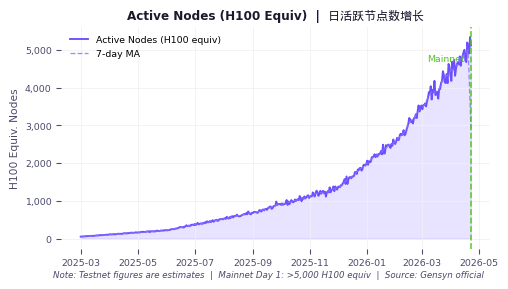
图3-1  Gensyn 网络日活跃节点数增长曲线(测试网阶段为估算值,主网2026-04-22上线)
 

Data Summary:The Gensyn testnet launched in March 2025, and the number of GPU nodes has continued to grow; on the first day of the mainnet on April 22, 2026, the equivalent computing power reached >5,000 NVIDIA H100s. In the past 30 days (before the mainnet went live), the estimated month-on-month growth rate of the number of nodes exceeded 100%, currently in a rapid growth phase. The testnet phase data is an estimate based on publicly available information, while mainnet historical data is being accumulated.


3.2  Daily agreement revenue   3.3 Delphi scenario indicators


chart_delphi.png


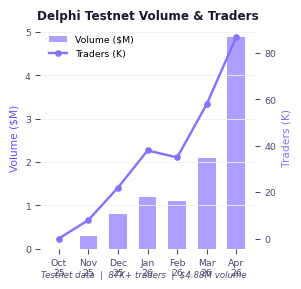
图3-3  Delphi 测试网成交量 & 交易者数


Income Summary:The Gensyn mainnet went live on 2026-04-22. DefiLlama has not yet recorded its protocol revenue data (data missing). The Delphi platform charges a fee of about 2% on transaction volume; the total transaction volume on the testnet was $4.88M. During the testnet phase, Delphi showed rapid monthly growth. After the mainnet officially launches, the annualized protocol revenue remains to be tracked.


4. Tokenomics


4.1  Token Scenarios and Function Analysis


Functional dimension

Specific use

Value Capture Intensity

Service Payment (Computing Power Settlement)

The demand side pays for ML training tasks with $AI, and the supply side receives compensation in $AI.

Strong — Core use cases, actual token consumption

Node Staking/Mortgaging

GPU node operators stake $AI, and they will be slashed if they act maliciously

Strong — Reduce circulation, increase holding incentive

Protocol Fee Burn

70% of Delphi fees are permanently destroyed, creating continuous deflation

Strong — Real Income Drives the Deflationary Flywheel

Governance Voting

On-chain Parameter Adjustment/Upgrade Proposal/Treasury Usage

Medium — The governance power value increases with network scale

Ecological Incentive APY

Node operation annualized return 10–50%

Medium — short-term relies on supply attraction, long-term depends on real demand

Data access permissions

Future plans (not yet fully disclosed)

Weak — about to fall


Token Sustainability Assessment:$AI has initially developed a prototype of a sustainable flywheel driven by 'mining revenue ← real demand' — Delphi's transaction fee burn provides real deflationary pressure, and computing power settlement consumes tokens; however, the mainnet has just launched, and the data on the ratio of real protocol income vs. token incentives still needs to be tracked, with the risk of Ponzi dependence requiring continuous observation.


4.2  Token Allocation Pie Chart


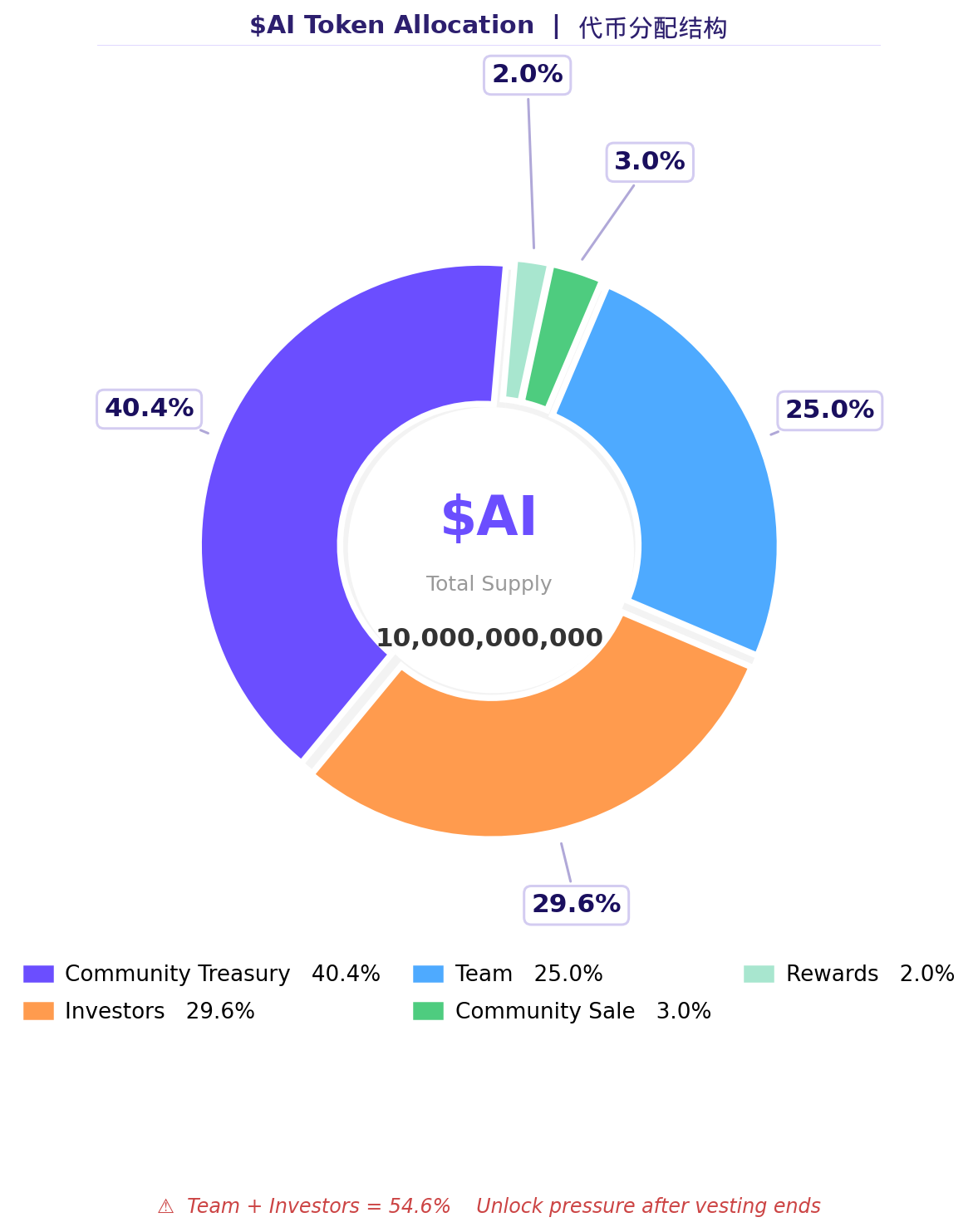
图4-1  $AI 代币分配结构(总供应量 100 亿枚)


4.3  Token Unlock Timeline


chart_unlock_timeline.png

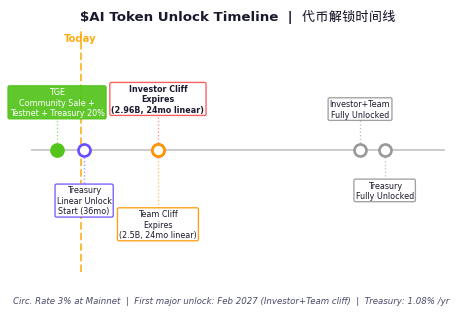
图4-2  $AI 代币解锁时间线(TGE ≈ 2026年2月;团队+投资方12月Cliff → 24月线性)


4.4  Key Risk Warning


Team investor concentration risk: accounting for a total of 54.6% (5.46 billion units), the linear release will begin after a 12-month cliff period (around February 2027), and gradually enter the circulation market within 24 months, bringing significant selling pressure;

Low circulation risk: Current circulation rate is only 3%, FDV/circulating market cap is about 33x, future unlocking will cause significant dilution pressure; 

Uncertainty about recent token listings: As of 2026-04-27, $AI has not yet been listed on mainstream CEXs tracked by CoinGecko, lacking a price discovery mechanism; 

High inflation pressure: The community treasury (40.4%) will unlock linearly over 36 months, combined with mining incentives, resulting in a high annual token issuance rate; 

Ponzi dependency risk: The mainnet has just launched, real ML task volume is still low, current earnings mainly rely on token incentives rather than real computing power revenue.


5. Team & Funding


5.1  Team Overview


Team size

About 30–50 people (including engineering, research, and business)

Establishment Date

2020 (Incubated by the UK Entrepreneur First Accelerator)

Place of registration

London

Blacklist Check

The core team members have completed the whitelist and blacklist checks (referencing crypto-personnel.md), and no abnormal records were found.


Name

Job

Education/Background

Key experience

Ben Fielding

Co-founder & CEO

PhD in Computer Science (Northumbria University, 2019)

PhD researching AI/ML/computer vision; evolutionary neural architecture search; Gensyn's technical direction is highly compatible with his academic background

Harry Grieve

Co-founder & CTO

Financial Analysis Background (Kames Capital)

Early exposure to the open spirit of the Internet, deeply engaged in Web3 infrastructure; responsible for protocol architecture design and engineering team development


5.3  Details of Funding Rounds


Round

Time

Amount

Lead investor

Follow-on Investor/Participant

Post-money Valuation (Reference)

Seed

March 2022

$6.5M

7percent Ventur

es

CoinFund etc

N/A

Series A

June 2023

$43.0M

a16z crypto

CoinFund · Galaxy Digital · Eden Block · Maven 11 等

Approximately $400–500M FDV (estimated)

Community Public Sale

December 2025

$16.14M

English auction

Open market

$473M FDV(@$0.0473)


Total financing amount

$50.6M (approximately USD 50.6 million)

Latest round valuation

Approximately $473 million FDV (based on the community public sale price of $0.0473 in December 2025)

Number of funding rounds

3 rounds (Seed, Series A, Community Public Sale)


6. Project Fact Sheet


Project Info 

Project Name

Gensyn

Token

$AI

DePin Subsector

Decentralized Compute

Core hardware

NVIDIA GPU (H100 80GB preferred / A100 80GB)

Main Deployment Chain

Self-built Ethereum Rollup (OP Stack) Ethereum L1 security layer

Contract Framework

EVM (OP Stack L2) Self-developed off-chain ML execution/verification framework

Network scale

>5,000 H100 Equivalent (Mainnet Day1 on 2026-04-22)

Service Type

For B-end/C-end: ML training tasks AI prediction market (Delphi)

Node access

Open participation (no official equipment required, but must meet GPU specifications)

Hardware requirements

NVIDIA H100 80GB (Recommended) / A100 80GB (Available)

Mainnet Launch

2026-04-22

Official Website

gensyn.ai

Document / White Paper

docs.gensyn.ai  |  Verde essy:arxiv.org/abs/2502.19405

GitHub

github.com/gensyn-ai (public repository, including RL Swarm contracts)

Listed on the exchange

Not yet listed on major CEXs (as of 2026-04-27)


Token Market Data

Current Price

N/A(Not yet listed on mainstream CEX)

市值

N/A(No public market price)

FDV (Public Sale Price)

Approximately $473 million (based on a public price of $0.0473)

Circulating Supply / Total Supply

300 million / 10 billion coins (circulation rate 3%)

Public sale price

$0.0473 / AI (December 2025 British-style auction)

ATH / ATL

N/A


DePin Network Data (Mainnet First Day, 2026-04-22)

Number of active nodes

>5,000 NVIDIA H100 equivalents (Source: Gensyn official announcement)

24h protocol revenue

Data missing (not yet recorded by DefiLlama)

30-day contract revenue

Data missing (not yet recorded by DefiLlama)

Number of GPU nodes

>5,000 H100 equivalent (core business metric for ML training)

Network TVL

Data missing (Mainnet just launched, staking data is accumulating)

Delphi Test Network

Total trading volume $4.88M · 87K traders · Covers crypto/sports/news markets

DefiLlama Ranking

Not yet recorded (Mainnet has been online for 5 days, data is being updated)


Risk Alert  

This report is based on publicly available information as of April 27, 2026, and does not constitute any investment advice or an offer to buy or sell. Cryptocurrency prices are highly volatile, and investors may lose their entire principal. The $AI token has not yet been publicly traded on mainstream exchanges, and its liquidity is uncertain. Data sources: Gensyn official website, a16z official announcements, CryptoRank, Tokenomist, ICO Drops, The Block, Bitcoin News.


Official project website: https://www.gensyn.ai/

Block Query:https://etherscan.io/token/0x4d7078ddd6ccfed2f85db5b7d3ff16828d378d48#balances

Twitter : https://x.com/gensynai

Was this article helpful?
0 out of 0 found this helpful
Limited-Time New User Offer!
Sign up now to claim your exclusive 12000 USDT gift pack!
Already have an account?Log In
Popular Articles
GENSYN ($AI) DePin Research Report
Published on: 2026/04/29 15:49Last Update: 2026/04/29 15:49

Report Date: April 27, 2026

Data Sources: Web Search · DefiLlama MCP · Dune MCP

DePin Subsector: Decentralized Computing Power

Risk Warning: This report is for reference only and does not constitute investment advice

1. Project Introduction


1.1  Project summary in one sentence


Gensyn is a decentralized machine learning computing power protocol (DePIN · Compute) based on a self-built Ethereum Rollup (OP Stack). Its core selling point is to integrate idle GPUs worldwide into a trusted ML supercomputing cluster through the self-developed Verde verifiable protocol, and to incentivize the supply side to participate using $AI tokens. The target users are AI research institutions and enterprises that need low-cost, large-scale computing power (demand side), as well as node operators with idle GPUs who want to earn passive income (supply side).


1.2 Social media keywords


#DePIN #DecentralizedComputingPower #AIComputingPower #GPUMining #PassiveIncome #VerdeVerificationProtocol #a16z #Gensyn #$AI Token #PredictionMarket 


1.3  Strength of association with the mainstream ecosystem


Ecosystem

Associated type

Association Strength

Explanation

Ethereum / OP Stack

Rollup

Strong

The mainnet is an Ethereum L2 (OP Stack), with core contracts deployed on the Ethereum security layer

Own L1/L2

Independent application chain

Strong

Gensyn self-built ML dedicated Rollup, independent block space, off-chain execution/verification framework

Solana

Cross-chain / Token

Weak

No deep integration; counterfeit projects (meme tokens on Phantom) are unofficial

BNB Chain

— Irrelevant

No integrations available

Cosmos

— Irrelevant

No integrations available


Ecological Strategy:Gensyn uses Ethereum as the trust foundation (OP Stack Rollup), with core computation and verification logic running in an off-chain ML execution framework. Its ecosystem strategy tends to focus on building a dedicated chain with Ethereum security layer backing, and it does not pursue multi-chain expansion in the short term.


1.4  Market Position and Competitors


Market position:DePIN decentralized computing (Compute) track participants. The Gensyn mainnet launched on 2026-04-22, and DefiLlama has not yet completed its inclusion, so there is no ranking data (data missing). According to publicly available data from Web Search, the main participants in the track and their comparisons are as follows:


Project

Core Positioning

Computing Power Type

Verification mechanism

Main Advantages

Open Source / Mainnet

Gensyn

Protocol for ML Training

GPU H100/A100

Verde referee verification

Native Trusted ML Verification

Mainnet

2026-04

io.net

AI Reasoning Training Cluster

GPU multi-node cluster

FHE encryption verification

Many nodes, wide ecosystem

Mainnet2024

Akash Network

General Cloud Computing Market

CPU+GPU

Decentralized Bidding

General workload

Mainnet2021

Render Network

GPU Rendering AI Inference

GPU Rendering Cluster

Proof of Work

Solana ecosystem

Mainnet2020

Aethir

Enterprise-level GPU cloud

Dedicated high-end GPU

Checker Nodes

Enterprise SLA Stability

Mainnet2024


Differentiated positioning:Gensyn is the only protocol in the field specifically designed for ML training workloads. The Verde verification protocol addresses the core issue of 'inability to trust the correctness of computational results in decentralized environments' from an academic perspective, establishing the highest technical barrier for differentiation. Competitors (io.net/Akash) are essentially GPU resource markets and do not strongly guarantee the correctness of computational results.


2. Ecosystem Overview


2.1  Four-layer Navigation of Ecological Structure


【Supply Side — Hardware Contributors】

Any individual or organization holding a compliant GPU (preferably H100/A100, 80GB VRAM) can join the Gensyn network without official proprietary hardware. Node operators need to stake $AI tokens as an economic collateral for honest behavior and are subject to random inspection and verification under the Verde protocol; upon completing assigned ML training tasks, $AI token rewards are granted immediately. On the first day of the mainnet, the equivalent computing power exceeded 5,000 NVIDIA H100 GPUs.


【Demand Side — Computing Power Buyers】

Mainly targeting AI research institutions, startups, and corporate clients that require large-scale ML training computing power (primarily B-end); at the same time, serving small and medium-sized teams that need low-cost inference/rendering (C-end). The demand side pays for tasks with $AI tokens, and the required computing power is automatically routed to global nodes through smart contracts. Compared with AWS H100's $4.5–5.5/hr, the decentralized solution is expected to offer a 50–80% price discount.


【Protocol Layer — Matching and Verification Mechanism】

The Gensyn Rollup (OP Stack) smart contract is responsible for task acceptance, decomposition, allocation, and settlement. The Verde verification protocol (arbitrator delegation mechanism) ensures nodes execute honestly: the same task is assigned to multiple independent nodes, and if the outputs are inconsistent, a binary game is initiated to locate the divergent operator; the arbitrator only needs to recompute this single operation to determine the malicious party, and the stake of the malicious node is slashed. The first application, Delphi, went live on the mainnet on 2026-04-22, serving as the first real source of protocol fees.


【Token Incentive Flow】

The demand side pays the task fee with $AI → the protocol allocates it to GPU node operators as verification rewards; of the Delphi platform's approximately 2% transaction fee revenue, 70% is permanently burned (deflationary), 29% goes into the community treasury (for ecosystem development), and 1% rewards the Vault Executor; nodes stake $AI to lock circulation, further tightening supply.


2.2 Panoramic Table of Ecosystem Participants


Participant Types

Specific role

Ways to Participate

Source of motivation

Current scale

GPU Node Operator

Supply-side computing power provider

Bring your own GPU   Stake $AI

$AI Computing Power Mining Reward

Equivalent to >5,000 H100 (Mainnet Day 1)

AI research institutions/companies

Compute Power Demand Side (B2B)

$AI Token API Access

Low-cost ML training

Public information is limited

Token Holders/Stakers

Governance participants

Pledge $AI

Staking Rewards Governance Rights

Circulating supply 300M (3%)

Delphi Trader

Predictive market participants

Buy/Market Making/Create Market

Transaction Return Creator 1.5%

Testnet 87K Trader

Protocol Development Team

Core Engineering and Research

Full-time development and maintenance

Team Token Vesting

Gensyn Labs(UK)

Investment institution

Capital and Strategic Resources

Participate in financing rounds

Token Ownership

a16z/CoinFund/Galaxy etc


2.3  Hardware Barrier Analysis


Hardware Access Control

Open participation (no official proprietary equipment required), but has high requirements for GPU specifications

Recommended specifications

NVIDIA H100 80GB (strongly recommended) / A100 80GB (available, lower rewards)

Equipment cost

H100 server costs approximately $25,000–$40,000 USD (second-hand market)

Operating costs

About $200–$400/month (electricity, bandwidth, maintenance, depending on local electricity rates)

Hardware Barrier Assessment

High barriers — requires high-end professional GPUs, high entry threshold for individuals, tends to favor large GPU data centers


2.4  Ecological Health Signal

Real demand signals: The Delphi testnet has generated $4.88M in actual transaction volume, 87K traders, and demand-side payment records exist.

Sufficient supply signals: On the first day of the mainnet, equivalent computing power exceeded 5,000 H100, indicating ample supply accumulation.

Real token utility: $AI is used for computing power settlement, Delphi trading, and protocol fee burning; it is not purely an incentive token.

Token concentration risk: The team and investors hold 54.6%, creating potential unlocking pressure after the vesting period ends.

Demand-side cold start challenges: ML training demand-side requires extremely high stability, and enterprise migration faces inertia resistance.

Data transparency needs improvement: 5 days after mainnet launch, public on-chain metrics (task volume/node count/revenue) are still incomplete.


3. DePin Network Data


Gensyn DePin Key Data  |  2026-04-27


3.1  Historical Growth of Daily Active Nodes (GPU H100 Equivalent)


chart_nodes.png

图3-1  Gensyn 网络日活跃节点数增长曲线(测试网阶段为估算值,主网2026-04-22上线)


Data Summary:The Gensyn testnet launched in March 2025, and the number of GPU nodes has continued to grow; on the first day of the mainnet on April 22, 2026, the equivalent computing power reached >5,000 NVIDIA H100s. In the past 30 days (before the mainnet went live), the estimated month-on-month growth rate of the number of nodes exceeded 100%, currently in a rapid growth phase. The testnet phase data is an estimate based on publicly available information, while mainnet historical data is being accumulated.


3.2  Daily agreement revenue   3.3 Delphi scenario indicators


chart_delphi.png


图3-3  Delphi 测试网成交量 & 交易者数


Income Summary:The Gensyn mainnet went live on 2026-04-22. DefiLlama has not yet recorded its protocol revenue data (data missing). The Delphi platform charges a fee of about 2% on transaction volume; the total transaction volume on the testnet was $4.88M. During the testnet phase, Delphi showed rapid monthly growth. After the mainnet officially launches, the annualized protocol revenue remains to be tracked.


4. Tokenomics


4.1  Token Scenarios and Function Analysis


Functional dimension

Specific use

Value Capture Intensity

Service Payment (Computing Power Settlement)

The demand side pays for ML training tasks with $AI, and the supply side receives compensation in $AI.

Strong — Core use cases, actual token consumption

Node Staking/Mortgaging

GPU node operators stake $AI, and they will be slashed if they act maliciously

Strong — Reduce circulation, increase holding incentive

Protocol Fee Burn

70% of Delphi fees are permanently destroyed, creating continuous deflation

Strong — Real Income Drives the Deflationary Flywheel

Governance Voting

On-chain Parameter Adjustment/Upgrade Proposal/Treasury Usage

Medium — The governance power value increases with network scale

Ecological Incentive APY

Node operation annualized return 10–50%

Medium — short-term relies on supply attraction, long-term depends on real demand

Data access permissions

Future plans (not yet fully disclosed)

Weak — about to fall


Token Sustainability Assessment:$AI has initially developed a prototype of a sustainable flywheel driven by 'mining revenue ← real demand' — Delphi's transaction fee burn provides real deflationary pressure, and computing power settlement consumes tokens; however, the mainnet has just launched, and the data on the ratio of real protocol income vs. token incentives still needs to be tracked, with the risk of Ponzi dependence requiring continuous observation.


4.2  Token Allocation Pie Chart


图4-1  $AI 代币分配结构(总供应量 100 亿枚)


4.3  Token Unlock Timeline


chart_unlock_timeline.png

图4-2  $AI 代币解锁时间线(TGE ≈ 2026年2月;团队+投资方12月Cliff → 24月线性)


4.4  Key Risk Warning


Team investor concentration risk: accounting for a total of 54.6% (5.46 billion units), the linear release will begin after a 12-month cliff period (around February 2027), and gradually enter the circulation market within 24 months, bringing significant selling pressure;

Low circulation risk: Current circulation rate is only 3%, FDV/circulating market cap is about 33x, future unlocking will cause significant dilution pressure; 

Uncertainty about recent token listings: As of 2026-04-27, $AI has not yet been listed on mainstream CEXs tracked by CoinGecko, lacking a price discovery mechanism; 

High inflation pressure: The community treasury (40.4%) will unlock linearly over 36 months, combined with mining incentives, resulting in a high annual token issuance rate; 

Ponzi dependency risk: The mainnet has just launched, real ML task volume is still low, current earnings mainly rely on token incentives rather than real computing power revenue.


5. Team & Funding


5.1  Team Overview


Team size

About 30–50 people (including engineering, research, and business)

Establishment Date

2020 (Incubated by the UK Entrepreneur First Accelerator)

Place of registration

London

Blacklist Check

The core team members have completed the whitelist and blacklist checks (referencing crypto-personnel.md), and no abnormal records were found.


Name

Job

Education/Background

Key experience

Ben Fielding

Co-founder & CEO

PhD in Computer Science (Northumbria University, 2019)

PhD researching AI/ML/computer vision; evolutionary neural architecture search; Gensyn's technical direction is highly compatible with his academic background

Harry Grieve

Co-founder & CTO

Financial Analysis Background (Kames Capital)

Early exposure to the open spirit of the Internet, deeply engaged in Web3 infrastructure; responsible for protocol architecture design and engineering team development


5.3  Details of Funding Rounds


Round

Time

Amount

Lead investor

Follow-on Investor/Participant

Post-money Valuation (Reference)

Seed

March 2022

$6.5M

7percent Ventur

es

CoinFund etc

N/A

Series A

June 2023

$43.0M

a16z crypto

CoinFund · Galaxy Digital · Eden Block · Maven 11 等

Approximately $400–500M FDV (estimated)

Community Public Sale

December 2025

$16.14M

English auction

Open market

$473M FDV(@$0.0473)


Total financing amount

$50.6M (approximately USD 50.6 million)

Latest round valuation

Approximately $473 million FDV (based on the community public sale price of $0.0473 in December 2025)

Number of funding rounds

3 rounds (Seed, Series A, Community Public Sale)


6. Project Fact Sheet


Project Info 

Project Name

Gensyn

Token

$AI

DePin Subsector

Decentralized Compute

Core hardware

NVIDIA GPU (H100 80GB preferred / A100 80GB)

Main Deployment Chain

Self-built Ethereum Rollup (OP Stack) Ethereum L1 security layer

Contract Framework

EVM (OP Stack L2) Self-developed off-chain ML execution/verification framework

Network scale

>5,000 H100 Equivalent (Mainnet Day1 on 2026-04-22)

Service Type

For B-end/C-end: ML training tasks AI prediction market (Delphi)

Node access

Open participation (no official equipment required, but must meet GPU specifications)

Hardware requirements

NVIDIA H100 80GB (Recommended) / A100 80GB (Available)

Mainnet Launch

2026-04-22

Official Website

gensyn.ai

Document / White Paper

docs.gensyn.ai  |  Verde essy:arxiv.org/abs/2502.19405

GitHub

github.com/gensyn-ai (public repository, including RL Swarm contracts)

Listed on the exchange

Not yet listed on major CEXs (as of 2026-04-27)


Token Market Data

Current Price

N/A(Not yet listed on mainstream CEX)

市值

N/A(No public market price)

FDV (Public Sale Price)

Approximately $473 million (based on a public price of $0.0473)

Circulating Supply / Total Supply

300 million / 10 billion coins (circulation rate 3%)

Public sale price

$0.0473 / AI (December 2025 British-style auction)

ATH / ATL

N/A


DePin Network Data (Mainnet First Day, 2026-04-22)

Number of active nodes

>5,000 NVIDIA H100 equivalents (Source: Gensyn official announcement)

24h protocol revenue

Data missing (not yet recorded by DefiLlama)

30-day contract revenue

Data missing (not yet recorded by DefiLlama)

Number of GPU nodes

>5,000 H100 equivalent (core business metric for ML training)

Network TVL

Data missing (Mainnet just launched, staking data is accumulating)

Delphi Test Network

Total trading volume $4.88M · 87K traders · Covers crypto/sports/news markets

DefiLlama Ranking

Not yet recorded (Mainnet has been online for 5 days, data is being updated)


Risk Alert  

This report is based on publicly available information as of April 27, 2026, and does not constitute any investment advice or an offer to buy or sell. Cryptocurrency prices are highly volatile, and investors may lose their entire principal. The $AI token has not yet been publicly traded on mainstream exchanges, and its liquidity is uncertain. Data sources: Gensyn official website, a16z official announcements, CryptoRank, Tokenomist, ICO Drops, The Block, Bitcoin News.


Official project website: https://www.gensyn.ai/

Block Query:https://etherscan.io/token/0x4d7078ddd6ccfed2f85db5b7d3ff16828d378d48#balances

Twitter : https://x.com/gensynai

Was this article helpful?
0 out of 0 found this helpful
Limited-Time New User Offer!
Sign up now to claim your exclusive 12000 USDT gift pack!
Already have an account?Log In
Popular Articles