FAQ
To enhance transparency in futures trading strategies and help users capture market opportunities more efficiently, CoinW officially launches Smart Money copy trading, a professional-grade futures copy trading tool.
1. What Is Smart Money Copy Trading?
Smart Money Copy Trading integrates on-chain smart money data with exchange trading data. In a transparent and systematic manner, it tracks and replicates the strategies of on-chain whales, experienced traders, and influential KOLs in real time, providing users a reliable and automated futures copy trading service.
2. How to Use
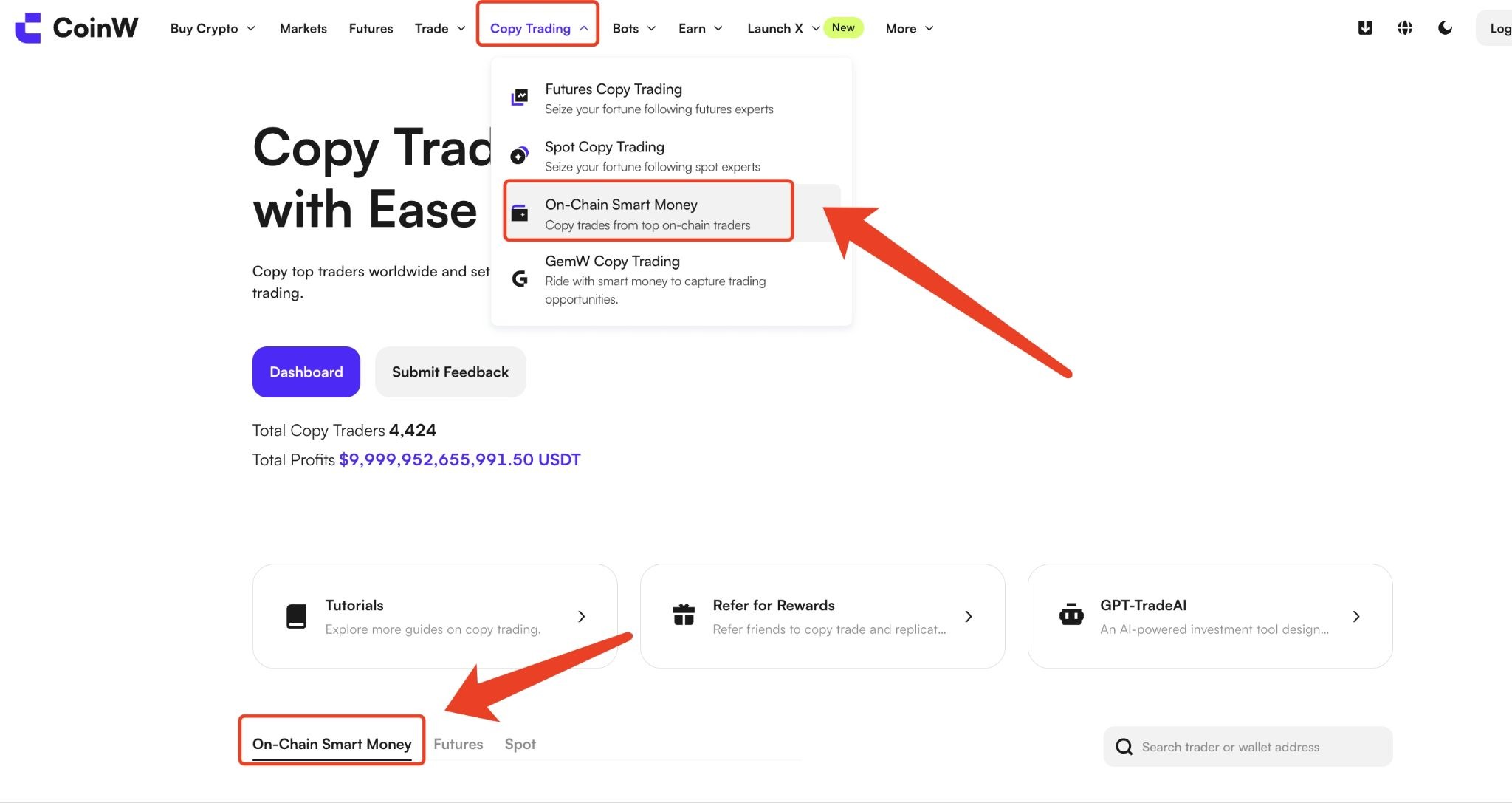
Step 1: Go to Homepage → Copy Trading → Smart Money
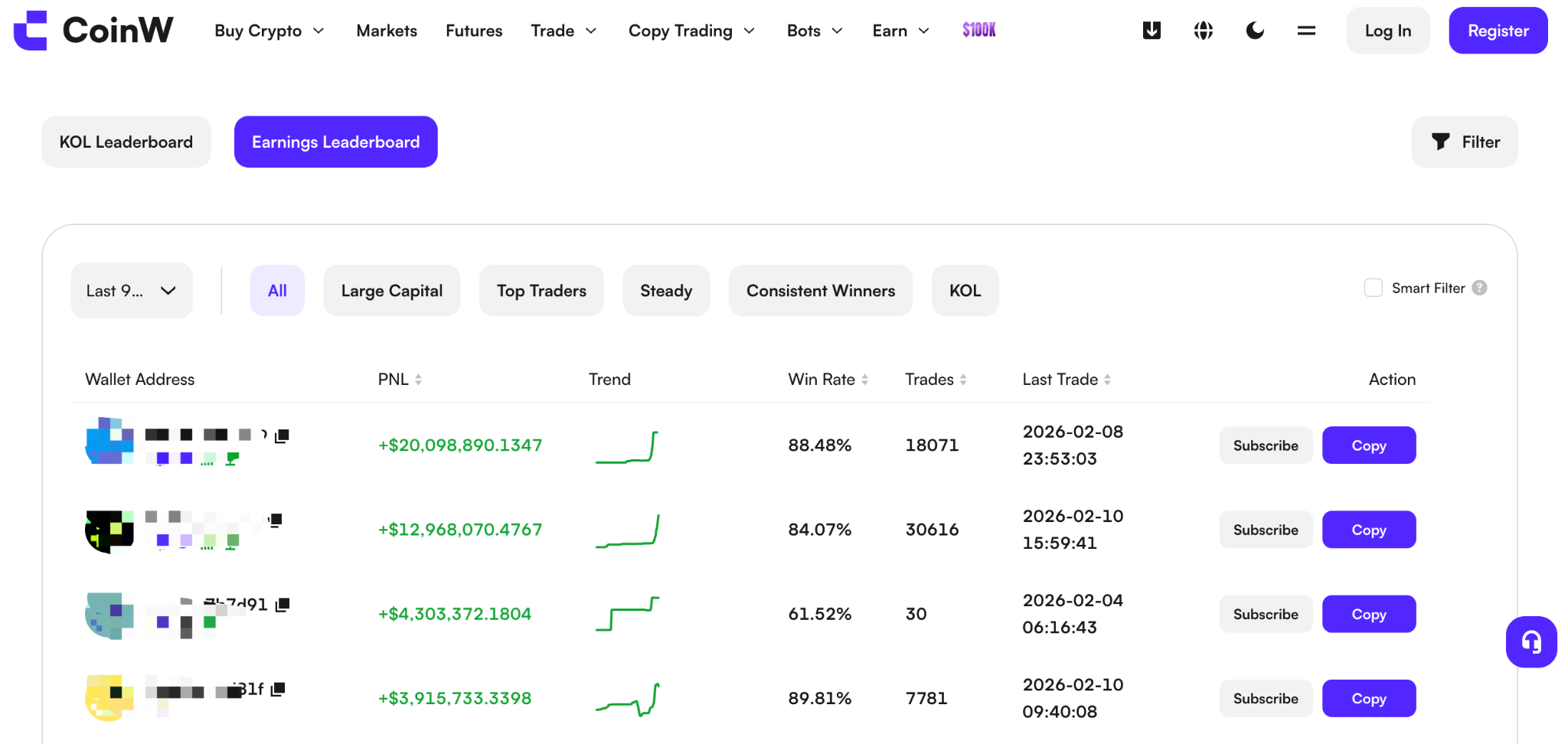
Step 2: Select a wallet address to view real trading data
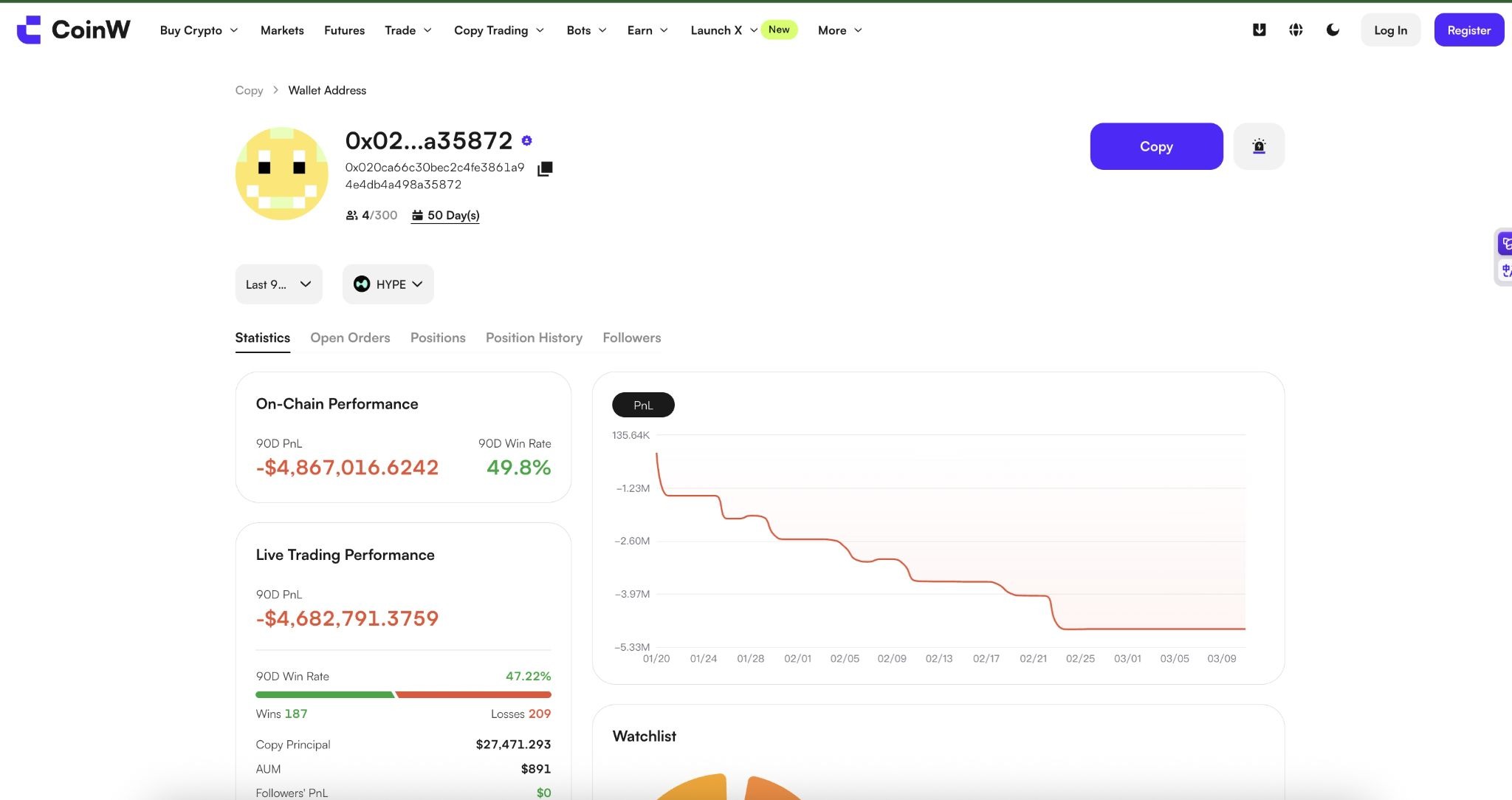
Step 3: On the wallet page, click “Copy”, enter your copy trading amount and cost per order, select the position type, set the opening slippage, and click the “Save” button to complete the setup
3. FAQ
Q: What makes CoinW Smart Money different from the Smart Moneys on other exchanges?
A: CoinW Smart Money adopts a zero profit-sharing model, allowing users to accurately track and copy top global on-chain whale and KOL addresses with a simple click. By transforming complex on-chain signals into a seamless automated copy trading experience, CoinW helps users reduce information gaps and easily follow top traders with lower barriers to entry. In addition, CoinW provides multi-dimensional ranking filters to help users quickly identify high-quality traders. For risk management, users can also manually close positions and set take-profit and stop-loss orders.
Most Smart Money features on other exchanges are primarily based on internal platform trading data and function more like signal dashboards or trader leaderboards. Users are generally required to manually analyze position data, win rates, and long/short trends before placing orders, which creates a higher learning barrier. Some platforms also require users to pay subscription fees to follow traders.
Unlike those platforms, CoinW supports manual position closing as well as take-profit and stop-loss settings, while many other platforms only provide trading indicators and require users to make trading decisions manually.
Q: How is the win rate of a Smart Money address calculated? If a Smart Money address trades tokens on HyperLiquid that are not listed on CoinW, will it affect the win rate calculation?
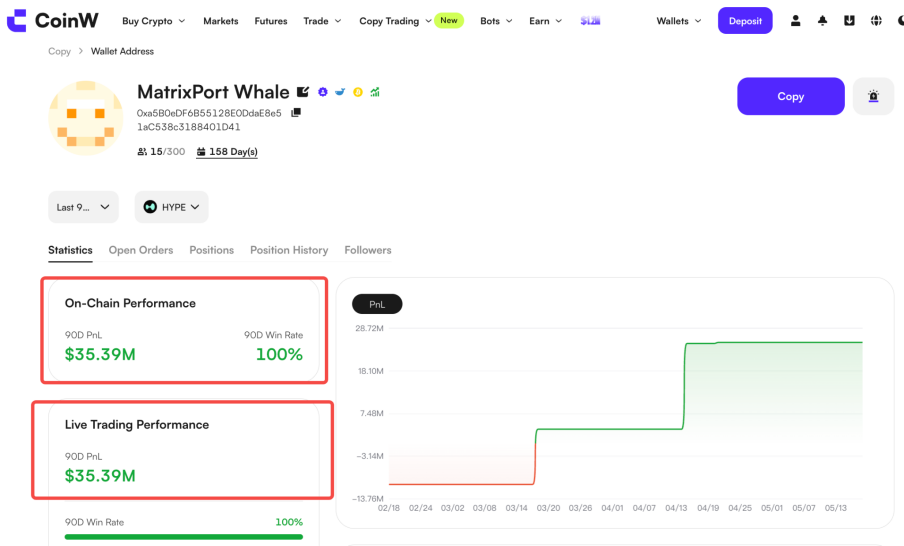
A: On the Smart Money dashboard, there are two different performance metrics available for users to review. One is the “On-Chain Performance,” which reflects the win rate statistics across all on-chain traded tokens. The other is the “Live Trading Performance,” which reflects the win rate statistics only for tokens available for copy trading on CoinW. Users can compare both sets of data for a more comprehensive evaluation before deciding whether to follow a Smart Money trader.
CoinW also tends to prioritize Smart Money addresses with stronger live trading performance, helping users reduce potential risks related to low-liquidity tokens and unsupported trading pairs.
Q: Can I add wallet addresses for monitoring manually?
A: Please contact our customer support for further assistance.
Q: How can I set slippage?
A: You can set a slippage tolerance between 0.1% and 0.5%. If the price deviation exceeds the set range, the corresponding copy order will not be executed. If no slippage is set, the system will take 0.5% as the default tolerance.
Q: Why did the trader open a position, but my account did not follow?
A: This may occur if the trading pair is not listed on CoinW, or if the order was blocked due to slippage protection or insufficient balance.
Q: Can I copy multiple Smart Money traders at the same time? How is my capital allocated?
A: Yes. You can assign a separate fixed amount to each trader.
For example, you can allocate 100 USDT to Trader A (aggressive) and 500 USDT to Trader B (conservative). Orders are placed and risk-managed independently based on the amount set for each address.
Q: Is there any delay in signal synchronization?
A: Our on-chain data is captured at the millisecond level, ensuring the copy trade execution is synchronized.
Q: What happens if a trader’s signals are lost?
A: The system includes automated protection mechanisms (dual-system switching, close-position signal priority, and an open-position circuit breaker) to reduce signal loss risk and help manage profits and losses effectively.
To enhance transparency in futures trading strategies and help users capture market opportunities more efficiently, CoinW officially launches Smart Money copy trading, a professional-grade futures copy trading tool.
1. What Is Smart Money Copy Trading?
Smart Money Copy Trading integrates on-chain smart money data with exchange trading data. In a transparent and systematic manner, it tracks and replicates the strategies of on-chain whales, experienced traders, and influential KOLs in real time, providing users a reliable and automated futures copy trading service.
2. How to Use
Step 1: Go to Homepage → Copy Trading → Smart Money
Step 2: Select a wallet address to view real trading data
Step 3: On the wallet page, click “Copy”, enter your copy trading amount and cost per order, select the position type, set the opening slippage, and click the “Save” button to complete the setup
3. FAQ
Q: What makes CoinW Smart Money different from the Smart Moneys on other exchanges?
A: CoinW Smart Money adopts a zero profit-sharing model, allowing users to accurately track and copy top global on-chain whale and KOL addresses with a simple click. By transforming complex on-chain signals into a seamless automated copy trading experience, CoinW helps users reduce information gaps and easily follow top traders with lower barriers to entry. In addition, CoinW provides multi-dimensional ranking filters to help users quickly identify high-quality traders. For risk management, users can also manually close positions and set take-profit and stop-loss orders.
Most Smart Money features on other exchanges are primarily based on internal platform trading data and function more like signal dashboards or trader leaderboards. Users are generally required to manually analyze position data, win rates, and long/short trends before placing orders, which creates a higher learning barrier. Some platforms also require users to pay subscription fees to follow traders.
Unlike those platforms, CoinW supports manual position closing as well as take-profit and stop-loss settings, while many other platforms only provide trading indicators and require users to make trading decisions manually.
Q: How is the win rate of a Smart Money address calculated? If a Smart Money address trades tokens on HyperLiquid that are not listed on CoinW, will it affect the win rate calculation?
A: On the Smart Money dashboard, there are two different performance metrics available for users to review. One is the “On-Chain Performance,” which reflects the win rate statistics across all on-chain traded tokens. The other is the “Live Trading Performance,” which reflects the win rate statistics only for tokens available for copy trading on CoinW. Users can compare both sets of data for a more comprehensive evaluation before deciding whether to follow a Smart Money trader.
CoinW also tends to prioritize Smart Money addresses with stronger live trading performance, helping users reduce potential risks related to low-liquidity tokens and unsupported trading pairs.
Q: Can I add wallet addresses for monitoring manually?
A: Please contact our customer support for further assistance.
Q: How can I set slippage?
A: You can set a slippage tolerance between 0.1% and 0.5%. If the price deviation exceeds the set range, the corresponding copy order will not be executed. If no slippage is set, the system will take 0.5% as the default tolerance.
Q: Why did the trader open a position, but my account did not follow?
A: This may occur if the trading pair is not listed on CoinW, or if the order was blocked due to slippage protection or insufficient balance.
Q: Can I copy multiple Smart Money traders at the same time? How is my capital allocated?
A: Yes. You can assign a separate fixed amount to each trader.
For example, you can allocate 100 USDT to Trader A (aggressive) and 500 USDT to Trader B (conservative). Orders are placed and risk-managed independently based on the amount set for each address.
Q: Is there any delay in signal synchronization?
A: Our on-chain data is captured at the millisecond level, ensuring the copy trade execution is synchronized.
Q: What happens if a trader’s signals are lost?
A: The system includes automated protection mechanisms (dual-system switching, close-position signal priority, and an open-position circuit breaker) to reduce signal loss risk and help manage profits and losses effectively.