What Is CWC? CoinW Utility Token, AI Trading & Benefits
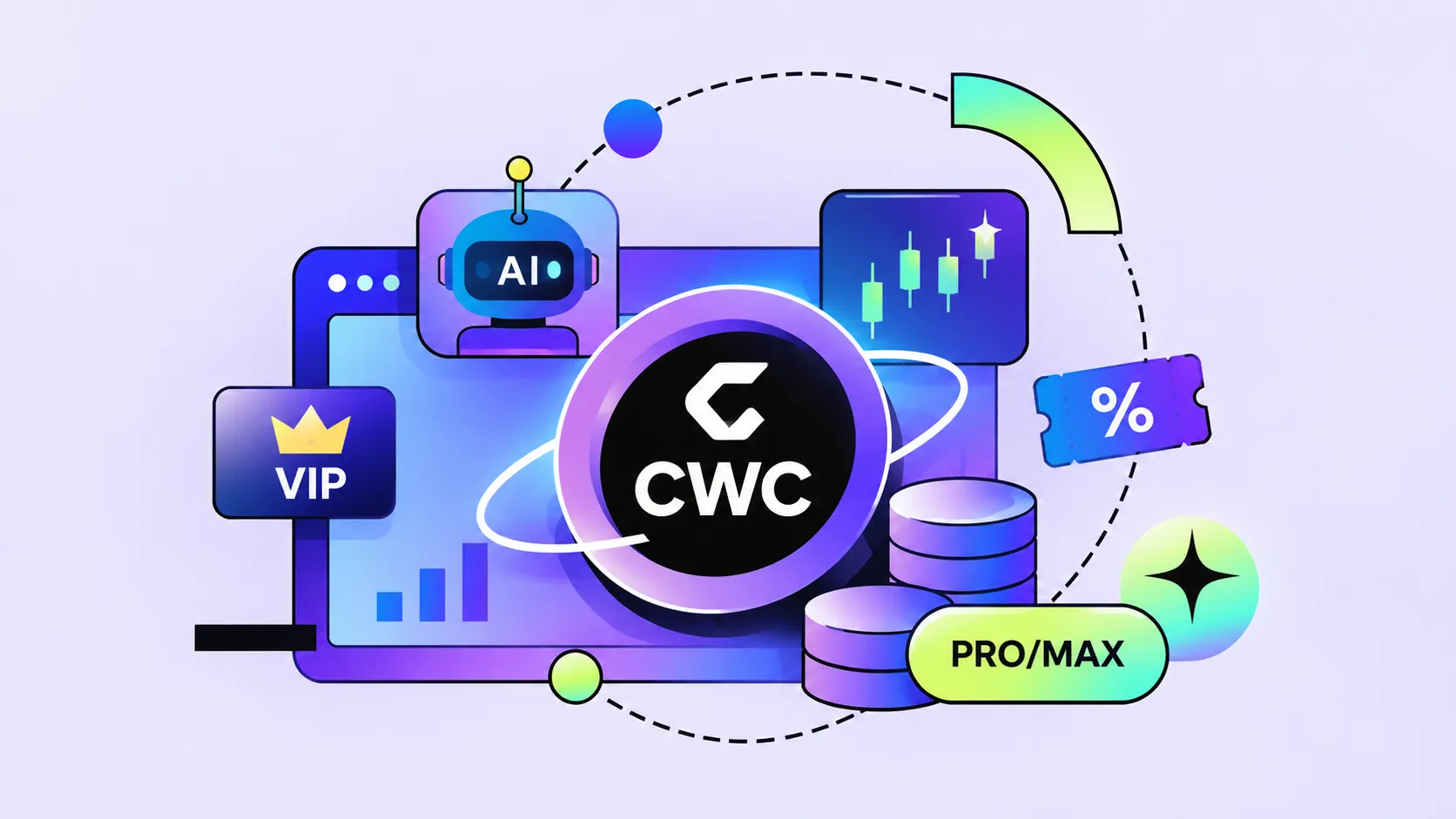
Overview | CoinW Academy · CoinW Utility Token and AI Trading
Why does CWC connect trading fee discounts with AI assistants, automated trading and monthly subscriptions? Its design brings selected trading services, AI features and ecosystem benefits together through CoinW Utility Token. Understanding CWC means examining its uses, allocation and vesting, and the conditions under which benefits become available.
Quick Summary: CWC can be understood as an access and payment tool for selected CoinW services. Holdings may affect eligibility or service tiers, while using certain services may require CWC payments. Holding CWC does not represent ownership of CoinW or a right to its profits.
In this guide: 1. What is CWC? | 2. Trading fees, VIP and exclusive benefits | 3. AI, Agentic trading and Monthly Passes | 4. Issuance, allocation and vesting | 5. Buybacks and burns | 6. Voting and participation checks | Takeaways, risks, disclaimer, FAQ and How-To
1. What Is CWC, and How Does It Relate to Agentic Trading?
As part of its 2026 platform upgrade, CoinW introduced CWC (CoinW Utility Token), connecting trading, AI services, premium services and ecosystem partnerships. This design extends beyond using CoinW Utility Token solely for trading fee discounts. Source: CoinW Utility Token upgrade announcement
Agentic trading broadly refers to AI Agents helping process information, call tools and execute trading workflows within settings and permissions authorized by users. An AI assistant providing analysis and an authorized Agent placing orders represent different levels of functionality.
Likewise, holding, spending and locking CWC are different:
- Holding CWC: Meeting specified requirements may provide benefit eligibility, service tiers or quotas.
- Spending CWC: Paying designated trading fees, subscription fees, API charges or other service costs.
- Locking CWC: Accepting restrictions on transfers or use for a defined period under applicable subscription, Earn or ecosystem arrangements.
These conditions do not necessarily apply together. Holding CWC does not make every service free or immediately available.
Remember: CWC’s utility concerns access to services and benefits. Its market price remains a separate consideration. Users can monitor crypto live prices to understand broader market conditions.
2. How Can Users Access Trading Fee, VIP and Exclusive Benefits?
For regular CoinW users, fee benefits and service eligibility are among CWC’s more straightforward applications. The table below summarizes designs described in the supplied draft and official introduction. The upgrade announcement states that holder benefits will be introduced in phases, with activation conditions announced separately. A feature description does not establish that every benefit is available to every account.
| Benefit | Described design | What should users verify? |
|---|---|---|
| Spot trading fee discount | A 20% discount when applicable Spot trading fees are paid in CWC | Eligible pairs and accounts, whether activation is required, and whether discounts can be combined |
| VIP upgrade acceleration | CWC holdings may offset up to 50% of the trading volume required for VIP upgrades | Holding calculation, target tier, validity and other upgrade requirements |
| Convert benefits | Zero fees and priority services for designated CWC conversion scenarios | Supported assets, final quote and amount received; zero fees do not mean there is no pricing spread |
| Bonuses and allowances | Access to higher Spot Bonus and Futures bonus quotas and interest-free leverage allowances | Activation conditions, expiry, permitted uses and withdrawal restrictions |
| Withdrawal fee benefits | An average daily holding of at least 1,000 CWC may qualify for one daily withdrawal fee waiver | Holding calculation, eligible assets and networks, limits and reset time |
| Futures protection quotas | Eligible tiers or activities may provide protection quotas | Triggers, application process, caps and exclusions; losses are not automatically compensated |
| New features and events | Potential priority access to selected features or activities | Rollout, regional, account and event restrictions |
For example, assume a trade would otherwise incur a fee equivalent to 10 USDT and qualifies for the 20% CWC fee discount. The discounted fee would be equivalent to 8 USDT. This illustrates the fee calculation only. The CWC amount charged depends on the platform’s conversion rules, while trading profit or loss is calculated separately.
The supplied draft also describes bonus interest for selected Earn products, subscription weight boosts in Rocket Plan activities, additional rewards for large holders, discounted subscriptions after meeting specified Earn participation periods, and CoinW Utility Token incentives. These are separate product or event benefits. An Interest Rate Coupon, subscription weight, discount eligibility and token reward are different benefits and do not automatically stack.
Check the Earn term, early redemption restrictions, reward currency, distribution schedule and eligibility separately. Receiving more CWC does not mean receiving a fixed USDT value.
3. How Do AI Assistants, Agentic Trading and PRO/MAX Monthly Passes Differ?
CWC’s AI applications become easier to understand through three questions: Which functions can I access? Who executes the action? How am I charged?
AI services: analysis, data queries and risk alerts
The supplied draft describes AI market analysis, signals, position risk alerts and access to market depth, on-chain activity and historical backtesting data. CWC may unlock corresponding capabilities or pay designated service charges.
These functions provide information and tools. A bullish AI analysis does not guarantee a price increase, and the absence of a risk alert does not establish that a position is safe. Analysis, signals and data may contain errors, delays or limitations.
Automated Agent trading: understand permissions before execution
Agent creation, operation and API calls may be settled in CWC under applicable rules, with service limits potentially linked to holding tiers. The draft also describes eligible AI-generated trading volume counting toward VIP assessment.
Users should verify permitted assets, individual and aggregate limits, leverage settings, and how to pause the Agent or revoke authorization. Higher holdings may change access or quotas; they do not make a strategy more certain or remove the risk of losses.
PRO/MAX Monthly Passes: a benefits bundle for a defined period
The draft describes 30-day PRO and MAX Monthly Passes. Their benefits may include Mega Coupons, Futures Insurance Fund quotas, Interest Rate Coupons, Super Bonuses for selected trading pairs, daily AI analysis and MAX-exclusive strategy updates.
| Comparison | Holding benefits | Monthly Pass benefits | Usage-based services |
|---|---|---|---|
| How accessed | Meet specified holding requirements | Purchase a PRO or MAX Monthly Pass under applicable rules | Pay according to actual usage |
| Key checks | Holding calculation, tier and ongoing eligibility | The 30-day term, package contents, claiming and activation | Price per use, usage volume, quotas and billing |
| Common misconception | Holding permanently unlocks every feature | Purchasing a pass activates every coupon and protection quota unconditionally | Paying in CWC permanently burns the tokens |
Check the actual package page for pricing, benefit quantities, daily AI call limits and renewal rules. Mega Coupons, bonuses and other vouchers have separate terms and should not be treated as freely withdrawable cash.
AI Earn and ecosystem services: distinguish tools, plans and long-term concepts
The draft lists an Intelligent Yield Router, a Natural-Language Earn Assistant, Risk-Adaptive Protection and Agent Vault (a long-term vision). These tools should be understood as supporting information selection or authorized workflows, rather than as a promise that AI manages funds on users’ behalf or automatically delivers higher returns.
Other ecosystem directions include a marketplace where developers publish trading, Earn and risk strategies for CWC subscriptions; incentives for eligible data contributions and CWC payments for advanced data services; and settlement for Agent creation, calls and subscriptions. Availability, charges and contribution incentives require individual confirmation. Agent Vault should continue to be described as a long-term concept.
Use the official CWC overview to explore services, then check the functions actually available in your account. This guide does not treat service plans as proof of a live product.
4. How Are CWC Issuance, Allocation and Vesting Structured?
Tokenomics involves more than total supply. Users should examine who receives tokens, when tokens can circulate and how they are used.
Basic information
| Item | Information |
|---|---|
| Name and symbol | CoinW Utility Token, CWC |
| Total issuance | 200,000,000 tokens; the upgrade announcement states no additional issuance |
| Listed issuance price | 0.5 USDT; not a current market quote or redemption commitment |
| Issuance model | Subscriptions and ecosystem incentives |
| Main uses | Selected trading benefits, AI services, Monthly Passes and ecosystem applications |
Sources: CoinW upgrade announcement and official CWC introduction. This guide does not independently audit the smart contract.
Allocation and vesting
| Category | Share | Tokens | Vesting summary |
|---|---|---|---|
| Airdrops | 40% | 80,000,000 | CWT conversion and ecosystem incentives |
| Core contributors | 25% | 50,000,000 | No initial unlock; 12-month lock, then 20-month vesting |
| Ecosystem development fund | 25% | 50,000,000 | Released over 24 months |
| Team incentives | 10% | 20,000,000 | No initial unlock; quarterly releases start after 6 months; completed within 48 months |
| Total | 100% | 200,000,000 | Not initial circulating supply |
Unallocated core-contributor tokens at TGE go to the ecosystem development fund. TGE means Token Generation Event. See the official allocation table; confirm start dates, individual unlocks and changes in formal disclosures.
Total supply, circulating supply and available account balances are different. Locked tokens have not necessarily been burned, and future unlocks may change the quantity available to circulate. This guide does not infer initial circulation or current circulating market capitalization from the summary above.
The utility cycle: subscription, lock-up, spending and burning
CWC’s design connects subscriptions, applicable lock-ups, service payments and buybacks and burns. Fee deductions, Monthly Passes, API calls, strategy subscriptions and data services create potential uses. Ecosystem growth may increase usage demand, but actual demand depends on whether users use those services.
“Consuming CWC” for a service generally describes a payment; it does not by itself establish that the tokens have permanently left supply. Only completed burns under the applicable rules should count as burned tokens. Lock-ups primarily affect availability for circulation, while burns affect token supply. The terms should not be used interchangeably.
5. How Do Buybacks and Burns Work, and Why Are They Not a Price Guarantee?
Buying back tokens and burning them are separate steps
The supplied draft describes buybacks funded by a portion of trading fee revenue, phased execution and disclosure. The current official introduction describes periodic purchases without a fixed schedule. This guide therefore does not present weekly buybacks as a fixed commitment. Funding and execution remain subject to the relevant rules and announcements.
Not all repurchased CWC is designated for burning. The official introduction lists these uses:
| Use | Share |
|---|---|
| Permanent burn | 20% |
| Ecosystem node rewards | 20% |
| Asset package acquisition | 20% |
| User incentives and purchase subsidies | 20% |
| Investor protection fund | 20% |
Source: Official CWC buyback allocation table. These percentages concern the allocation of repurchased CWC. They are not the proportion of platform revenue committed to buybacks or returns claimable by holders. A fund or protection label is not an insurance or compensation guarantee.
Transparency depends on actual records
The supplied draft proposes publishing burn addresses, amounts, times, transaction hashes and quarterly reports. When reviewing disclosures, check these separately:
- Buyback records: Execution period, quantity, average price and funding basis.
- Allocation: How much is pending burn and how much serves other ecosystem purposes.
- Burn records: Whether tokens reached the disclosed burn address and whether amounts and records correspond.
- Supply updates: Whether total, circulating and locked supply use consistent definitions.
A mechanism description does not replace evidence of completed execution. This guide does not count planned buybacks or burns as completed transactions.
Lower supply does not guarantee a higher price
Even after a burn, CWC’s price remains affected by demand, liquidity, unlocks, expectations and broader market conditions. Buybacks and burns can change supply structure, but do not constitute price support, guaranteed appreciation, principal protection or profit distributions.
6. What Are the Boundaries of Voting and Ecosystem Participation?
Voting provides community input
CWC holders may participate in feedback collection or non-binding votes on matters opened by CoinW, potentially including candidate projects, product priorities, fee policies or ecosystem fund use.
Users can express preferences, but this should not be described as the community determining listings or requiring holder approval for fee changes. Results inform decisions. CoinW retains final discretion based on laws, user protection, risk controls, commercial arrangements and platform security.
Partner collateral is a business arrangement
The draft describes CWC collateral or staking arrangements for project teams, market makers and OTC merchants. These apply to designated partners. Implementation, amounts, release and enforcement depend on the relevant agreements and rules.
Collateral arrangements may limit circulation but do not directly reduce total issuance or guarantee compensation for all user losses.
Three questions for ordinary users
What will I actually use? Match fee benefits, Monthly Passes, AI queries or event access to your needs.
What does eligibility cost? Check holding requirements, subscription and usage fees, lock-ups and committed funds.
Is the benefit active for my account? Confirm regional eligibility, identity verification, rollout and actual account availability.
Start with the official CWC overview and the relevant product terms before deciding whether to participate. This guide does not provide unconfirmed trading pairs, subscription links or launch dates.
Key Takeaways
CWC is designed to connect selected CoinW trading benefits, AI tools, Monthly Passes and ecosystem services through CoinW Utility Token. The starting point for users is identifying a function they need, then checking its requirements, costs and validity.
Allocation and vesting determine how supply enters the ecosystem. Buybacks and burns explain how some tokens may be redistributed or removed from supply. Reviewing these mechanisms alongside available services provides a fuller understanding of CWC. None independently determines its future price or a user’s return.
Risk Notice
| Risk | Potential impact | What to check |
|---|---|---|
| Price and liquidity | Significant price fluctuations or limited execution and exit liquidity | Do not treat issuance prices, reward conversion prices or buybacks as a price floor |
| Lock-ups and vesting | Restricted access to funds; unlocks may change circulation | Start dates, redemption terms and unlock schedules |
| Benefits and rule changes | Phased rollouts and possible changes to requirements, quotas or events | Latest announcements and actual account availability |
| AI and automation | Model errors, delays, strategy failures or unsuitable permissions may cause losses | Strategy, limits, stopping procedures and authorization scope |
| Earn and rewards | Reward-token prices, lock-ups and distribution conditions affect outcomes | Distinguish displayed annualized rates, token quantities and realizable value |
| Protection and subsidies | Eligibility, caps and exclusions may restrict use | Do not interpret quotas, funds or subsidies as principal protection or guaranteed compensation |
| Platform, network and compliance | System issues, security events, business changes or regional restrictions | Eligibility, account security and applicable rules |
Disclaimer
This article is provided by CoinW Academy for information sharing and investor education only. It does not constitute investment advice, an offer, solicitation or recommendation to buy or sell CWC or participate in any platform product, activity or service. The information, analysis and examples should not be the sole basis for investment decisions. Users should conduct independent research, understand the mechanisms and risks, and make decisions based on their own circumstances.
CoinW product materials refer to CWC as CoinW Utility Token for selected functions and benefits. Holding CWC does not represent shares, equity, debt, ownership, dividend rights or profit-sharing rights in CoinW or its affiliates. Legal classification and eligibility are subject to applicable jurisdictional laws and regulations. CoinW does not guarantee CWC’s price performance, appreciation, liquidity, investment returns or principal safety. Buybacks, burns, subsidies and ecosystem allocations do not constitute price maintenance, principal protection, profit distributions or guaranteed returns.
Regulatory frameworks for blockchain projects, digital token issuance and related activities may remain uncertain in some jurisdictions. Legal, policy or regulatory changes may cause losses. Risks include, without limitation, policy, regulatory, compliance, economic cycle, cybersecurity, management, digital asset industry, price volatility and other unlisted risks. Trading digital assets and derivatives carries substantial risk and may result in partial or total loss of principal. Users bear the corresponding consequences.
AI functions are provided for information, analysis, risk alerts or operational assistance only. They do not constitute investment advice, trading recommendations, asset management, discretionary management of user funds or guaranteed returns. AI analysis, signals, strategies, yield routing and risk alerts may be inaccurate, delayed or unsuitable. Automated functions must be used under applicable product rules and user authorization. Users independently decide whether to use them and whether to trade, and bear the associated risks.
Any CWC subscriptions, airdrops, trading, Earn products, Monthly Passes, rewards, protection quotas, compensation or subsidies, if introduced, are subject to CoinW’s relevant product rules, account eligibility requirements, risk disclosures, applicable laws and actual product pages. Such arrangements do not constitute fixed income, principal protection, insurance, guaranteed compensation or risk-free returns. CoinW determines buybacks, burns and other ecosystem arrangements based on market conditions, business development, compliance requirements and risk controls. Implementation and changes remain subject to applicable rules.
CWC-related services are unavailable to users in restricted jurisdictions, sanctioned persons, users who have not passed platform KYC/AML checks, or persons prohibited from participating under local law. Users must comply with local laws and verify their own eligibility. CoinW may restrict, suspend or terminate participation based on applicable laws, regulatory requirements, sanctions rules, risk controls and platform policies. Read the user agreement, risk disclosures and specific product terms before participating.
FAQ
Q1: Is CWC equivalent to CoinW shares or dividend rights?
A: No. CWC provides access to selected platform functions and benefits. It does not represent equity, debt or profit-sharing rights. Platform buybacks are not holder dividends.
Q2: Does holding CWC unlock every AI function and Monthly Pass benefit?
A: No. Holding tiers, Monthly Pass purchases, feature availability and usage charges may have separate conditions. Check the services available to your account and their rules.
Q3: Are tokens burned whenever CWC pays trading or AI fees?
A: Payment and burning are different processes. Only completed, disclosed burns should count toward burned supply. Neither all service payments nor all buybacks should be treated as burns.
Q4: Do buybacks and burns guarantee that CWC keeps rising?
A: No. Demand, liquidity, unlocks and market conditions still affect price. Buybacks and burns do not establish a price floor.
Q5: Do Futures protection quotas or AI risk controls guarantee against losses?
A: No. Protection quotas have conditions and limits. AI risk controls may fail or be delayed. Neither eliminates trading risk.
Q6: When can CWC be traded, and where can I check current benefits?
A: Check CoinW’s latest formal announcements and account pages for trading availability, supported markets and benefit activation. Start with the official overview; this article and historical event materials do not replace current rules.
How-To: Six Steps to Understand and Use CWC
- Confirm the official source: Read the CoinW CWC overview and check announcement dates. Do not rely solely on community screenshots or similar token names.
- Check eligibility: Review regional restrictions, KYC/AML requirements and actual account availability.
- Choose a service: Identify whether you need fee benefits, VIP, a Monthly Pass, AI tools or a specific activity, then read its terms.
- Check total costs: Review holding requirements, fees, lock-ups, voucher expiry, reward currencies and exit conditions.
- Review execution permissions: Before using an Agent, understand limits, strategy, risk settings and stopping procedures. Authorize only according to your needs.
- Record and review outcomes: Check fee deductions, benefit activation, rewards and unlocks. For buybacks and burns, compare announcements with actual execution records separately.