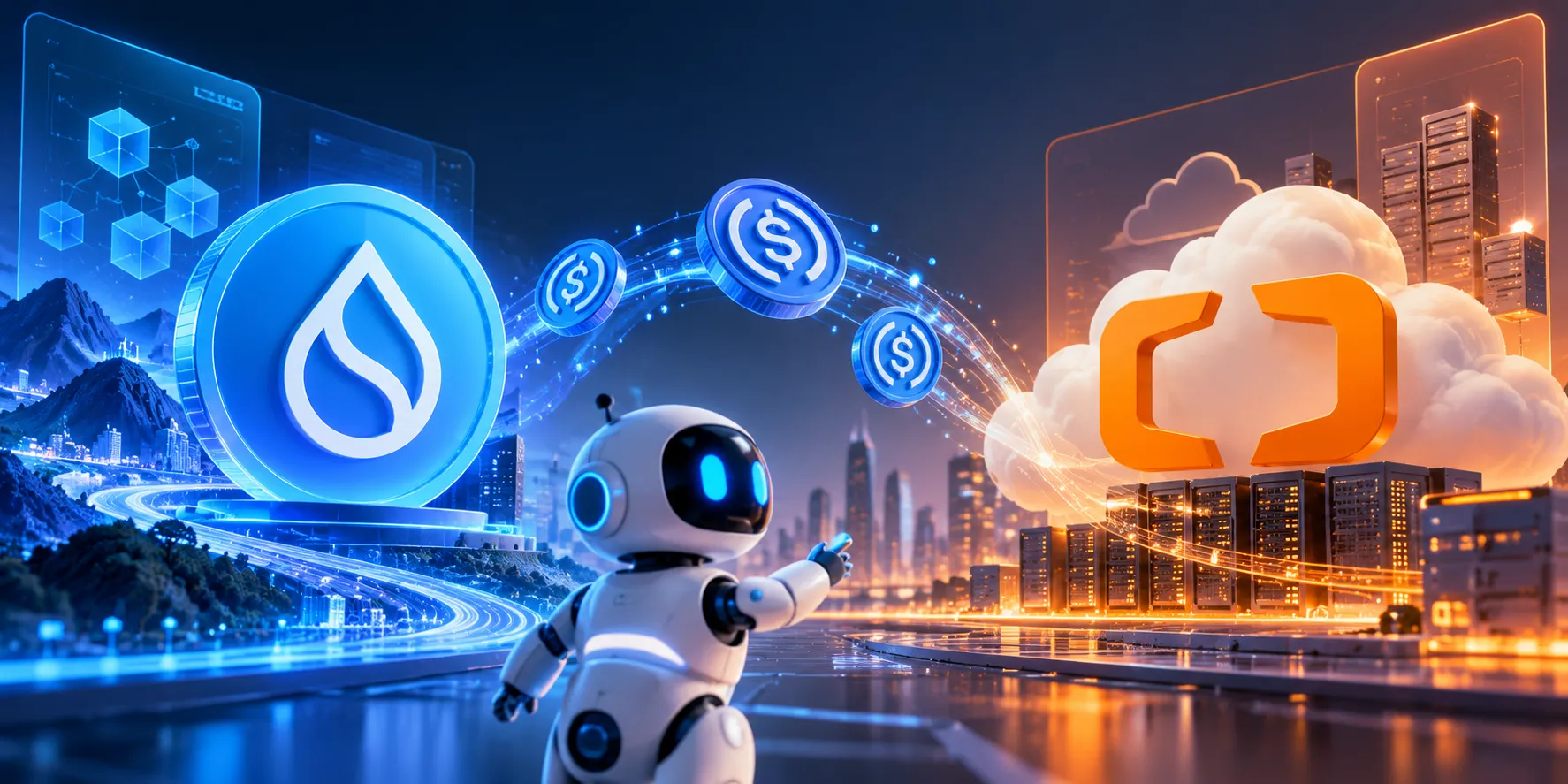
Sui Partners With Alibaba Cloud to Bring Stablecoin Payments to AI Agent Services
Sui has partnered with Alibaba Cloud to enable stablecoin-based, per-call payments for AI agent services, bringing blockchain settlement directly into the rapidly expanding agentic AI economy.
The collaboration connects Alibaba Cloud's AI infrastructure with Sui's blockchain-based payment capabilities, allowing autonomous AI agents to access services and pay for individual calls using stablecoins rather than relying on conventional subscriptions, credit cards, or manually managed payment accounts.
The development is particularly significant because Sui has been positioning its network as infrastructure for autonomous software and agentic commerce. Through Sui Agent Payments, AI agents can discover services, pay for individual calls using USDC, and receive receipts that can be independently verified onchain.
For more background on the blockchain powering the integration, read CoinW Academy's guide to Sui or follow the SUI price on CoinW.
Quick Summary
Sui and Alibaba Cloud are collaborating on AI agent payments using blockchain-based settlement.
AI agents will be able to use stablecoins to pay for services on a per-call basis.
Sui Agent Payments supports service discovery, USDC payments, and verifiable onchain payment receipts.
The model could allow autonomous agents to purchase APIs, compute, data, and other digital services without requiring a human to approve every individual transaction.
Alibaba Cloud already operates extensive infrastructure for building, deploying, authenticating, and running AI agents.
The partnership expands Sui's push into agentic commerce and machine-to-machine payments.
What Did Sui and Alibaba Cloud Announce?
The collaboration between Sui and Alibaba Cloud is designed to introduce stablecoin-based payments into AI agent services. Instead of paying for an entire service through a conventional billing relationship, an AI agent can potentially pay as it consumes individual services.
This is commonly described as per-call payment: a service has a price attached to an API request or other machine-readable action, and the agent pays when it needs that service.
The approach is well suited to AI agents because autonomous systems may interact with dozens or potentially thousands of external services while completing a task. Traditional payment infrastructure was largely designed around human users, accounts, subscriptions, and checkout screens rather than autonomous software making high-frequency purchases.
Sui has been developing infrastructure specifically for this emerging use case. Its Agent Payments system allows services to advertise a price per call while agents operate against spending permissions established by their owners.
How Do Stablecoin-Based Per-Call Payments Work?
At a high level, the system turns payment into another programmable part of an AI agent's workflow.
An AI agent needs a service. This could include data, inference, storage, an API request, compute resources, or another machine-accessible service.
The service publishes a price. Instead of requiring a conventional subscription, the service can be priced per request or call.
The agent receives spending authority. The owner can define how much the agent is permitted to spend rather than giving it unrestricted control over funds.
The agent makes the payment. Stablecoins such as USDC can be used to settle the transaction.
The service is delivered. After payment, the requested API, data, compute, or other service can be provided to the agent.
A verifiable receipt is produced. Sui's infrastructure can provide an onchain record showing that the payment occurred.
This effectively gives AI agents a machine-native way to buy digital services.
Why Sui Is Building Payment Infrastructure for AI Agents
Sui's broader strategy increasingly focuses on what it calls trusted autonomous execution: infrastructure that allows autonomous systems to act and transact while remaining constrained by predefined rules.
AI agents create a fundamentally different payment environment from traditional ecommerce. A person may make several online purchases per day, but an autonomous agent could potentially make hundreds or thousands of small service requests while executing a single workflow.
According to Sui, payment infrastructure for agents therefore needs low-cost settlement, programmable spending authority, and the ability to coordinate multiple operations reliably.
Sui's agentic commerce architecture includes Payment Intents, which can allow a single request from an application or agent to coordinate multiple actions and settle them atomically.
This means that a multi-step transaction can be structured so that the required actions either complete together or fail together, reducing the risk of an agent paying for only part of a workflow.
The Role of x402 in AI Agent Payments
Another important component of Sui's approach is x402, an open payment protocol designed for programmatic internet payments.
The concept makes the largely unused HTTP 402 "Payment Required" status useful for machine-to-machine commerce. A service can tell an AI agent that payment is required, specify the amount and payment conditions, and allow the agent to satisfy those conditions programmatically.
Sui describes x402 as a mechanism for triggering machine-native payments, while blockchain infrastructure handles the actual movement and settlement of value.
This model removes one of the major obstacles facing autonomous commerce: an AI agent does not need to stop its workflow and ask a human to enter card details every time it wants to purchase a digital service.
Why Stablecoins Are Important for AI Agents
Stablecoins provide a natural settlement asset for machine-to-machine payments because they combine blockchain programmability with a relatively stable unit of account.
For an AI agent purchasing a service priced at $0.01, for example, paying with a volatile cryptocurrency could introduce unnecessary pricing complexity. Dollar-denominated stablecoins allow services to quote predictable prices while retaining the programmability of blockchain settlement.
Sui Agent Payments specifically highlights USDC as a payment asset for agent services. Readers interested in how USDC differs from the crypto industry's other dominant dollar stablecoin can read CoinW Academy's USDC vs. USDT comparison.
Users can also monitor SUI, stablecoins, and other digital assets through CoinW's crypto live prices.
Sui Already Supports Gasless Stablecoin Transfers
The Alibaba Cloud collaboration also builds on payment infrastructure that Sui has already introduced.
In May 2026, Sui launched gasless stablecoin transfers, allowing supported stablecoins to be transferred without requiring users to maintain a separate SUI balance specifically for transaction fees.
This distinction could become increasingly important for AI agents. Requiring every autonomous service to acquire and manage a separate blockchain gas token would add another operational layer to machine payments.
Using stablecoins directly can make the payment experience closer to conventional internet billing: the asset used to purchase the service can also serve as the asset used to execute the payment workflow.
Why Alibaba Cloud Matters for Agentic AI
Alibaba Cloud brings a substantial AI and cloud infrastructure ecosystem to the collaboration.
Alibaba has been expanding its technology stack around autonomous agents, including infrastructure, foundation models, model services, and specialized agent tools.
Its Agent Identity service, for example, provides identity and credential management specifically for AI agents. The system is designed to allow agents to authenticate and access Alibaba Cloud services, third-party SaaS applications, and enterprise resources while operating under defined authorization controls.
Alibaba Cloud's existing AgentCore infrastructure also uses usage-based billing for resources including compute, gateways, storage, and internet data transfer. Request calls passing through its gateway are already individually metered, providing a natural environment for exploring payment models tied directly to service consumption.
From Cloud Billing to Machine-Native Payments
The larger shift represented by the Sui-Alibaba Cloud collaboration is the potential move from account-based cloud billing to autonomous machine payments.
| Feature
|
Traditional Cloud Billing
|
Agentic Stablecoin Payments
|
|---|---|---|
| Payer
|
Individual or company account
|
AI agent with delegated authority
|
| Billing model
|
Account balance, card, invoice, or subscription
|
Per-call programmable payment
|
| Settlement asset
|
Fiat currency
|
Stablecoin such as USDC
|
| Authorization
|
Account credentials and payment methods
|
Programmable spending authority
|
| Payment evidence
|
Provider billing records
|
Verifiable blockchain receipt
|
| Designed for autonomous agents
|
Not primarily
|
Yes
|
What Could AI Agents Pay for?
If agent-based payment infrastructure becomes widely adopted, AI agents could autonomously purchase many of the digital resources they require to complete tasks.
AI inference: paying another model for a specialized inference request.
APIs: purchasing access to data or functionality on a per-request basis.
Cloud compute: obtaining computing resources when additional capacity is required.
Data: purchasing datasets, market information, research, or real-time feeds.
Storage: paying for temporary or persistent data storage.
Other AI agents: hiring specialized agents to perform individual parts of a larger task.
AI Agents Could Become Economic Participants
The significance of agent payments extends beyond making cloud billing more efficient. Giving AI agents the ability to spend within predefined limits effectively allows software to become an economic participant.
An agent could receive a task, determine which external resources it needs, compare available services, pay providers, obtain the required information or compute, complete the workflow, and produce payment records without requiring a human to approve each intermediate action.
The owner would still establish the rules governing that activity. Sui's approach emphasizes scoped authority, where agents receive clearly defined spending permissions rather than unrestricted access to a wallet.
This distinction is essential because autonomous payments introduce new risks involving authorization, overspending, compromised agents, incorrect transactions, and accountability.
Sui Is Building a Broader Agentic Commerce Stack
The Alibaba Cloud development is part of a much broader expansion of Sui into AI infrastructure.
Sui has described its network as infrastructure for autonomous execution, combining blockchain settlement with technologies for data, identity, privacy, access control, and agent payments.
Its stack includes Sui for policy-bound coordination, Walrus for decentralized data, Seal for access control, Nautilus for verifiable compute, DeepBook for liquidity, and SuiNS for identity-related infrastructure.
In July 2026, Sui also demonstrated the potential scale of machine activity during an experiment involving autonomous AI agents, games, payments, and chat. Using programmable tunnels that ultimately settle to Sui mainnet, the experiment recorded a peak of more than 6 million transactions per second.
While an experimental throughput test should not be interpreted as ordinary Sui mainnet throughput, it illustrates the scale of activity that Sui expects autonomous systems to eventually generate.
Why the Sui-Alibaba Cloud Partnership Matters for Crypto
The collaboration highlights an emerging use case where blockchain technology can operate behind the scenes rather than requiring users to interact directly with crypto applications.
An AI agent does not necessarily care whether a payment uses a blockchain. It needs a payment system that is programmable, fast, inexpensive, globally accessible, and capable of providing reliable proof that a transaction occurred.
Stablecoins and blockchain settlement can provide those characteristics while allowing autonomous software to interact economically without traditional checkout processes.
If this model expands, blockchain networks could increasingly function as financial infrastructure for software-to-software commerce, with users interacting primarily with AI agents while payments and settlement occur automatically in the background.
What Does the Alibaba Cloud Partnership Mean for SUI?
The collaboration expands the range of real-world applications being developed around the Sui ecosystem, particularly in payments and artificial intelligence.
However, the adoption of Sui-based AI payment infrastructure should not automatically be interpreted as direct demand for the SUI token. Sui Agent Payments can use stablecoins such as USDC, and Sui has developed mechanisms that reduce the need for end users to maintain SUI balances simply to execute stablecoin payments.
SUI nevertheless remains the native token of the Sui network and plays important roles in network operation, including staking, governance, and the broader Sui ecosystem.
Investors interested in the ecosystem can follow the latest SUI market information on CoinW.
Future Outlook for AI Agent Payments
AI agents are rapidly evolving from systems that simply generate information into software capable of executing tasks across multiple applications and services.
Payments are likely to become a critical component of that transition.
If autonomous agents routinely purchase compute, APIs, data, storage, software, and services from one another, the internet may require payment infrastructure capable of processing enormous numbers of small, automated transactions.
The Sui-Alibaba Cloud collaboration provides an example of how stablecoins could become part of that infrastructure. Rather than requiring an agent to maintain dozens of subscriptions and payment accounts, services could potentially expose a price and allow the agent to pay only when the resource is required.
Whether this model reaches widespread adoption will depend on factors including developer adoption, security, interoperability, regulation, stablecoin availability, and the ability to reliably constrain autonomous spending.
Nevertheless, the combination of AI agents, stablecoins, usage-based cloud services, and programmable blockchain settlement is emerging as one of the clearest potential intersections between artificial intelligence and crypto infrastructure.
FAQs
What is the Sui and Alibaba Cloud partnership?
Sui and Alibaba Cloud are collaborating to enable stablecoin-based, per-call payments for AI agent services, allowing autonomous software to pay for digital resources as they are consumed.
What is Sui Agent Payments?
Sui Agent Payments is infrastructure designed for machine-to-machine commerce. It allows AI agents to discover services, make payments using assets such as USDC, and receive verifiable payment receipts.
What does per-call payment mean?
Per-call payment means a service is paid each time it is requested or used rather than through a conventional monthly subscription. This model is particularly suitable for AI agents that dynamically access many different APIs and digital services.
Why use stablecoins for AI agent payments?
Stablecoins provide a relatively stable unit of account while retaining the programmability and automated settlement capabilities of blockchain infrastructure. This allows services to price resources in dollar-like units while accepting machine-executed payments.
Which stablecoin does Sui Agent Payments use?
Sui's developer materials specifically describe agents discovering services and paying per call using USDC.
Can AI agents make payments without human approval?
Potentially, yes, provided the agent has previously been granted appropriate spending authority. The goal is to allow agents to operate autonomously within limits defined by their owners rather than giving them unrestricted access to funds.
Conclusion
The partnership between Sui and Alibaba Cloud brings together two rapidly developing technology trends: autonomous AI agents and blockchain-based stablecoin payments.
By enabling stablecoin-based payments on a per-call basis, the collaboration could allow AI agents to purchase cloud resources, APIs, data, compute, and other digital services dynamically as they perform tasks.
For Sui, the development reinforces its strategy of becoming infrastructure for agentic commerce and autonomous financial activity. For the broader crypto industry, it provides another example of how stablecoins and blockchain settlement could become embedded within software infrastructure without requiring a human to manually initiate every transaction.
As AI systems become increasingly autonomous, the ability for machines to securely hold spending authority, purchase services, and generate verifiable payment records could become a foundational part of the emerging agent economy.
References / Sources
Sui — Build on Sui with AI and Sui Agent Payments
Sui — Blockchain for AI Agents: How Agentic Commerce Works on Sui
Sui — When Agents Pay: The Trust Layer for Agentic Commerce
Sui — Gasless Stablecoin Transfers
Alibaba Cloud — Agent Identity
Alibaba Cloud — AgentCore Billing
-
-