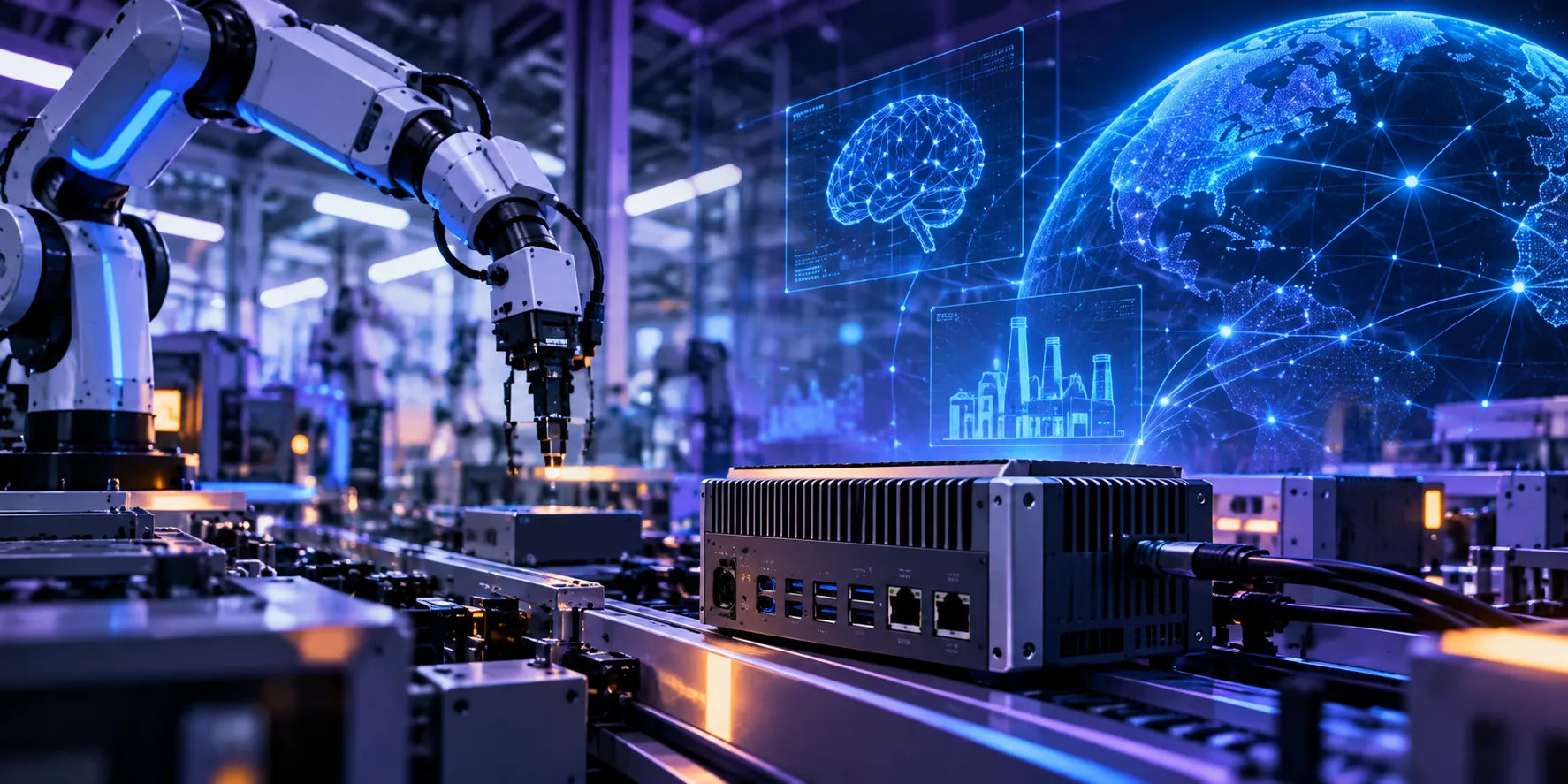
OMRON's $675 Million OnLogic Acquisition: How Physical AI Is Moving From the Cloud to the Factory Floor
OMRON Corporation has agreed to acquire U.S. industrial computer manufacturer OnLogic and its parent company, Interlogic, in a $675 million transaction aimed at accelerating the development of physical artificial intelligence (AI), industrial automation, and edge computing.
The agreement, signed on October 10, 2026, represents a strategic investment in bringing AI processing capabilities closer to machines, sensors, and production environments. Rather than relying exclusively on centralized cloud infrastructure, industrial companies are increasingly exploring systems capable of processing information and making decisions directly where operations take place.
According to OMRON's official acquisition announcement, the company intends to combine OnLogic's industrial computing hardware with its existing sensing, robotics, and precision control technologies.
The acquisition also highlights a broader transformation in computing infrastructure, with potential implications for artificial intelligence, decentralized physical infrastructure networks (DePIN), and blockchain-based computing ecosystems.
Quick Summary
Acquisition value: OMRON has agreed to acquire OnLogic and its parent company, Interlogic, for an enterprise value of $675 million.
Announcement: The agreement was signed on October 10, 2026, with OMRON's public announcement dated October 12, 2026.
Expected completion: Around January 2027, subject to regulatory approvals and other closing conditions.
Strategic objective: Combine industrial computers, robotics, sensing, and control systems to develop physical AI platforms.
Business continuity: OnLogic is expected to retain its brand, management team, and direct-to-customer business model.
Crypto relevance: The transaction illustrates growing commercial interest in distributed computing infrastructure, a technology category that also intersects with DePIN and decentralized AI projects.
What Is OMRON's $675 Million OnLogic Deal?
OMRON is a Japanese technology company established in 1933, specializing in automation, sensing, control systems, healthcare technology, and industrial equipment.
OnLogic, founded in 2003 and headquartered in South Burlington, Vermont, develops industrial computers designed for demanding operational environments. Its products support applications such as manufacturing automation, machine vision, data processing, and edge AI.
Under the agreement, OMRON will acquire Interlogic, Inc., the holding company that owns OnLogic and its subsidiaries, through a reverse triangular merger involving a newly established U.S. subsidiary.
The transaction is structured as a cash acquisition, primarily financed using OMRON's existing cash resources. Once completed, Interlogic will become a wholly owned subsidiary of OMRON.
| Category | Details |
|---|---|
| Acquirer | OMRON Corporation |
| Acquisition targets | Interlogic, Inc. and its subsidiaries, including OnLogic |
| Enterprise value | $675 million |
| Payment method | Cash |
| Agreement date | October 10, 2026 |
| Planned completion | Around January 2027 |
| Primary strategic focus | Physical AI, industrial edge computing, and factory automation |
| Ownership after closing | 100% |
OMRON also disclosed that Interlogic generated $154.2 million in consolidated net sales during 2025, compared with $122.3 million in 2024. Adjusted EBITDA reached $27.1 million in 2025.
These figures provide financial context for the acquisition, although the $675 million enterprise value should not be interpreted as a direct investment in AI software alone. The transaction includes an established industrial computing business, its commercial relationships, and its operational capabilities.
Why Is OMRON Investing in Physical AI?
Physical AI refers to artificial intelligence systems capable of interpreting information from the physical environment and supporting or controlling real-world actions. Unlike AI applications that primarily generate text, images, or software outputs, physical AI interacts with equipment, machines, robots, and sensors.
Examples include industrial robots adjusting their movements based on sensor feedback, computer vision systems identifying defective products, and automated production equipment responding to changing operating conditions.
OMRON's acquisition strategy reflects its ambition to expand beyond traditional factory automation equipment into integrated digital transformation and physical AI solutions.
Combining AI Computing With Industrial Automation
The acquisition is intended to combine several complementary technologies:
Industrial computing: OnLogic supplies configurable computers designed for industrial workloads and demanding operating conditions.
Sensing technologies: OMRON provides systems that collect information about machinery, production processes, and physical environments.
Precision control: OMRON's automation technologies support accurate and coordinated machine operations.
Robotics: Integrating local AI processing with robotics could enable more responsive automated systems.
Industrial data processing: Local computers can analyze operational information without requiring every calculation to be performed in a remote data center.
OMRON has identified the joint development of manufacturing-site digital transformation and physical AI solutions as a central objective of the acquisition.
How Does Edge Computing Move AI From the Cloud to the Factory Floor?
One of the most important technological themes behind the acquisition is edge computing, which involves processing data near the location where it is generated rather than transmitting all information to centralized servers.
Traditional cloud AI architectures often depend on remote infrastructure to perform computational tasks. This approach offers scalability and centralized management, but it can introduce network latency, bandwidth costs, connectivity dependencies, and data governance challenges.
Industrial environments may require faster responses and greater operational independence.
For example, a factory quality-control system analyzing images from a production line may benefit from identifying defects locally, particularly when immediate intervention is necessary.
Cloud AI vs. Edge AI
| Feature | Cloud AI | Edge AI |
|---|---|---|
| Processing location | Remote data centers | Local industrial devices or servers |
| Latency | Affected by network conditions | Can support low-latency processing |
| Connectivity | Often requires reliable external connectivity | Can perform selected tasks locally |
| Data transfer | May require substantial network bandwidth | Can reduce transmission of raw data |
| Scalability | Centralized resource scaling | Distributed hardware deployment |
| Typical applications | Large-scale model training and centralized analytics | Machine vision, local inference, and equipment monitoring |
These approaches are complementary rather than mutually exclusive. Industrial companies may use cloud infrastructure for model training and centralized analytics while deploying trained models locally for operational inference.
OnLogic has already emphasized practical edge AI deployments. In its June 2026 announcement for Automate 2026, the company highlighted localized physical AI and industrial computing solutions designed to address cloud latency, bandwidth costs, and deployment complexity.
What Does the Acquisition Mean for the AI Infrastructure Industry?
The acquisition demonstrates how established industrial automation companies are seeking greater control over the computing infrastructure required to deploy AI in physical environments.
OMRON's strategy is particularly relevant because industrial AI adoption depends on more than access to powerful AI models. Successful deployments also require reliable hardware, integration with existing equipment, appropriate cybersecurity controls, and systems capable of operating continuously.
Industrial AI Hardware Is Becoming Strategically Important
OnLogic develops computers designed for environments where conventional office hardware may be unsuitable. Industrial systems can require resistance to vibration, challenging temperatures, dust, and other operational conditions.
By acquiring an established industrial computing manufacturer, OMRON aims to strengthen its ability to deliver integrated solutions rather than relying entirely on external hardware suppliers.
Regional Expansion and Cross-Selling Opportunities
OMRON reported that more than 90% of OnLogic's sales originate in the Americas and Europe.
This geographical footprint creates opportunities for cross-selling industrial automation equipment and computing systems to existing customers.
OMRON also intends to support OnLogic's expansion through its established business infrastructure in Asia.
Physical AI Could Expand Industrial Automation Applications
Combining industrial computers with sensing and robotics technologies could support applications such as predictive maintenance, automated inspection, adaptive robotics, and intelligent manufacturing systems.
However, these potential applications should be distinguished from products already commercially available. OMRON's announcement outlines strategic development objectives rather than guaranteeing specific product launches or deployment timelines.
How Is Physical AI Connected to Cryptocurrency and Blockchain?
Although OMRON's acquisition is not a cryptocurrency transaction, it is relevant to the broader evolution of decentralized computing infrastructure.
Blockchain and AI projects increasingly explore ways to coordinate computational resources, verify machine-generated information, and create economic incentives for infrastructure providers.
The technological overlap is especially relevant to decentralized physical infrastructure networks (DePIN), which use blockchain-based coordination and incentives to organize real-world infrastructure or computing resources.
Importantly, edge computing is not inherently decentralized in the blockchain sense. A factory can operate locally distributed computers while retaining completely centralized ownership and control.
Nevertheless, the expansion of industrial edge computing may create opportunities for future systems combining physical infrastructure with decentralized coordination mechanisms.
Decentralized AI Computing and Gensyn (AI)
Gensyn is an example of a blockchain-oriented project focused on decentralized machine intelligence infrastructure.
Its approach involves coordinating computing resources and supporting the training, verification, and exchange of machine intelligence through decentralized systems.
Readers can explore the project through CoinW's AI token price page and the CoinW Research Institute's project insights, which include research into decentralized AI infrastructure.
Gensyn's decentralized computing model differs from OMRON's industrial automation strategy. The connection lies in the broader importance of distributed computational resources, not in any announced commercial relationship between the companies.
Bittensor (TAO) and Distributed Machine Intelligence
Bittensor (TAO) is another blockchain ecosystem associated with decentralized machine intelligence.
Bittensor uses a network of specialized subnets and incentive mechanisms to support different forms of machine intelligence and computational services.
Unlike OMRON's acquisition, which focuses on industrial hardware and automation integration, Bittensor explores how decentralized networks can coordinate and reward contributions to AI-related services.
Market participants interested in the decentralized AI sector can follow the Bittensor (TAO) price on CoinW.
Render (RENDER) and Distributed GPU Computing
Render (RENDER) is a decentralized GPU computing network associated with rendering workloads and the broader use of distributed graphics processing resources.
GPU infrastructure is important for many AI workloads, including model inference, training, and computer vision.
Render's infrastructure model differs from industrial edge computing because its primary network functions and target applications are not equivalent to factory automation systems.
However, both sectors illustrate the increasing importance of accessing computational capacity beyond traditional centralized cloud arrangements.
Readers can monitor the RENDER token price alongside other AI infrastructure assets.
What Other Decentralized AI Projects Are Relevant?
Several blockchain projects explore different components of decentralized computing, including AI inference, computational resource allocation, and infrastructure coordination.
| Project | Primary Focus | Connection to Distributed Computing |
|---|---|---|
| Gensyn (AI) | Decentralized machine intelligence infrastructure | Coordinates computational resources and verification |
| Bittensor (TAO) | Decentralized AI services and incentives | Supports specialized AI subnets |
| Render (RENDER) | Distributed GPU rendering and computing | Coordinates access to GPU resources |
| Chutes | Decentralized AI inference | Provides distributed model inference infrastructure |
CoinW Research Institute has examined Chutes in its report Chutes: Reconstructing the Decentralized Serverless Infrastructure for Web3 and AI Inference.
The report explores how distributed computing resources can support AI inference through a decentralized serverless model.
These projects should not be interpreted as direct beneficiaries of the OMRON transaction. No partnership, investment, or integration between OMRON and these blockchain ecosystems has been established by the acquisition announcement.
Could Edge AI Change the Economics of Cloud Computing?
The expansion of edge AI could influence how businesses distribute computational workloads between centralized data centers and local infrastructure.
Cloud platforms remain important for large-scale training, centralized data storage, software management, and workloads requiring substantial computational capacity.
However, certain industrial applications may achieve operational advantages by processing information closer to the equipment generating it.
Potential Benefits of Edge AI
Reduced latency: Local processing can eliminate some of the network delays associated with remote computation.
Lower bandwidth requirements: Processing raw data locally may reduce the amount of information transmitted to remote infrastructure.
Operational resilience: Selected systems may continue functioning when external connectivity becomes unavailable.
Data governance: Local processing can help organizations control where sensitive operational information is handled.
Real-time automation: Local inference can support applications requiring rapid interpretation of sensor information.
These advantages depend on workload requirements, system architecture, hardware capabilities, and deployment costs. Edge computing does not automatically reduce total operating expenses or outperform centralized cloud systems.
CoinW Academy has also explored the changing economics of computational infrastructure in From Mining to Hashrate Centers: AI Is Becoming the Bitcoin Killer, which examines how AI demand is influencing the use of energy and computing infrastructure traditionally associated with cryptocurrency mining.
What Are the Risks and Challenges of Physical AI Adoption?
Despite its potential, the transition toward industrial physical AI introduces technical, operational, and financial challenges.
Hardware and Integration Costs
Deploying industrial AI can require specialized computing equipment, sensors, networking infrastructure, and software integration. Organizations must evaluate whether productivity improvements justify these investments.
Cybersecurity and Operational Safety
Connecting AI systems to industrial equipment creates additional security considerations. Unauthorized access, compromised software, or incorrect automated decisions can have consequences beyond ordinary data-processing errors.
Safety-critical systems therefore require appropriate testing, access controls, monitoring, and operational safeguards.
AI Model Reliability
AI models may produce incorrect predictions or behave unpredictably when operating conditions differ from their training environments.
Industrial deployments must account for model validation, changing environmental conditions, and appropriate human oversight.
Acquisition and Execution Risks
OMRON's acquisition remains subject to regulatory approvals and customary closing conditions.
Even after completion, integrating hardware capabilities with existing automation products will require successful engineering, commercial execution, and coordination between the companies.
What Does OMRON's Acquisition Mean for AI Crypto Tokens?
OMRON's $675 million acquisition provides evidence of corporate investment in industrial computing and physical AI infrastructure. However, it does not establish a direct financial relationship with AI-related cryptocurrencies.
For cryptocurrency market participants, the development is relevant primarily as an indicator of broader technological demand for computing hardware, AI inference, and distributed infrastructure.
Projects associated with decentralized AI and computing may attract attention as these technologies become more prominent, but their token performance depends on factors such as network adoption, token utility, supply dynamics, liquidity, and overall market conditions.
Readers interested in comparing AI-related crypto assets can follow crypto live prices on CoinW.
Corporate investment in physical AI should not be treated as a prediction of cryptocurrency price appreciation. Industrial edge computing and decentralized blockchain infrastructure remain distinct markets with different commercial models.
Future Outlook: What Happens Next for OMRON and OnLogic?
The next major milestone is the expected completion of the acquisition around January 2027.
Following closing, OMRON intends to maintain OnLogic as an independently operated business within its corporate group, preserving the OnLogic brand and its direct sales model.
OMRON also expects OnLogic's existing management team, including CEO Sean Larkin, to remain in place.
The longer-term strategy centers on combining OnLogic's industrial computing expertise with OMRON's automation portfolio to develop physical AI platforms and expand international sales opportunities.
OMRON stated that the acquisition is expected to have an immaterial impact on its consolidated financial results for the fiscal year ending March 2027.
Future developments worth monitoring include the completion of regulatory approvals, new integrated hardware and software offerings, commercial adoption of physical AI systems, and OMRON's progress in expanding its manufacturing-site digital transformation business.
FAQs
How much is OMRON paying for OnLogic?
OMRON has agreed to acquire OnLogic and its parent company, Interlogic, in a transaction with an enterprise value of $675 million. The acquisition will be paid for in cash, primarily using OMRON's existing funds.
Why is OMRON acquiring OnLogic?
OMRON wants to combine OnLogic's industrial computing technology with its sensing, control, and robotics capabilities to accelerate the development of physical AI and manufacturing-site digital transformation solutions.
When will OMRON complete the OnLogic acquisition?
The transaction is expected to close around January 2027, subject to regulatory approvals and other closing conditions.
What is physical AI in manufacturing?
Physical AI refers to artificial intelligence systems that interpret real-world information and support actions involving machinery, robots, sensors, and other physical equipment. Manufacturing applications can include quality inspection, predictive maintenance, and intelligent robotics.
What is the difference between edge AI and cloud AI?
Edge AI processes information on local devices or nearby computing systems, while cloud AI relies on remote data centers. Edge AI can reduce network latency and support local operations, whereas cloud infrastructure often provides greater centralized computational capacity and scalability.
Does OMRON's acquisition involve cryptocurrency?
No. OMRON's acquisition is a corporate transaction involving industrial computing companies. The official announcement does not identify any cryptocurrency investment, blockchain integration, or partnership with decentralized AI token projects.
Which cryptocurrencies are associated with decentralized AI computing?
Examples include Bittensor (TAO), Gensyn (AI), and Render (RENDER). These projects explore different aspects of decentralized machine intelligence, computational coordination, and distributed GPU infrastructure. They are not announced participants in the OMRON acquisition.
Conclusion
OMRON's $675 million agreement to acquire OnLogic represents a significant strategic move toward physical AI and industrial edge computing.
By combining industrial computing hardware with sensing, robotics, and precision control technologies, OMRON aims to develop systems capable of bringing more AI functionality directly into manufacturing environments.
The transaction also reflects a broader shift in how AI infrastructure is being deployed. Centralized cloud computing will continue to play an important role, but industrial applications increasingly require local processing, reliable hardware, and integration with physical equipment.
For the cryptocurrency industry, the development provides useful context for understanding the growing importance of distributed computing and decentralized AI infrastructure. However, the commercial opportunities created by physical AI should be evaluated separately from the investment prospects of individual crypto tokens.
References / Sources
-
OnLogic — Official Website and Industrial Computing Solutions
OnLogic — Practical Physical AI and Industrial Edge Solutions at Automate 2026
OnLogic — Siemens and OnLogic Industrial Edge Partnership (2026)
OnLogic — The Edge AI Deployment Roadmap
CoinW Research Institute — Chutes: Decentralized Serverless Infrastructure for Web3 and AI Inference
CoinW Academy — From Mining to Hashrate Centers: AI Is Becoming the Bitcoin Killer