Uniswap v4 Launches Aggregator Hooks Across Three Blockchain Networks
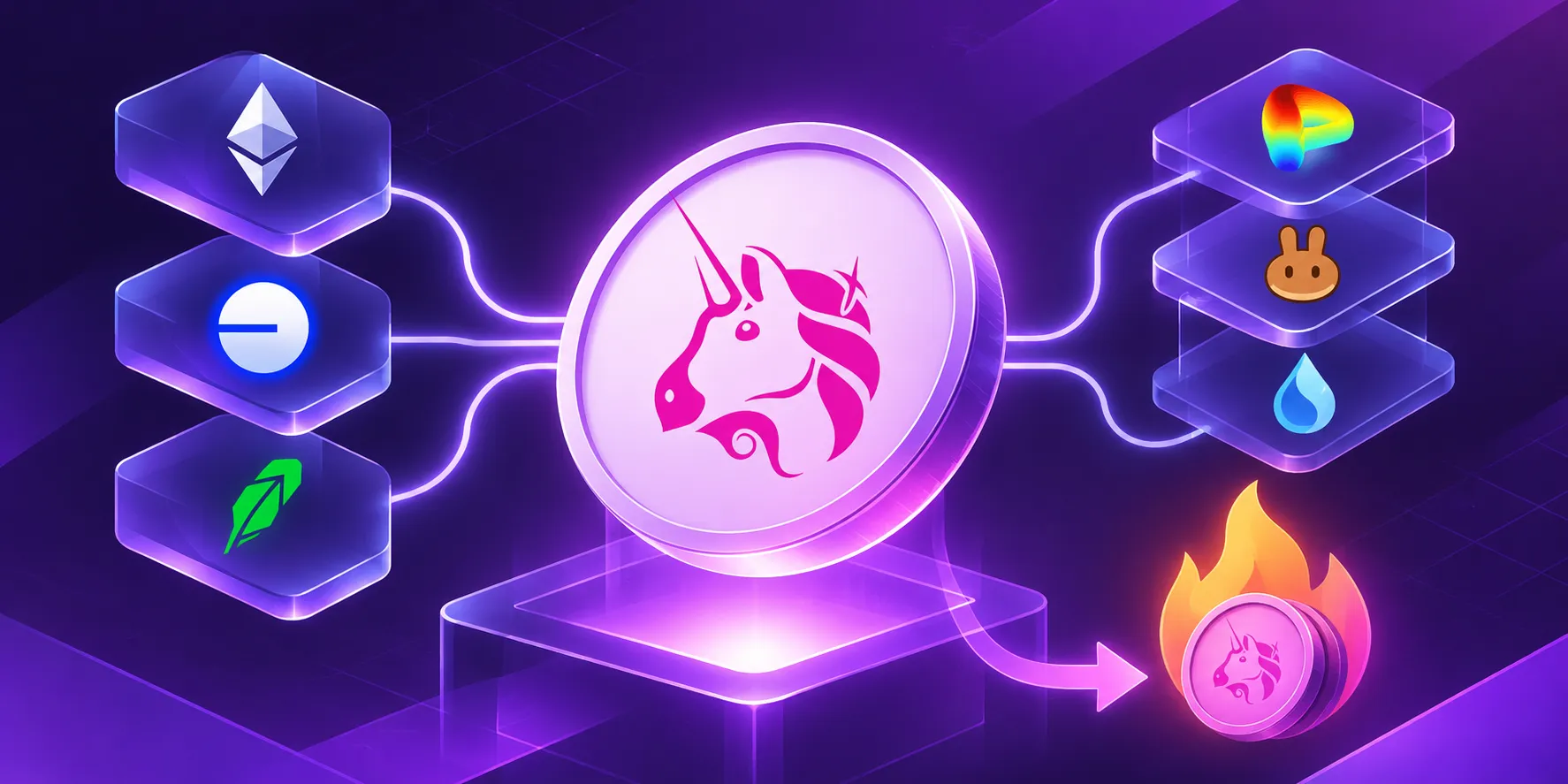
Uniswap Labs has launched Aggregator Hooks for Uniswap v4, enabling the decentralized exchange (DEX) to access external liquidity across Ethereum mainnet, Base, and Robinhood Chain. Announced on October 22, 2026, the upgrade allows Uniswap to incorporate liquidity from other decentralized trading protocols directly into its routing infrastructure.
According to the official Uniswap Labs announcement, seven external liquidity sources were supported at launch, collectively covering more than 90% of decentralized exchange activity across the three networks. Aggregator Hooks are available through the Uniswap Web App and API.
The development represents an important change in decentralized trading infrastructure. Rather than relying exclusively on its native liquidity pools, Uniswap v4 can now aggregate liquidity from external protocols while maintaining a unified transaction experience.
Quick Summary
Launch date: October 22, 2026.
Supported networks: Ethereum mainnet, Base, and Robinhood Chain.
External liquidity: Seven sources supported at launch, representing more than 90% of DEX activity across the supported networks, according to Uniswap Labs.
Trading functionality: Aggregator Hooks allow Uniswap v4 to incorporate external liquidity into swap routing and execute the selected route within a single transaction.
UNI token economics: Swaps routed through external liquidity sources pay protocol fees that contribute to UNI token burns.
Availability: The functionality is integrated into the Uniswap Web App and accessible to developers through the Uniswap API.
What Are Uniswap v4 Aggregator Hooks?
Aggregator Hooks are smart contract integrations that allow Uniswap v4 to access liquidity from external decentralized exchanges as though those sources were native Uniswap liquidity pools.
Uniswap v4 introduced hooks as a mechanism for extending the functionality of individual liquidity pools. These external smart contracts can execute customized logic at specific stages of pool operations, including before or after swaps.
The official Uniswap v4 developer documentation explains that hooks enable developers to implement specialized trading mechanisms, customized fees, and additional liquidity management features.
Aggregator Hooks apply this architecture to liquidity aggregation. Each hook wraps an external liquidity source, allowing Uniswap's routing infrastructure to recognize and interact with it as a v4 pool.
This means that Uniswap can consider liquidity distributed across multiple decentralized trading protocols when constructing a swap route, rather than limiting execution to liquidity already held in its own pools.
How Do Uniswap Aggregator Hooks Work?
Aggregator Hooks connect external liquidity sources to Uniswap v4 through smart contracts that make those sources accessible to compatible routers.
According to Uniswap Labs, the routing system retrieves updated quotes from connected sources every block. When a user initiates a swap, the router evaluates available liquidity across Uniswap pools and external sources to construct an efficient execution route.
External Liquidity Integration
Each Aggregator Hook acts as an interface between an external liquidity source and Uniswap v4. The external source is represented as a compatible pool, enabling the routing system to include it when evaluating available trading paths.
This approach extends Uniswap's liquidity reach without requiring every external protocol to migrate its liquidity into native Uniswap pools.
Real-Time Quote Comparison
The routing system obtains updated quotes from connected liquidity sources on a block-by-block basis. It can then compare available execution paths using both native and external liquidity.
Access to additional sources may improve execution quality, particularly when liquidity is fragmented across different protocols. However, better execution is not guaranteed for every transaction, since results depend on liquidity depth, fees, gas costs, and market conditions.
Single-Transaction Settlement
Once a route has been selected, the complete swap can settle in a single blockchain transaction.
Uniswap Labs states that the integration does not require additional token approvals beyond those already needed for the existing swap process.
This reduces the need for users to manually navigate between decentralized exchanges when seeking liquidity from different protocols.
Which Blockchain Networks Support Aggregator Hooks?
The October 2026 launch introduced Aggregator Hooks across three blockchain environments: Ethereum mainnet, Base, and Robinhood Chain.
| Network | Aggregator Hooks Support | Access |
|---|---|---|
| Ethereum Mainnet | Live | Web App and API |
| Base | Live | Web App and API |
| Robinhood Chain | Live | Web App and API |
Ethereum provides the established smart contract ecosystem in which Uniswap originated. Its extensive decentralized finance infrastructure makes liquidity aggregation particularly relevant for trading pairs distributed across multiple protocols.
Base, an Ethereum Layer-2 network, provides another environment where decentralized trading applications can benefit from access to multiple liquidity sources.
Robinhood Chain is also included in the rollout, extending the aggregation architecture to another blockchain environment.
The integration operates within each supported network. It should not be confused with cross-chain bridging, which involves transferring assets between separate blockchain networks.
Readers interested in the underlying Ethereum ecosystem can explore Ethereum (ETH) market information on CoinW.
Which External DEX Liquidity Sources Are Integrated?
Uniswap Labs confirmed that seven external liquidity sources were available at launch, covering more than 90% of decentralized exchange activity across the three supported networks.
The supported liquidity infrastructure includes integrations involving established decentralized trading systems such as Curve, Fluid, PancakeSwap V3, and other compatible liquidity mechanisms.
These integrations allow Uniswap's routing infrastructure to evaluate liquidity beyond its own automated market maker pools.
Importantly, the reported 90% coverage represents the scope of DEX activity covered by the connected sources, according to Uniswap Labs. It does not mean that Uniswap controls 90% of liquidity or that every trading pair can access the same execution depth.
Actual liquidity availability varies according to the blockchain network, token pair, connected protocols, and prevailing market conditions.
How Aggregator Hooks Affect UNI Token Burns
One of the most significant economic aspects of the upgrade is its connection to the Uniswap (UNI) token burn mechanism.
Uniswap Labs explains that swaps routed through external liquidity sources pay protocol fees, which contribute to UNI burns.
This creates a mechanism through which trading activity originating from liquidity outside native Uniswap pools can contribute to the protocol's token economics.
The approach builds on the UNIfication proposal, which outlined a broader strategy for protocol fees, token burns, and the expansion of Uniswap's liquidity infrastructure.
Under this strategy, Aggregator Hooks serve two related purposes: expanding the liquidity accessible through Uniswap and allowing eligible trading activity to contribute protocol fees.
UNI burns permanently reduce the number of tokens in circulation when executed. However, the introduction of a burn mechanism does not guarantee that UNI's market price will increase.
The actual economic impact depends on trading volume, applicable protocol fees, the quantity of UNI burned, and broader market demand.
Traders following these developments can monitor the Uniswap (UNI) price and market data on CoinW to evaluate how the token performs as the aggregation infrastructure develops.
Why the Upgrade Matters for Decentralized Finance
The introduction of Aggregator Hooks reflects a broader shift toward connecting fragmented decentralized liquidity through unified trading infrastructure.
Historically, decentralized exchanges have competed to attract liquidity into their own pools. Specialized DEX aggregators emerged to search across multiple trading venues and identify favorable execution routes.
With Aggregator Hooks, Uniswap v4 incorporates aggregation functionality directly into its protocol architecture.
Reduced Liquidity Fragmentation
Liquidity fragmentation occurs when trading capital is distributed across multiple decentralized exchanges, reducing the amount available through any single trading venue.
By connecting external sources, Uniswap can evaluate a wider selection of liquidity without requiring users to visit each protocol individually.
Potential Improvements in Swap Execution
Access to more liquidity sources may help routers identify favorable execution paths, potentially reducing price impact or slippage for certain trades.
These benefits depend on the characteristics of each transaction. Gas costs, market volatility, available pool depth, and execution fees can affect the final result.
Expanded Developer Integration Opportunities
Developers integrating the Uniswap API can access Aggregator Hooks without building separate connections to every external liquidity source themselves.
This may simplify the development of decentralized trading interfaces, wallet swap features, and applications requiring access to multiple liquidity venues.
Greater Competition Among DEX Aggregators
By introducing aggregation into its own infrastructure, Uniswap expands beyond its traditional role as an automated market maker.
The development could increase competition between decentralized exchanges and independent liquidity aggregators, particularly where execution quality and access to liquidity are major factors influencing user adoption.
What Are the Risks and Limitations of Aggregator Hooks?
Although Aggregator Hooks expand trading functionality, their implementation introduces considerations that users and developers should evaluate.
Smart contract risk: Routing through external protocols creates dependencies on additional smart contracts, which may contain vulnerabilities.
Execution uncertainty: Quotes can change between route calculation and transaction settlement because of market movements or changes in available liquidity.
Gas costs: More complex execution routes may introduce additional transaction costs, depending on the network and contracts involved.
External protocol dependencies: Problems affecting connected liquidity sources could influence routing availability or execution.
Token market volatility: Expanded aggregation functionality does not eliminate price volatility or guarantee favorable trading conditions.
Economic uncertainty: Increased protocol fee generation and UNI burns do not necessarily translate into positive token price performance.
Users should review transaction details, network fees, slippage settings, and the relevant smart contract risks before executing decentralized swaps.
How to Access Uniswap v4 Aggregator Hooks
Aggregator Hooks are incorporated automatically into supported swaps through the Uniswap Web App.
Users can access the official Uniswap trading interface, connect a compatible wallet, select a supported network, and request a token swap.
When available and appropriate for the selected trade, external liquidity sources can be considered by the routing infrastructure without requiring the user to manually select individual decentralized exchanges.
Developers can also incorporate this functionality through the Uniswap API on Ethereum mainnet, Base, and Robinhood Chain.
For traders interested in Uniswap's governance token rather than interacting directly with decentralized liquidity pools, CoinW provides a spot trading market that includes UNI/USDT.
Users can also follow crypto live prices to compare UNI, ETH, and other cryptocurrency market movements.
FAQs About Uniswap v4 Aggregator Hooks
What are Uniswap v4 Aggregator Hooks?
Aggregator Hooks are smart contract integrations that allow Uniswap v4 to incorporate liquidity from external decentralized exchanges into its swap routing infrastructure.
When did Uniswap launch Aggregator Hooks?
Uniswap Labs announced the launch of Aggregator Hooks on October 22, 2026, with support for Ethereum mainnet, Base, and Robinhood Chain.
Which blockchains support Uniswap Aggregator Hooks?
The initial launch supports Ethereum mainnet, Base, and Robinhood Chain through the Uniswap Web App and API.
Do Aggregator Hooks reduce trading fees?
Aggregator Hooks expand the liquidity sources available for routing and may improve execution for certain trades. However, they do not guarantee lower trading fees or reduced total transaction costs.
How do Aggregator Hooks affect UNI token supply?
Swaps routed through external liquidity sources pay protocol fees that contribute to UNI token burns. These burns can reduce circulating token supply, although their impact depends on actual trading activity and fee generation.
Do users need additional token approvals?
According to Uniswap Labs, Aggregator Hooks do not introduce additional approval requirements beyond the existing swap process. Standard wallet permissions and token approvals may still be required.
Can Aggregator Hooks execute cross-chain swaps?
The announced functionality aggregates liquidity within supported blockchain networks. It does not, by itself, provide cross-chain bridging between Ethereum, Base, and Robinhood Chain.
Future Outlook for Uniswap v4 and DEX Aggregation
The launch of Aggregator Hooks marks an expansion of Uniswap's role within decentralized finance, combining automated market making with access to external liquidity sources.
Uniswap Labs reports that the protocol has facilitated more than $4.5 trillion in cumulative swaps, illustrating the scale of its existing trading infrastructure.
By extending routing beyond native pools, Uniswap aims to strengthen its position as a liquidity access layer for decentralized trading applications.
The longer-term impact will depend on adoption by traders and developers, execution quality, the reliability of external integrations, and the amount of trading activity contributing to protocol fees.
For UNI, the upgrade also establishes another connection between protocol usage and token burns. Nevertheless, the relationship between burns, token supply, and market valuation remains dependent on broader economic conditions.
As decentralized trading infrastructure evolves, the ability to access multiple liquidity venues through a unified protocol may become increasingly important for both retail users and institutional applications.
Conclusion
Uniswap v4 Aggregator Hooks expand decentralized trading by connecting external DEX liquidity across Ethereum mainnet, Base, and Robinhood Chain. The upgrade allows the protocol to evaluate a wider range of liquidity sources, execute selected routes in a single transaction, and generate protocol fees that contribute to UNI token burns.
While the integration may improve liquidity access and trading efficiency, its practical benefits depend on market conditions, execution costs, and the performance of connected protocols.
The development represents an important step in Uniswap's evolution from a decentralized exchange centered on native liquidity pools toward a broader onchain liquidity aggregation infrastructure.
References / Sources