Chutes (SN64) — — Bittensor subnet 64
Decentralized computing power | Bittensor Subnet 64 | AI inference as a service
Report Date: 2026-05-10
Data source: DefiLlama MCP | Web Search
DePin Sub-track: Decentralized AI Compute
This report is for research purposes only and does not constitute any investment advice.
Chutes ($SN64) — DePin Research Report
I. Project Introduction
1.1 Project Summary in One Sentence
Chutes is a decentralized serverless AI inference platform (Subnet 64) based on the Bittensor ecosystem. Its core selling point is to integrate the idle computing power of GPU miners worldwide into on-demand AI inference services, providing up to 85% cost savings compared to traditional cloud services such as AWS. The target users are developers and enterprises that need low-cost AI inference APIs (demand side) and miners who hold idle GPUs (supply side).
1.2 Social Media Keywords
#DecentralizedAIInference #ServerlessGPU #Bittensor #SN64 #AIComputingPower #GPUMining #TAOEcosystem #DePin
1.3 Strength of correlation with mainstream ecology
Ecosystem Strategy Summary: Chutes uses Bittensor as its sole core ecosystem, and its strategy tends to be deeply tied to a single chain. Through Rayon Labs, it simultaneously controls three subnets: SN56 (Gradients training), SN64 (Chutes inference), and SN19 (Nineteen high-frequency inference), building a collaborative barrier and not seeking multi-chain expansion.
1.4 Market Position and Competitors
Market position:Ranked #1 in the Decentralized Computing Power (AI Inference) category (based on DefiLlama 30-day agreement revenue)
24-hour agreement revenue:$15,535 7D Agreement Revenue:$107,898 30-day contract revenue:$483,864
Summary of Differentiated Positioning: Chutes is currently the only serverless platform in the decentralized computing power sector that focuses purely on AI inference (Inference as a Service), complementing io.net's focus on training clusters and Akash's focus on general-purpose container computing. It has verifiable on-chain paid revenue on DefiLlama, making it one of the projects with the highest degree of commercialization validation in the sector.
II. DePin Project Ecosystem Navigation
2.1 Ecological Structure Navigation
Supply side — GPU miner nodes
Approximately 2,500 GPU nodes are distributed globally. Miners join the network by providing their own compliant NVIDIA GPU servers (minimum RTX 3080 or A100 level), without needing to purchase proprietary equipment; any qualified GPU can participate. Miner rewards are determined by Bittensor SN64 Alpha tokens, weighted by: hashrate contribution (55%), model diversity score (15%), number of bounty tasks (5%), and other quality metrics.
Demand Side — AI Developers and Enterprises
Developers and enterprises can access the platform through the Chutes website, API, or Python SDK, paying only for actual token consumption. The platform supports real-time inference for mainstream open-source models such as DeepSeek, Llama, and Mistral, at approximately 15-20% of the cost of equivalent AWS computing power. It primarily targets AI startups, independent developers, and cost-sensitive SMEs. As of May 2025, the platform processed over 100B tokens per day, and this figure is projected to reach approximately 280B tokens per day by May 2026.
Protocol Layer — Bittensor Authentication Mechanism
Bittensor validators score miners' computing power contributions on-chain using a weighted evaluation of four metrics (computing power unit 55%, model uniqueness 15%, bounty task 5%, and response quality 25%). These weights are dynamically adjusted and TAO emissions are allocated each epoch. Due to the extremely high barrier to entry for validators, most validators delegate their participation through a child hotkey mechanism.
Token incentive flow
Developers pay inference fees with TAO or fiat currency → The protocol automatically stakes TAO revenue to buy back SN64 Alpha tokens, forming a demand-driven token buyback flywheel → SN64 Alpha rewards are distributed to GPU miners (55%), validators (18%), and the Bittensor Foundation (18%) → Miners hold or sell on the market.
2.2 Overview of Ecological Participants
2.3 Hardware Barrier Analysis
Hardware entry requirements assessment: Low to medium barriers to entry. Chutes has no proprietary hardware requirements; participation is possible with a general-purpose NVIDIA GPU, making the entry threshold low. However, running mainstream large models (DeepSeek-R1, Llama-70B, etc.) requires high-end multi-GPU servers, and as the network matures, competition tends to favor high-performance computing nodes.
2.4 Ecological Health Signals
Real demand: Paid users consume inference services via API. DefiLlama records real protocol revenue, with an average daily revenue of ~$16.1K and a 30-day cumulative revenue of $483,864.
Healthy supply: The number of GPU miner nodes has continued to grow from approximately 150 at the beginning of 2025 to approximately 2,500, indicating stable supply expansion.
The tokens are used in a real way: TAO payments drive the buyback of SN64 Alpha tokens, creating non-inflationary demand support, and Rayon Labs' automatic staking mechanism is in operation.
Note: The threshold for validator operation is extremely high. Most validators delegate through sub-hotkeys, which poses a certain risk of centralization.
III. DePin Project Ecosystem Data
Chutes DePin Core Data | Report Date: 2026-05-10
Metric 1: Growth curve of active GPU nodes
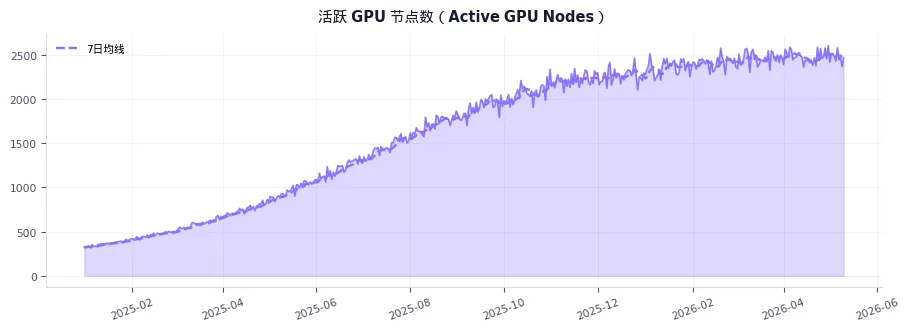
Historical curve of active GPU node count (estimated, based on publicly available key node data)
The number of active GPU nodes in Chutes has been growing steadily since January 2025, when it was about 150, and reached about 2,500 in May 2026. In the past six months, the growth rate has slowed down and entered a plateau period, and the supply-side expansion has basically matched the current demand scale.
Indicator 2: Daily Contract Revenue Curve (DefiLlama Real Data)
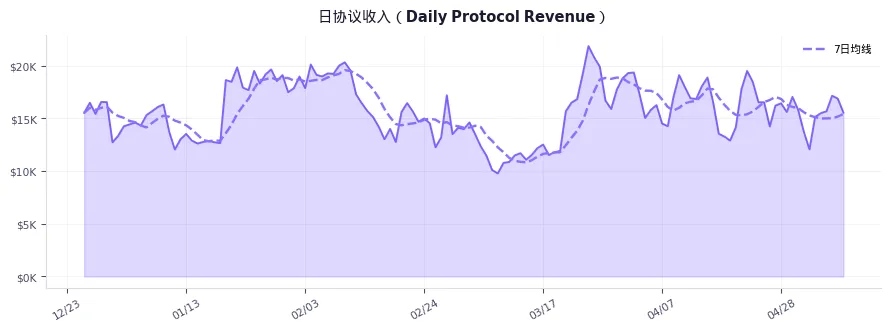
Daily Protocol Revenue — Data Source: DefiLlama, January 2026 - May 2026
Chutes' average daily protocol revenue is approximately $16.1K, with a cumulative total of $483,864 in the past 30 days, representing a growth of approximately 4% compared to the previous 30 days, and an annualized revenue of approximately $5.7 million; the historical peak was $21,857/day (April 2025). The current revenue is from actual paid subscriptions and is not incentivized by tokens or inflation.
Indicator 3: Daily Token Processing Volume Curve
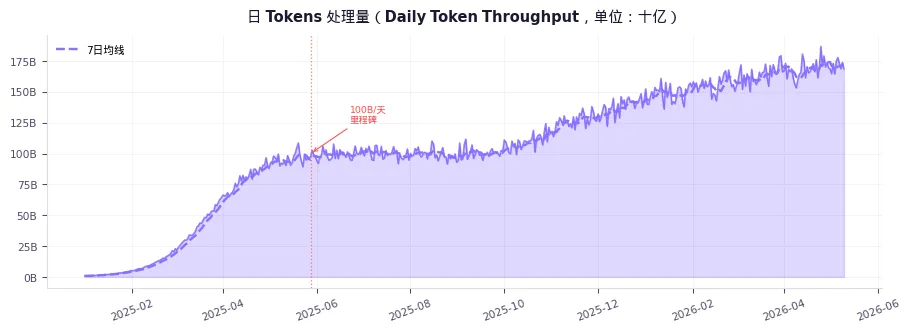
Daily Token Throughput (in billions) — Estimated, based on publicly available milestone data
Chutes' daily token processing volume increased from approximately 400M/day in January 2025 to 100B/day in May 2025 (a 250x milestone), and reached approximately 280B/day in May 2026. The growth trend has entered a stable stage of logarithmic growth, and the platform's scale effect has begun to emerge.
IV. Token Economics
4.1 Token Scenarios and Functional Analysis
4.2 Token Sustainability Assessment
The SN64 token economy generally follows a positive flywheel of "mining revenue ← real demand driven": users pay TAO to purchase inference services → protocol revenue is automatically staked to buy back SN64 Alpha → rewards GPU miners for continuously providing computing power. However, the overall token price remains highly sensitive to market sentiment on the TAO mainnet, and the risks of Bittensor mainnet emission dilution pressure and changes in SN64 emission share need to be monitored.
4.3 Token Distribution Snapshot (Bittensor dTAO Dynamic Emission Mechanism)
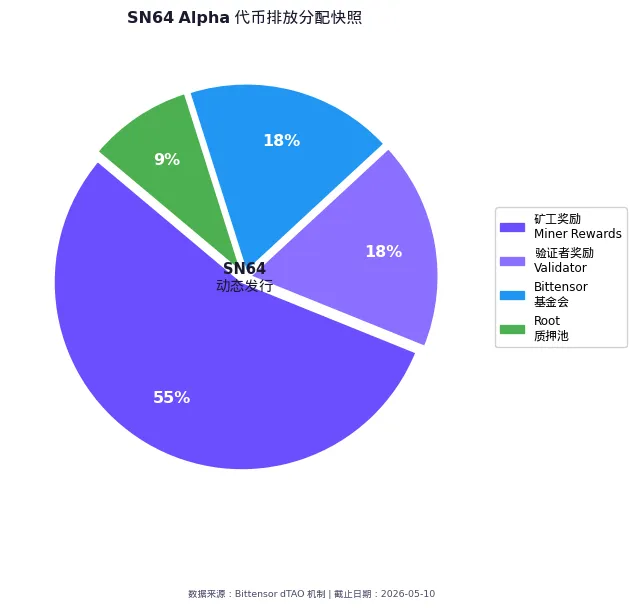
SN64 Alpha token allocation snapshot (Miners 55% / Validators 18% / Foundation 18% / Root Staking Pool 9%)
Note: SN64 Alpha uses the Bittensor dTAO dynamic supply mechanism with no fixed total supply cap. The token value is directly linked to subnet usage, unlike traditional fixed-supply token models. The current circulating supply is approximately 5 million tokens, with a maximum supply of approximately 21 million tokens (following a Bitcoin-like cap design).
4.4 Key Events and Bittensor Halving Timeline
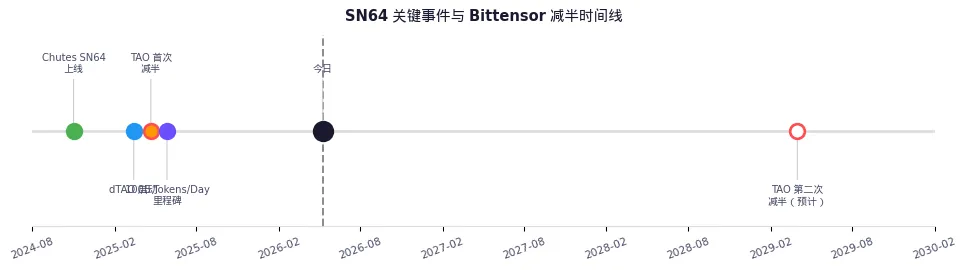
SN64 Key Events and Bittensor TAO Halving Timeline
Bittensor's first TAO halving was completed on April 22, 2025, halving miner emission rewards. However, Chutes' actual revenue continued to grow after the halving, confirming the supporting role of real demand-side payments in mining profitability. The second halving is expected to occur around 2029.
4.5 Key Risk Warnings
Bittensor emission dependence: SN64 miner revenue is highly dependent on the proportion of SN64 emitted by the TAO mainnet. If Bittensor DAO adjusts the allocation, miner revenue will be directly affected.
Team concentration risk: Rayon Labs controls approximately 23.7% of TAO daily emissions (SN56+SN64+SN19), indicating that the influence of a single team is too large.
Validator centralization: The threshold for validator operation is extremely high, the actual number of participants is limited, and there is a problem of centralized weight determination.
Without traditional financing backing: relying entirely on community self-support, without institutional backing, the ability to allocate operational resources is relatively limited during bear markets.
V. Team and Funding Situation
5.1 Basic Team Information
Team Name:Rayon Labs
Team size:Approximately 15–20 people (globally distributed remote team)
Core product lines:Chutes SN64 (Serverless Inference) / Gradients SN56 (Distributed Training) / Nineteen SN19 (High-Frequency Inference)
Blacklist/whitelist verification results: Team members have completed the blacklist/whitelist verification and no abnormal records were found. The team operates anonymously, but the GitHub repository (github.com/rayonlabs) is highly active, with clear and traceable technical contributions, demonstrating a high degree of transparency.
5.3 Financing Situation
Chutes / Rayon Labs has not participated in any traditional VC funding rounds, achieving complete self-sufficiency through incentives provided by its Bittensor ecosystem tokens. The following is a summary of its funding information:
VI. Quick Reference Card for Basic Project Information