Why Do Traders Still Lose Copying Smart Money? 3 On-Chain Data Mistakes
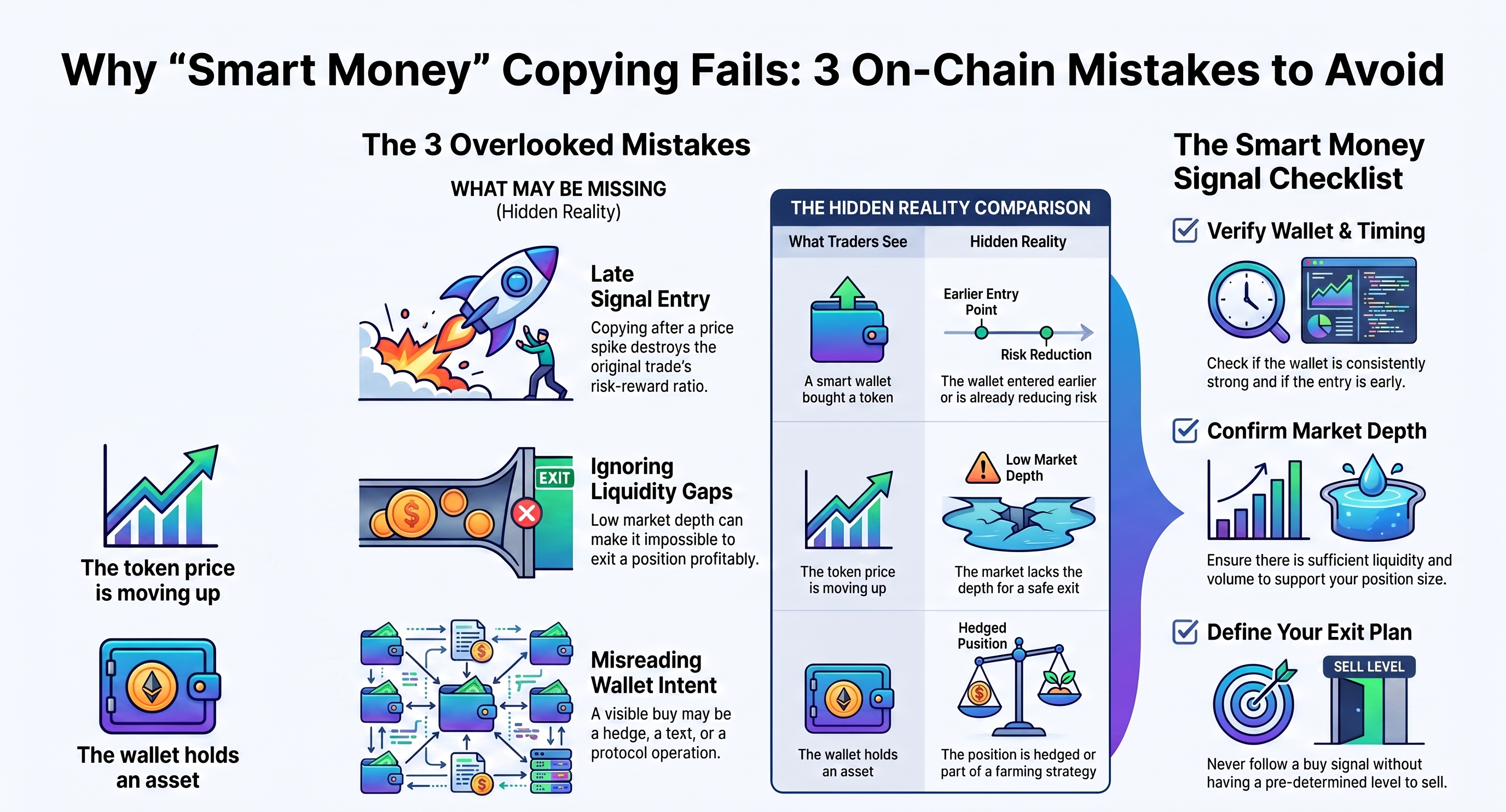
Why Do Some People Still Lose Copying Smart Money? 3 Overlooked On-Chain Data Mistakes
Losing with smart money copy usually happens when traders mistake on-chain visibility for certainty. Blockchain data can show wallet movements, token transfers, accumulation, and exchange flows, but it cannot always reveal hidden strategies, hedges, timing differences, or liquidity constraints.
Smart money copy trading can help users learn from experienced wallets, but it is not a guaranteed profit method. Many smart money losing cases happen because traders misread the data, copy too late, or ignore risk factors that are not obvious from a single transaction.
This guide explains three overlooked on-chain data mistakes, why they cause losses, and how traders can reduce data misinterpretation through better risk education.
Quick Summary
Smart money can be wrong, early, hedged, or operating with a different time horizon.
The most common losses come from copying late, ignoring liquidity, and misreading wallet intent.
On-chain data is useful, but it does not show the full strategy behind every transaction.
Better risk education helps users treat smart money signals as research inputs, not automatic trading instructions.
Why Copying Smart Money Can Still Lead to Losses
Copying smart money sounds logical: if experienced wallets are buying, retail traders may want to follow. However, the problem is that the visible transaction is only one part of the full trading picture.
A smart wallet may have entered earlier, received tokens through private allocation, used another wallet to hedge, or be preparing to exit while retail traders are still copying the buy signal. This is why misreading smart money signals can turn a useful clue into a losing trade.
| Late Signal
|
A smart wallet bought a token.
|
The wallet may have entered much earlier or may already be reducing risk.
|
| Liquidity Gap
|
The token price is moving upward.
|
The market may not have enough depth for safe entry or exit.
|
| Hidden Strategy
|
The wallet holds or buys an asset.
|
The wallet may be hedged, farming, testing, or using multiple addresses.
|
Mistake 1: Treating Every Smart Wallet Buy as an Entry Signal
The first mistake is assuming that every smart wallet buy is a signal to buy immediately. In reality, a transaction must be judged by timing, price, size, wallet history, and market context.
For example, a wallet may have accumulated a token quietly for weeks before retail users notice. If a trader copies only after the price has already moved sharply, the original smart money trade and the copied retail trade are no longer the same setup.
Why This Causes Losses
Retail traders may enter after most of the upside has already happened.
Smart wallets may already be preparing to distribute.
The copied trade may have a worse entry price and weaker risk-reward ratio.
How to Avoid It
Compare the wallet’s entry price with the current market price.
Check whether the wallet is still accumulating or already selling.
Avoid chasing trades after major price spikes or viral attention.
Mistake 2: Ignoring Liquidity Risk
The second mistake is ignoring liquidity. A smart money wallet may enter a small token early, when liquidity conditions are favorable. Retail traders who copy later may face slippage, wider spreads, or limited exits.
Liquidity risk matters because a trade can be directionally correct but still difficult to execute profitably. If the market is too thin, buying may move the price up and selling may push the price down.
Why This Causes Losses
Users may overpay when entering low-liquidity tokens.
Exits may become difficult during volatility.
Small markets can be more vulnerable to manipulation and sudden drawdowns.
How to Avoid It
Review trading volume, market depth, and slippage before entering.
Use smaller position sizes in thin markets.
Be cautious when smart money enters assets that are difficult for retail traders to exit.
Mistake 3: Misreading Wallet Intent
The third mistake is assuming that a wallet’s visible action reveals its full intention. On-chain data shows what happened, but not always why it happened.
A wallet may buy a token for many reasons: long-term conviction, short-term speculation, liquidity farming, arbitrage, hedging, testing a protocol, or preparing for an airdrop. Without context, traders may misread the signal.
Why This Causes Losses
A wallet may be hedged elsewhere, while the copier is fully exposed.
A position may be part of a broader strategy involving multiple wallets.
The visible transaction may be operational rather than directional.
How to Avoid It
Study the wallet’s broader history, not one transaction.
Check whether the wallet repeats similar behavior across assets.
Look for confirmation from multiple quality wallets and market data.
How to Read Smart Money Signals More Carefully
Smart money signals should be filtered before they become trading decisions. A stronger signal usually combines wallet quality, repeated accumulation, sufficient liquidity, and supportive market context.
| Is this wallet consistently strong?
|
One lucky trade does not prove smart money status.
|
| Is the signal early or late?
|
Late copying can destroy the original risk-reward setup.
|
| Is liquidity strong enough?
|
Poor liquidity can make profitable-looking trades difficult to exit.
|
| Are multiple wallets confirming the move?
|
Several quality wallets may provide stronger confirmation than one transaction.
|
| Do I have an exit plan?
|
Without an exit plan, traders may hold while smart money is already distributing.
|
Why Risk Management Matters More Than Perfect Signals
Even strong signals fail. Markets can reverse because of liquidity shocks, macro news, token-specific events, scams, or sudden changes in sentiment. That is why risk management matters more than finding a perfect wallet to copy.
Risk education teaches traders to control position size, avoid overexposure, define exit levels, and accept that no strategy wins every trade.
Token Examples: Why Market Context Matters
Smart money may track major assets such as Bitcoin, Ethereum, and USDT because they help reveal broader liquidity conditions and market risk appetite.
If major assets are weakening while a small token is receiving smart money inflows, the signal may still carry higher risk. If liquidity is improving across the market, the same signal may have a stronger context.
Common Smart Money Losing Cases
Late copy: a trader enters after the smart wallet already captured most of the move.
Low liquidity: the copied asset cannot support a clean exit.
Hidden hedge: the wallet is protected elsewhere, but the copier is not.
Wrong wallet label: the wallet looks important but has weak or inconsistent results.
No exit plan: the trader copies the buy but misses the sell signal.
Scam exposure: the trader follows wallet activity into unsafe tokens, phishing links, or manipulated markets.
How CoinW Users Can Apply Better Risk Education
CoinW users can use smart money signals as one part of a broader trading process. Before entering a trade, users should compare wallet activity with current market prices, volume, liquidity, personal risk tolerance, and platform security practices.
For users reviewing market opportunities, CoinW Academy resources and trading tools can support a more structured approach. The goal is not to copy every smart money movement, but to understand whether the signal fits a clear plan.
FAQs
Why do people still lose copying smart money?
People lose because they may copy too late, ignore liquidity risk, misunderstand wallet intent, overallocate, or follow signals without an exit plan.
What are the most common on-chain data mistakes?
The most common mistakes are treating every wallet buy as a signal, ignoring liquidity, and assuming visible transactions reveal the full strategy.
Can smart money wallets lose money?
Yes. Smart money wallets can lose money due to volatility, poor liquidity, incorrect assumptions, or unexpected market events.
What is data misinterpretation in smart money copy trading?
Data misinterpretation means reading on-chain activity incorrectly, such as assuming a wallet transfer means conviction buying when it may be a hedge, test, exit, or operational movement.
How can beginners reduce smart money copy risk?
Beginners can reduce risk by checking wallet history, avoiding late entries, reviewing liquidity, using small positions, and planning exits before entering trades.
Conclusion
Losing with smart money copy usually does not happen because on-chain data is useless. It happens because traders read the data too simply. A wallet movement is only a signal, not a complete strategy.
To avoid common smart money losing cases, traders need to understand timing, liquidity, wallet intent, and risk management. Smart money analysis works best when it supports disciplined decision-making instead of replacing it.
References / Sources
CoinW Academy: Follow Me! A Practical Manual for Copying Smart Money On-Chain
Nansen: How to Monitor Wallet Activity and Track Smart Money in Crypto
Nansen: How to Track Smart Money Crypto Accumulation
Nansen: Who Counts as Smart Money in Crypto?
Chainalysis: On-Chain User Segmentation Guide
Chainalysis: Crypto Crime Research
-
-
-