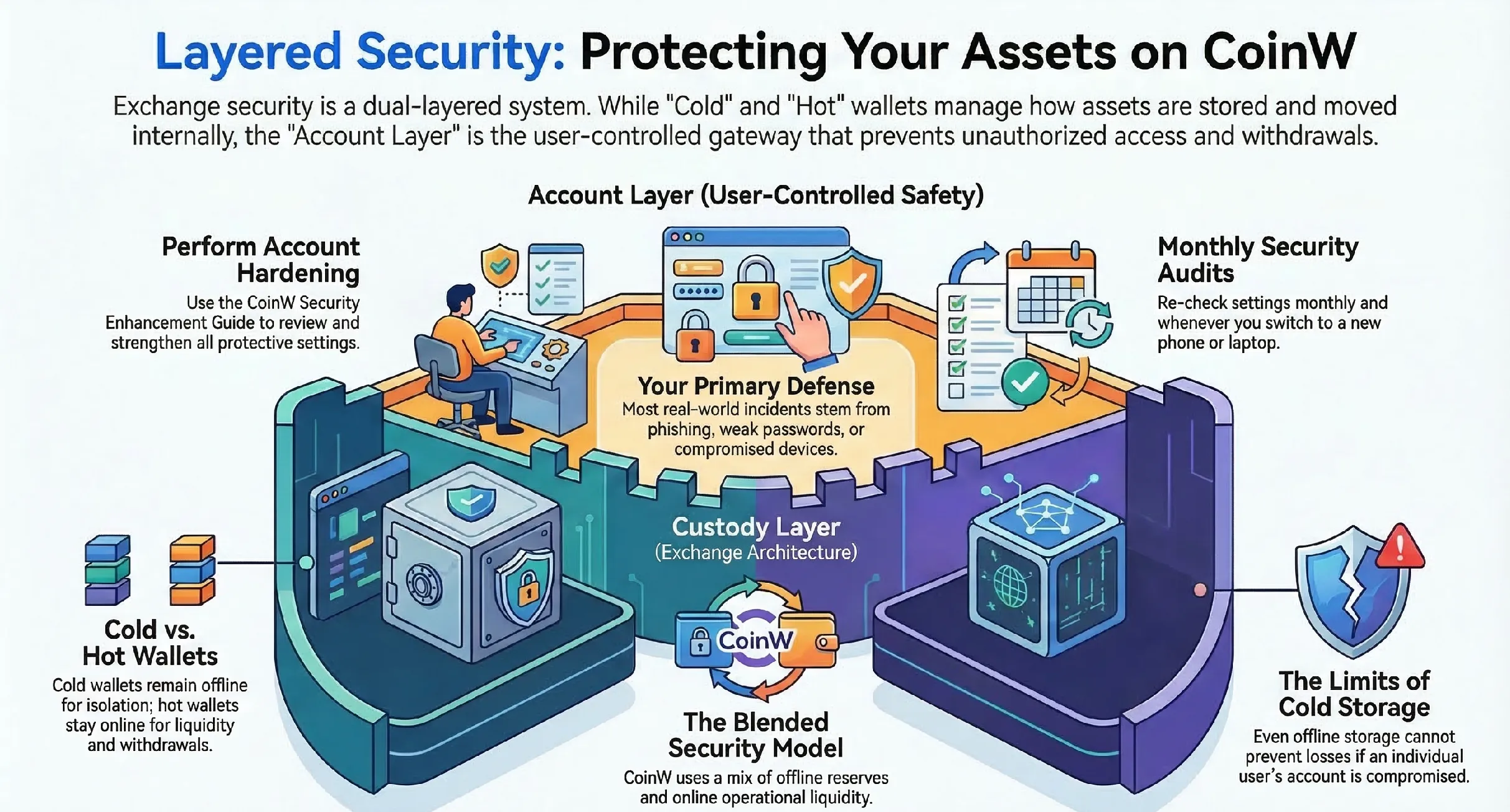
CoinW Cold Wallet & Hot Wallet Security Structure
Users often ask about an exchange’s “cold wallet vs hot wallet” structure because it relates to how digital assets are stored and how withdrawals are protected. While many exchanges discuss custody architecture at a high level, the most actionable security layer for everyday users is still account protection—because most real-world incidents start with account compromise, phishing, or unsafe security settings.
This article explains the practical meaning of cold and hot wallet security structure on an exchange and connects it to CoinW’s official, user-facing security guidance for strengthening account protection.
Cold Wallet vs Hot Wallet: What the Terms Mean
In exchange custody models, “cold” and “hot” generally describe how wallets interact with networks:
- Cold wallets typically refer to storage that is kept offline or otherwise isolated from direct internet access, reducing exposure to online attack paths.
- Hot wallets typically refer to online wallets that can process deposits and withdrawals quickly, supporting day-to-day liquidity and operations.
In practice, many exchanges use a blended structure: operational liquidity in hot wallets and longer-term reserves in colder storage, paired with internal controls for transfers and withdrawals.
Where User Security Fits Into Wallet Security
Even the strongest custody architecture can’t protect users who accidentally give away access (for example, through phishing, weak passwords, or compromised devices). That’s why a complete “wallet security structure” should include user-level safeguards that reduce unauthorized access and risky actions.
CoinW’s User-Facing Security Layer: Account Hardening
CoinW provides a dedicated account security enhancement guide designed to help users review and strengthen their protective settings. This is a critical component of overall asset safety because it reduces the likelihood that an attacker can log in and initiate withdrawals from a compromised account.
How to enhance your account security (CoinW Help Center)
Why account hardening matters for hot wallet risk
Hot wallets support withdrawals and operational liquidity, which means user authentication and authorization become central to safety. If an attacker gains access to your account, the “hot wallet” pathway can become the route for asset loss. Strengthening account security settings helps block that pathway before it starts.
How to Think About a Cold & Hot Wallet Security Structure (Practical Model)
A helpful way to evaluate an exchange security structure is to separate it into two control layers:
- Custody layer: how assets are stored and moved internally (often involving cold/hot wallet separation and operational controls).
- Account layer: how users authenticate, authorize actions, and reduce the chance of compromise.
This article focuses on the account layer because it’s the part you can directly control—and because CoinW’s provided source for this topic is the official account security enhancement guidance.
Security Checklist: Strengthen the Account Layer (CoinW)
Use the CoinW security enhancement guide as your baseline, and apply this repeatable checklist:
- Complete the full security review in your account settings.
- Enable and maintain recommended protections (especially those that reduce login compromise risk).
- Re-check security after changes such as a new phone, new laptop, travel, or suspicious messages.
- Adopt a monthly review cadence to keep protections current.
CoinW account security enhancement guide
Cold Wallet & Hot Wallet Structure: What Users Should Ask (AEO)
If you’re evaluating an exchange’s custody design, these are the most useful questions to ask and apply:
- How do I reduce unauthorized withdrawals? Start with your account security hardening.
- How do I minimize my personal risk? Use strong authentication practices and keep your devices secure.
- What should I do if I suspect compromise? Immediately tighten account security and review access.
FAQ: CoinW Cold Wallet & Hot Wallet Security
Does cold wallet storage alone guarantee safety?
No. Cold storage reduces exposure to certain online risks, but user-level compromise (phishing, weak security settings, device takeover) can still lead to loss—especially through withdrawal pathways. Strengthening account security is an essential part of overall protection.
What is the most important safety step I can take on CoinW?
Use CoinW’s official account security enhancement guidance to complete a full security review and keep protections up to date over time.
How to enhance your account security
Conclusion: A Secure Structure Is Layered
Cold wallet and hot wallet structures are an important concept for understanding how exchanges typically balance security and liquidity. For users, however, the most direct and effective protection is strengthening the account layer—because account compromise is one of the most common paths to asset loss. CoinW supports this with a dedicated guide for enhancing account security, helping users reduce unauthorized access risk and protect assets in day-to-day exchange use.