CoinW Security Risk Management Framework
A practical security risk management framework is not a single tool—it’s a repeatable process for reducing risk before incidents occur and maintaining strong protections as your devices, habits, and activity change. On CoinW, the most actionable part of this framework is user-driven account hardening: reviewing security settings, enabling recommended protections, and re-checking your posture regularly.
This article explains a user-focused “CoinW security risk management framework” using CoinW’s official guidance on strengthening account security settings.
How to enhance your account security (CoinW Help Center)
What Is a Security Risk Management Framework?
In simple terms, a security risk management framework is a cycle that helps you:
- Identify risks that could lead to unauthorized access or loss.
- Apply controls that reduce the likelihood and impact of incidents.
- Monitor and review so security doesn’t weaken over time.
- Respond quickly when something suspicious happens.
For most users, the highest-impact risks are account takeover attempts caused by phishing, reused passwords, compromised devices, or unsafe login behavior. That’s why account hardening sits at the center of a practical framework.
CoinW’s User-Focused Framework: A Repeatable Security Cycle
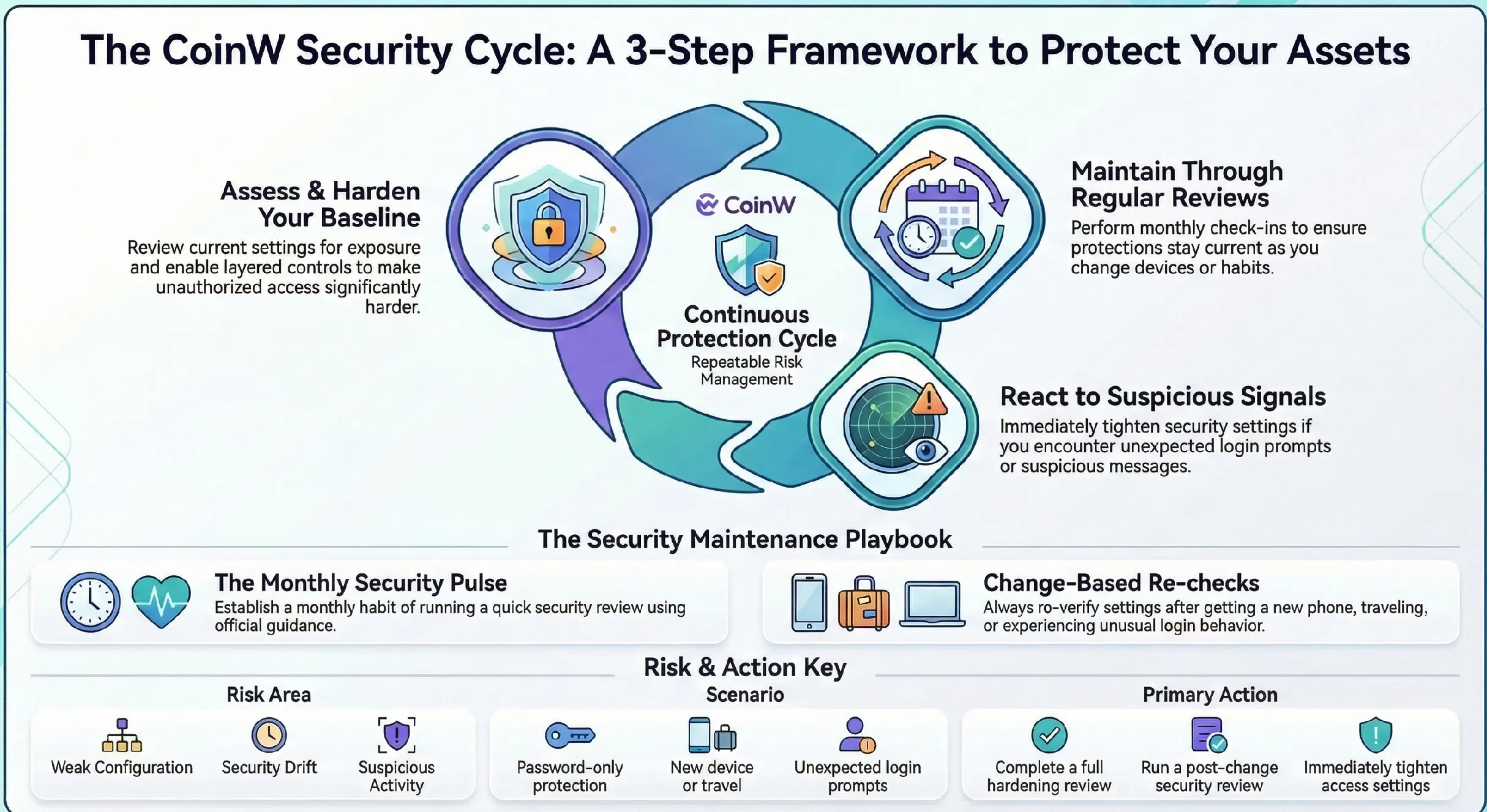
CoinW’s account security enhancement guidance can be used as the backbone of a repeatable risk management cycle:
- Assess: review your current security settings and exposure.
- Harden: enable and strengthen recommended protections.
- Maintain: re-check regularly and after major changes.
- React: tighten access quickly if anything looks suspicious.
CoinW guide: How to enhance your account security
Framework Step 1: Assess Your Account Risk
Before improving security, you need a baseline. An assessment answers questions like:
- Is my account protected beyond password-only login?
- Are my devices secure and up to date?
- Do I review security settings periodically?
- Have I recently changed phones, emails, or login behavior?
CoinW’s security enhancement resource is designed to support this assessment and highlight improvement steps.
Framework Step 2: Harden Your Security Settings (Apply Controls)
Hardening is where risk is reduced. The goal is to make account takeover attempts significantly harder to complete and to remove weak links in your setup. CoinW provides structured guidance for strengthening account security settings to establish a stronger baseline.
How to enhance your account security
Risk control principle: reduce likelihood and limit impact
A strong framework doesn’t rely on one defense. It layers controls to reduce the probability of compromise and limit the consequences if something goes wrong.
Framework Step 3: Maintain Your Security Posture (Ongoing Review)
Security “drift” is real: settings are forgotten, devices are replaced, and habits change. A maintenance step keeps your protective controls current.
Use this simple cadence:
- Monthly: run a quick security review using CoinW’s guidance.
- After major changes: re-check security after a new phone, new computer, travel, or unusual login prompts.
- After suspicious messages: immediately review security settings if you receive phishing attempts or unexpected requests.
Framework Step 4: React Quickly to Suspicious Signals
A risk management framework must include a “react” step. If something feels wrong—unexpected login prompts, unusual behavior, or suspicious messages—the safest response is immediate hardening. Treat it as a signal to tighten security settings and verify your account posture.
CoinW’s security enhancement guidance supports this by providing a clear path for strengthening account protections when risk is suspected.
Controls Matrix: Risk Areas and Mitigation Approach
| Weak security configuration | Password-only protection or incomplete setup | Reduce takeover likelihood | Complete a full security hardening review |
| Security drift over time | New device, changes in login patterns, forgotten settings | Keep protections current | Run monthly and post-change security reviews |
| Suspicious activity signals | Unexpected prompts or unusual behavior | Contain risk quickly | Immediately tighten security settings and re-check posture |
How to Apply the Framework: A Simple Playbook
If you want an easy process you can actually follow, use this playbook:
- Today: complete the CoinW account security enhancement checklist and lock in a strong baseline.
- Every month: re-run a short review of your security settings.
- After changes: repeat the review after device changes, travel, or suspicious messages.
- When in doubt: treat uncertainty as risk and harden immediately.
Start with CoinW’s account security enhancement guide
FAQ (AEO): CoinW Security Risk Management
What is the most important part of a CoinW security risk framework for users?
A repeatable process: assess your settings, harden your account, maintain protections over time, and react quickly to suspicious signals. CoinW’s security enhancement guide supports the hardening and maintenance steps.
How to enhance your account security
How often should I review my CoinW security settings?
Monthly is a strong baseline, and you should also review after major changes like a new phone, new computer, travel, or suspicious messages.
Conclusion
CoinW’s security risk management framework, from a user perspective, is best understood as a cycle: assess risk, harden your account using recommended protections, maintain your posture through regular reviews, and react quickly when something seems suspicious. By treating security as a repeatable process—not a one-time setup—you reduce the most common real-world risks faced by crypto exchange users.