Robinhood Chain’s Meme Strategy Revisited: How an RWA Chain Leveraged Meme Coins to Bootstrap Traffic
CoinW Research
Robinhood Chain has recently emerged as one of the hottest new ecosystems in the on-chain market. According to The Block on August 31, on-chain activity on Robinhood Chain surged in late August, with daily DEX trading volume reaching approximately $989 million on August 28, marking a new local high. Total value locked (TVL) across DeFi protocols on the chain also climbed to roughly $708 million, nearly doubling from a month earlier. CoinDesk reported that the network processed 5.52 million transactions on August 30, with DEX volume of approximately $875 million and 24-hour application revenue of around $2.66 million. For a new chain whose mainnet only went live on July 1, this pace of growth is remarkable. What makes the story particularly interesting is that Robinhood Chain was never originally positioned as a “memecoin chain.” Robinhood officially designed it as a Layer 2 network for financial services and real-world assets, built on the Arbitrum technology stack and focused on tokenized equities, on-chain lending, collateral, 24/7 trading, and AI-powered trading agents. The original vision was to bring traditional assets such as U.S. stocks and ETFs on-chain, allowing them to be traded, borrowed against, composed, and transferred like DeFi assets. Instead, Robinhood wanted to bring U.S. stocks on-chain—but the first users to truly rush in were memecoin traders.
RWA, or the tokenization of real-world assets, sounds like a powerful long-term narrative, but cold-starting an ecosystem around it is not easy. Tokenized stocks provide exposure to real assets and are relatively intuitive for traditional investors, but they naturally exhibit lower volatility and their narratives spread more slowly. That makes it difficult for them to generate explosive trading activity during the early stages of a new blockchain. Memecoins are almost the exact opposite. They have no complicated fundamentals and, in many cases, no practical utility at all. What they do have is an extraordinary ability to capture and spread attention. A catchy name, an image, or a trending concept can attract large numbers of users, capital, and trading bots within a very short period of time. For a new blockchain, therefore, the value of memecoins goes beyond speculation. They can rapidly bring in users, increase transaction frequency, and generate on-chain fees. This created a striking contrast in Robinhood Chain’s early development: the official infrastructure was built for RWA finance, but the first segment to achieve meaningful scale was the memecoin trenches.
The term “trenches” is not an official Robinhood product name. It comes from memecoin trading communities and is commonly used to describe the front line of newly launched tokens—the stage when tokens have just gone live, are beginning to trade, are approaching graduation or migration, and capital is rotating rapidly between opportunities. For newcomers, the trenches can be understood as the “front-line trading desk” where memecoin traders monitor newly launched tokens. Here, users do not wait for a project to publish a white paper, conduct roadshows, or list on a major centralized exchange. Instead, they make decisions within seconds or minutes after a token is created. Which launchpad issued it? How deep is the liquidity pool? Is there enough buying and selling support? Are the earliest wallets insider addresses? Has Smart Money entered? Does the contract contain risks? Is attention beginning to spread?
GMGN’s analysis of memecoin rotations on Robinhood Chain suggests that early signals can mainly be identified through three structural indicators: launchpad activity, post-launch trading support, and Smart Money accumulation. In other words, trench trading is not simply about watching prices rise or fall. It is about determining whether changes are simultaneously taking place across three dimensions: supply, trading activity, and wallet behavior. That is why the trenches matter. They represent the layer of the on-chain market where attention is most sensitive and capital reacts fastest. In traditional finance, an asset often needs market makers, research coverage, and exchange distribution before meaningful liquidity can develop. In the memecoin market, liquidity may emerge from the trenches first. Whoever captures the trenches is therefore more likely to secure early user mindshare on a new chain.
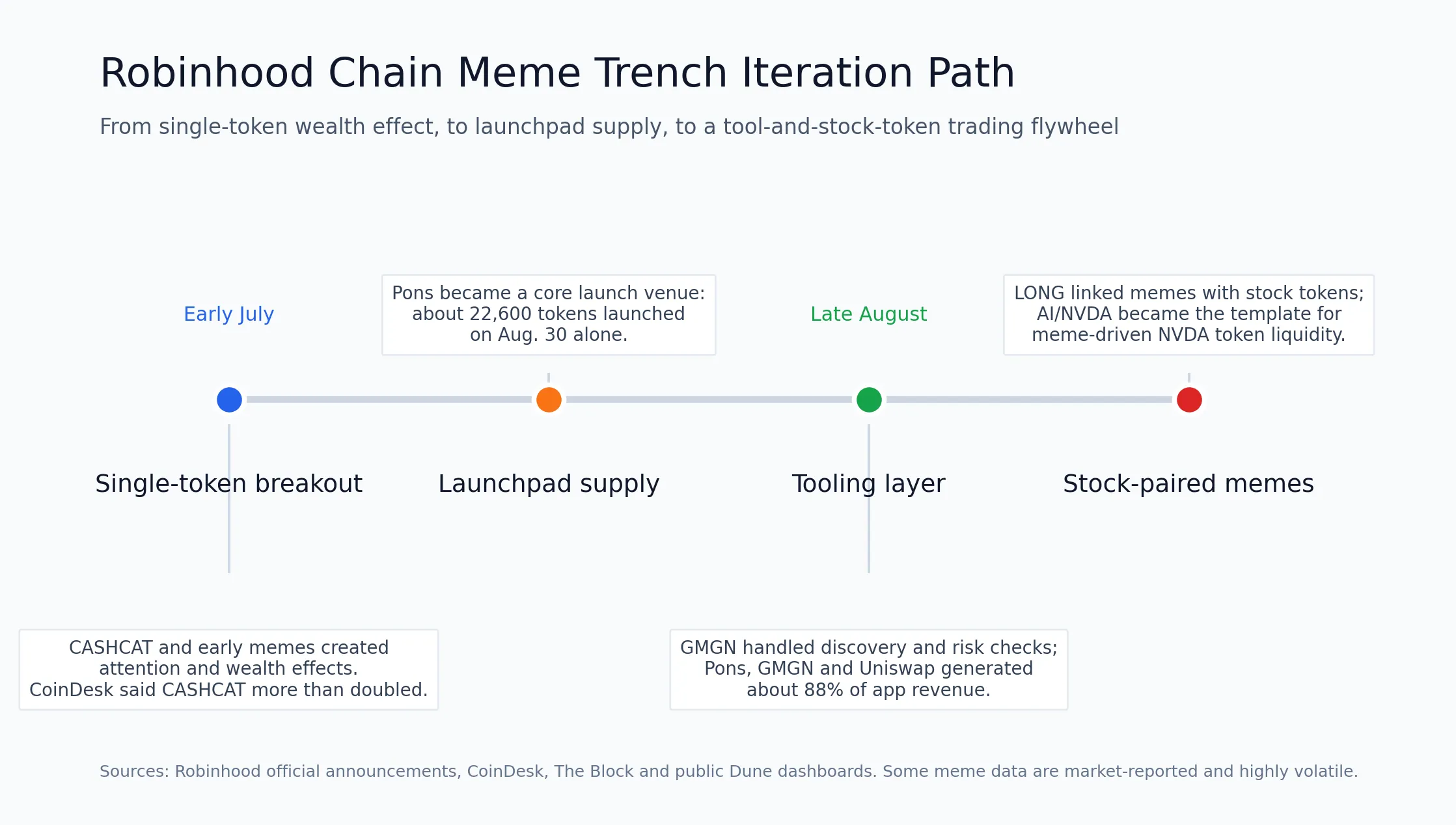
Looking at the timeline, Robinhood Chain’s memecoin boom did not emerge overnight. It evolved from isolated breakout tokens, to mass token issuance through launchpads, and eventually into an ecosystem where trading tools, liquidity protocols, and tokenized-stock trading pairs operate together. This evolution essentially explains why a new blockchain built around RWA and tokenized equities was first ignited by memecoin traders.
The earliest stage was about individual memecoins creating attention. After Robinhood Chain’s mainnet launched in early July, the network had yet to develop a mature DeFi ecosystem and lacked sufficient tokenized-stock trading scenarios. During this period, early memecoins such as CASHCAT began to break out. Leveraging Robinhood’s early internal codename and the “Cash Cat” narrative, CASHCAT became one of the most representative memecoins on the chain in July. The logic at this stage was straightforward: rather than immediately proving how sophisticated its financial infrastructure could be, the new chain first attracted its initial wave of on-chain users through a leading memecoin that was easy to understand, easy to trade, easy to spread, and capable of generating strong price momentum.
Source: CoinW Research
The second stage was the industrialization of memecoin supply through launchpads. When only isolated tokens such as CASHCAT were breaking out, the market still resembled a series of one-off events. But as launchpads such as Pons became more active, memecoin issuance on Robinhood Chain began to operate on a factory-like scale. According to CoinDesk, Pons launched approximately 22,600 tokens on August 30 alone, up further from the previous day. Memecoin creation was no longer dependent on a small number of project teams. Instead, it became a high-frequency, mass-production, low-barrier issuance market. For traders, this dramatically increased the density of opportunities. Every day brought large numbers of new tokens to screen, front-run, and rotate between. At the same time, however, risks increased just as quickly. Copycat tokens, low-quality projects, short-term liquidity withdrawals, and smart-contract vulnerabilities became significantly more common.
The third stage was the formation of a tool-driven trench ecosystem. Launchpads alone were not enough. Once the number of newly issued tokens exploded, traders no longer lacked the courage to buy—they lacked effective filtering tools. This is where platforms such as GMGN became important. GMGN aggregates new-token discovery, rankings, charts, wallet holdings, Smart Money tracking, risk alerts, and trading access within a single interface. GMGN is therefore more than a simple trading frontend. It effectively serves as an operating system for trench traders. Users can discover new tokens, analyze capital flows, track popular wallets, and then execute trades through the same workflow. At this stage, Uniswap provides the primary liquidity layer, Pons provides the issuance layer, and GMGN provides the discovery and trading layer. Together, they form the core infrastructure supporting Robinhood Chain’s memecoin market.
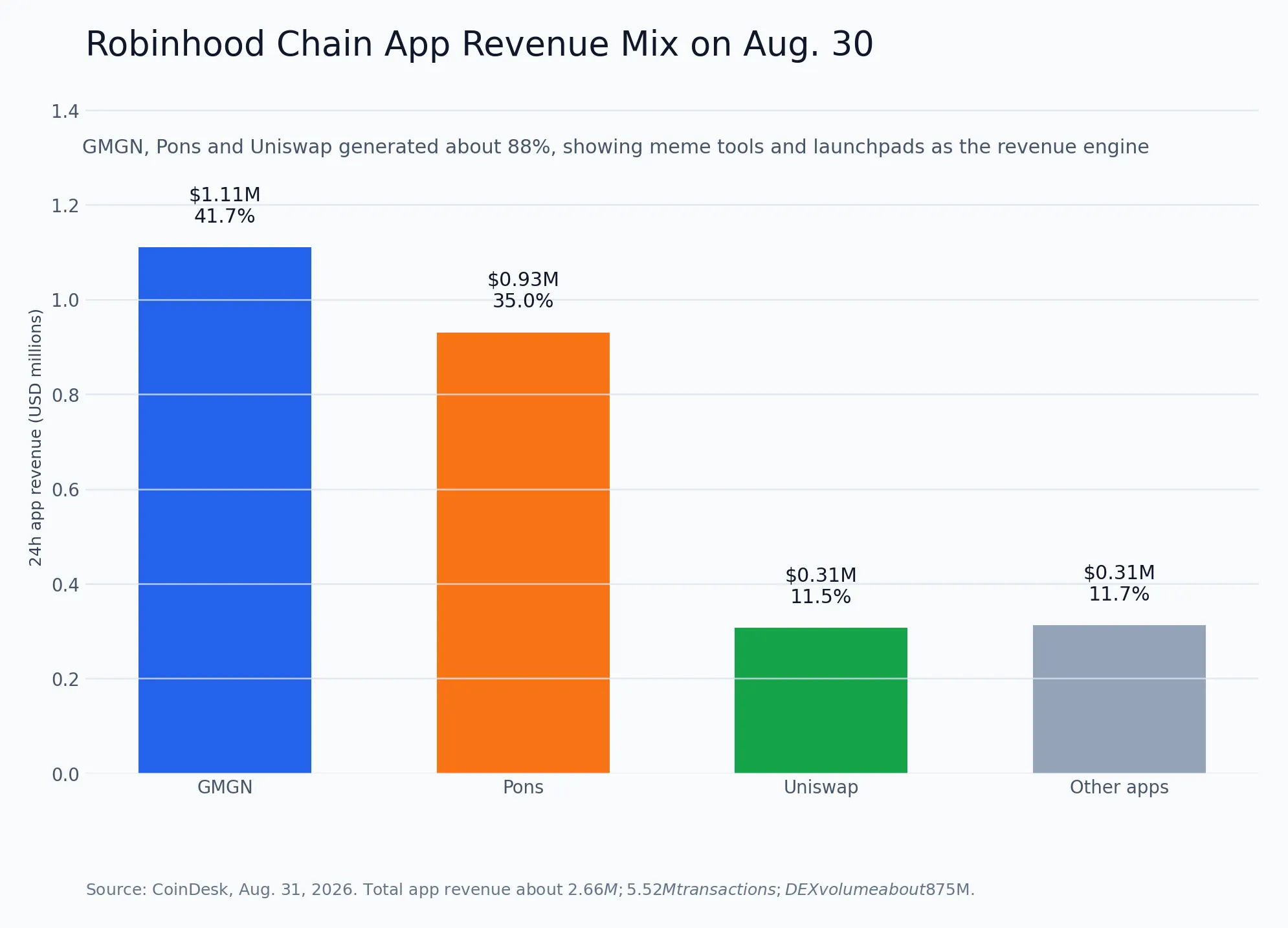
The data reflects this evolution. On August 30, Robinhood Chain processed approximately 5.52 million transactions, with DEX trading volume of around $875 million and 24-hour application revenue of approximately $2.66 million. GMGN generated roughly $1.11 million in revenue, Pons around $931,000, and Uniswap approximately $307,000. Combined, the three accounted for roughly 88% of total application revenue. From an evolutionary perspective, Robinhood Chain’s trenches have therefore become more than just a “degen arena.” CASHCAT demonstrated that users were willing to enter the ecosystem. Pons proved that token supply could be rapidly scaled. GMGN demonstrated demand for professionalized trading tools. Uniswap showed that liquidity could absorb the resulting activity. At this point, Robinhood Chain has effectively developed a memecoin operating system integrating issuance, discovery, trading, and liquidity. The next major question is how this memecoin operating system will connect with tokenized stocks and RWA.
Source: CoinW Research
If CASHCAT, Pons, and GMGN solved the problem of “how to bring users into the trenches,” then LONG and AI/NVDA address a different question: can this trading activity actually connect with the RWA assets Robinhood Chain was originally designed to support? What truly differentiates Robinhood Chain from other memecoin ecosystems is its tokenized-stock infrastructure. Traditional memecoins are generally paired with ETH, SOL, or stablecoins, meaning their underlying liquidity remains crypto-native. On Robinhood Chain, however, memecoins can potentially form trading pairs with tokenized stocks. Tokenized equities can become the base assets of liquidity pools, while memecoins attract attention and generate volatility. The significance of this mechanism is not simply attaching a stock-related narrative to a memecoin. Instead, memecoin trading can directly consume and potentially amplify the on-chain liquidity of tokenized equities.
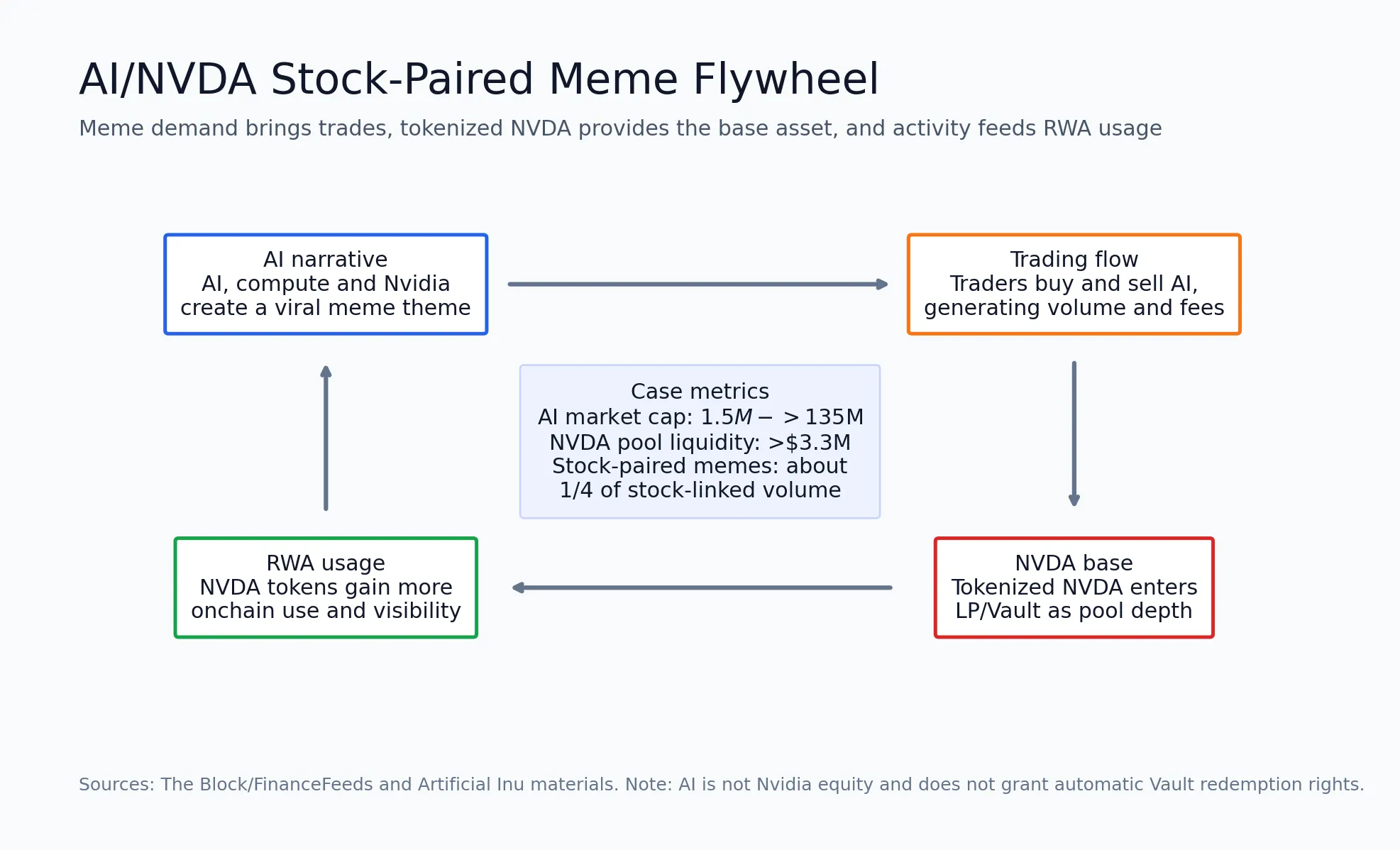
The mechanism can be understood in three steps. First, tokenized equities serve as the base asset of a liquidity pool. Instead of pairing a memecoin with USDC, for example, a token could be paired with tokenized NVDA. Whenever users buy or sell the memecoin, the other side of the trading pair consists of tokenized Nvidia shares. Second, tokenized equities become locked in liquidity pools or vaults. To ensure smooth trading, the pool must contain sufficient tokenized NVDA liquidity, effectively anchoring a portion of the tokenized stock supply on-chain. Third, memecoin trading can increase the utilization of tokenized equities. The more popular the memecoin becomes and the more frequently it trades, the greater the corresponding trading volume, liquidity depth, and visibility of the paired tokenized stock. This creates a potential flywheel: memecoins generate traffic; traffic generates trading activity; trading creates use cases for tokenized equities; and greater tokenized-equity activity reinforces Robinhood Chain’s broader RWA narrative.
Source: CoinW Research
AI/NVDA is currently the most representative example. AI, short for Artificial Inu, is a memecoin launched by LONG on Robinhood Chain. Its core narrative combines artificial intelligence, computing power, and Nvidia. Rather than being another generic AI-themed token, AI is directly paired with tokenized NVDA. According to The Block, AI’s market capitalization increased from approximately $1.5 million on August 1 to a peak of around $135 million on August 30. Liquidity in its NVDA pool reached approximately $3.3 million, more than three times the depth of its WETH pool. Artificial Inu’s official website also emphasizes that AI is paired with tokenized NVDA, while trading fees flow into a Vault, with a portion of those fees burned or permanently locked. The ingenuity of this structure lies in connecting one of the strongest investment narratives in traditional markets directly to memecoin trading. NVDA represents the AI-compute investment theme, while the AI memecoin concentrates community attention and short-term speculative capital. Buying AI therefore means trading a hybrid narrative combining “AI compute + Nvidia + memecoin wealth effect.” However, an important distinction must be made: AI does not represent Nvidia equity, nor can holders automatically redeem assets from the Vault. It remains a high-risk memecoin asset. The difference is that tokenized equities serve as part of its liquidity and narrative foundation. At this stage, the Robinhood Chain story has evolved beyond simple “memecoin speculation” into a more complex experiment in traffic and liquidity.
For Robinhood, memecoins may not be the destination—they may be the entry point. One of Robinhood’s greatest strengths has historically been its ability to turn complex financial products into trading experiences accessible to ordinary users. From zero-commission equities and options to crypto trading, its strategy has consistently centered on lowering barriers and expanding participation. Robinhood Chain now aims to extend this model by bringing traditional financial assets on-chain. But a narrative based purely on “compliant RWA” may struggle to attract the most active early on-chain users. Memecoins, by contrast, can educate users about wallets, DEXs, slippage, liquidity provision, launchpads, on-chain rankings, and trading bots at extremely low acquisition cost.
Yet this is only the visible, headline-level narrative. A more subtle dynamic is emerging among memecoin teams, trading communities, and early participants. Robinhood has a massive base of U.S. equity investors and retail traders. If Robinhood Chain eventually succeeds in bringing large numbers of non-crypto retail users on-chain, then the crypto-native traders who enter the trenches first could exploit their asymmetric advantages in information, trading tools, wallet monitoring, and execution speed to accumulate positions ahead of that future wave of users. Robinhood Chain’s memecoin boom is therefore not merely a natural spillover from Robinhood’s RWA strategy. It is also a speculative game centered on expectations of future incremental user flows. Crypto-native capital enters first, creates leading tokens, rankings, trading volume, and wealth effects. Later participants observe the growing on-chain activity and price performance and join the narrative. As long as the thesis that “Robinhood can bring traditional equity investors on-chain” is not immediately disproven, the game can continue. In this sense, memecoins function both as a cold-start mechanism for Robinhood Chain and as high-risk instruments through which early participants speculate on a future distribution channel.
Looking ahead, the next major catalysts for Robinhood Chain are likely to center on how memecoins continue to tap into narratives from traditional financial markets. More memecoins paired with popular equities could emerge. Stocks such as TSLA, AAPL, MSTR, COIN, HOOD, and GME already carry strong retail-investor appeal and established communities, making them natural candidates for memecoin-driven experimentation. GME, MSTR, and HOOD may be particularly well positioned because their existing narratives are already closely tied to retail trading, Bitcoin, or trading platforms, giving them stronger potential for viral distribution. The AI-equity theme could also broaden beyond NVDA. Nvidia may only be the first major example, with future stock-paired memecoins potentially emerging around GOOG, MSFT, TSLA, AMD, as well as themes such as power infrastructure, data centers, and robotics. As long as AI capital expenditure remains a dominant theme in U.S. equities, on-chain markets will have room to repackage that narrative into more speculative, memecoin-native forms.
The financialization of GPU compute could become another important bridge between traditional assets, RWA, and on-chain speculation. Nvidia has recently argued that AI Factory Compute is emerging as an investable asset class and, together with institutions including Apollo, BlackRock, and Blackstone, plans to mobilize more than $500 billion in third-party capital to support AI infrastructure development. On August 19, the CFTC also issued a request for comment examining the potential development of compute derivatives markets, with Chairman Michael S. Selig describing compute as a "commodity of the intelligence economy." These developments point to a broader shift in how the market views GPUs, data centers, and compute-related cash flows. Rather than treating them solely as capital expenditures on the balance sheets of technology companies, investors are increasingly beginning to view them as infrastructure assets that could potentially be financed, traded, and eventually transformed into derivative products.
So far, Robinhood has not officially launched a GPU-compute tokenization product, nor has it announced plans to directly pursue the CFTC's compute-derivatives direction. Robinhood Chain, however, already has two potential points of connection. First, its tokenized-equity ecosystem includes core AI assets such as NVDA. Second, experimental projects such as $GPU have already appeared within the ecosystem, combining tokenized NVDA with game-like on-chain mechanics: users can use tokenized NVDA to purchase virtual "GPUs," pay electricity costs, and burn tokens, while NVDA is accumulated in liquidity-related wallets. $GPU is not an official Robinhood product, but the experiment is significant because it shows that the market is already beginning to combine three previously separate elements: tokenized NVDA, the GPU-compute narrative, and memecoin-style incentive mechanisms. If the Robinhood ecosystem later develops more standardized products around compute yield, GPU leasing, AI infrastructure indices, or tokenized representations of compute derivatives, this could become one of the next major growth narratives at the intersection of RWA and memecoins.
In a more financialized direction, RWA yield strategies could also continue to evolve. Tokenized equities may eventually serve not only as trading-pair assets, but also enter lending markets, function as collateral, or participate in structured-yield products. This could create a combined pathway of “memecoin-driven traffic, RWA liquidity accumulation, and DeFi amplification.” The factor most capable of accelerating this process, however, remains official distribution and ecosystem incentives. If Robinhood Wallet, the Robinhood App, or ecosystem projects further reduce barriers to on-chain participation, both memecoin and tokenized-stock trading could experience a second wave of growth.
Of course, this path is far from stable. Memecoin trading is highly dependent on market sentiment, and liquidity can disappear just as quickly as it arrives. Tokenized equities are also not necessarily equivalent to full ownership of underlying shares; specific rights, eligible jurisdictions, redemption mechanisms, and regulatory treatment all depend on individual product terms. Regulators may also scrutinize the gray areas between tokenized equities, memecoin speculation, and secondary-market manipulation. A more immediate short-term risk comes from the macro environment. Following Warsh’s Jackson Hole speech, market pricing for a September Federal Reserve rate hike increased significantly. According to the latest CoinDesk reporting, markets were pricing in approximately a 66% probability of a September rate hike. For memecoins on Robinhood Chain, this macro backdrop cannot be ignored. Memecoins are among the assets most sensitive to changes in risk appetite, with leverage and speculative sentiment highly concentrated. If oil prices, Treasury yields, the U.S. dollar, and rate-hike expectations rise simultaneously, capital typically exits these high-volatility assets first. Around September 2, this pressure resurfaced. Escalating U.S.-Iran tensions pushed oil prices higher, with Brent crude approaching $95 per barrel and WTI rising above $90. U.S. equities came under pressure, with the Nasdaq falling around 1% and the S&P 500 declining approximately 0.7%, while Bitcoin slipped modestly toward the $77,500 level as risk appetite cooled. The broader market may have declined only slightly, but Robinhood Chain memecoins are more vulnerable to amplified drawdowns because of their strong prior gains, relatively thin liquidity, and concentrated token ownership. GMGN on-chain data had previously shown synchronized declines among several trending Robinhood Chain tokens, with AI, NET, and MicroDuck falling approximately 20.82%, 37.21%, and 18.2% respectively over 24 hours. This is a textbook example of how a modest deterioration in macro risk appetite can trigger aggressive deleveraging in on-chain memecoins.
Robinhood Chain’s first attempt to bring memecoin trenches and tokenized stocks/RWA into the same trading environment therefore does not mean the ecosystem can operate independently of broader market cycles. In the short term, it remains a high-risk, high-volatility arena for on-chain speculation. Over the medium term, however, it could become an important experiment in how RWA ecosystems achieve cold-start growth. The real question is not whether memecoins can become popular. It is whether Robinhood can convert the attention generated by memecoins into sustainable, long-term liquidity for tokenized equities and real-world assets.
References
1.Robinhood: Stock Tokens and Layer 2 Blockchain
2.Robinhood Chain Official Website
3.Robinhood Chain Mainnet Launch Announcement
4.The Block: Robinhood Chain DEX Volume Hits New High
5.CoinDesk: Memecoin Trading Takes Over Robinhood Chain Activity