Layer 1 vs. Layer 2 Blockchains: Key Differences Explained
Layer 1 vs. Layer 2 Blockchains: Key Differences Explained
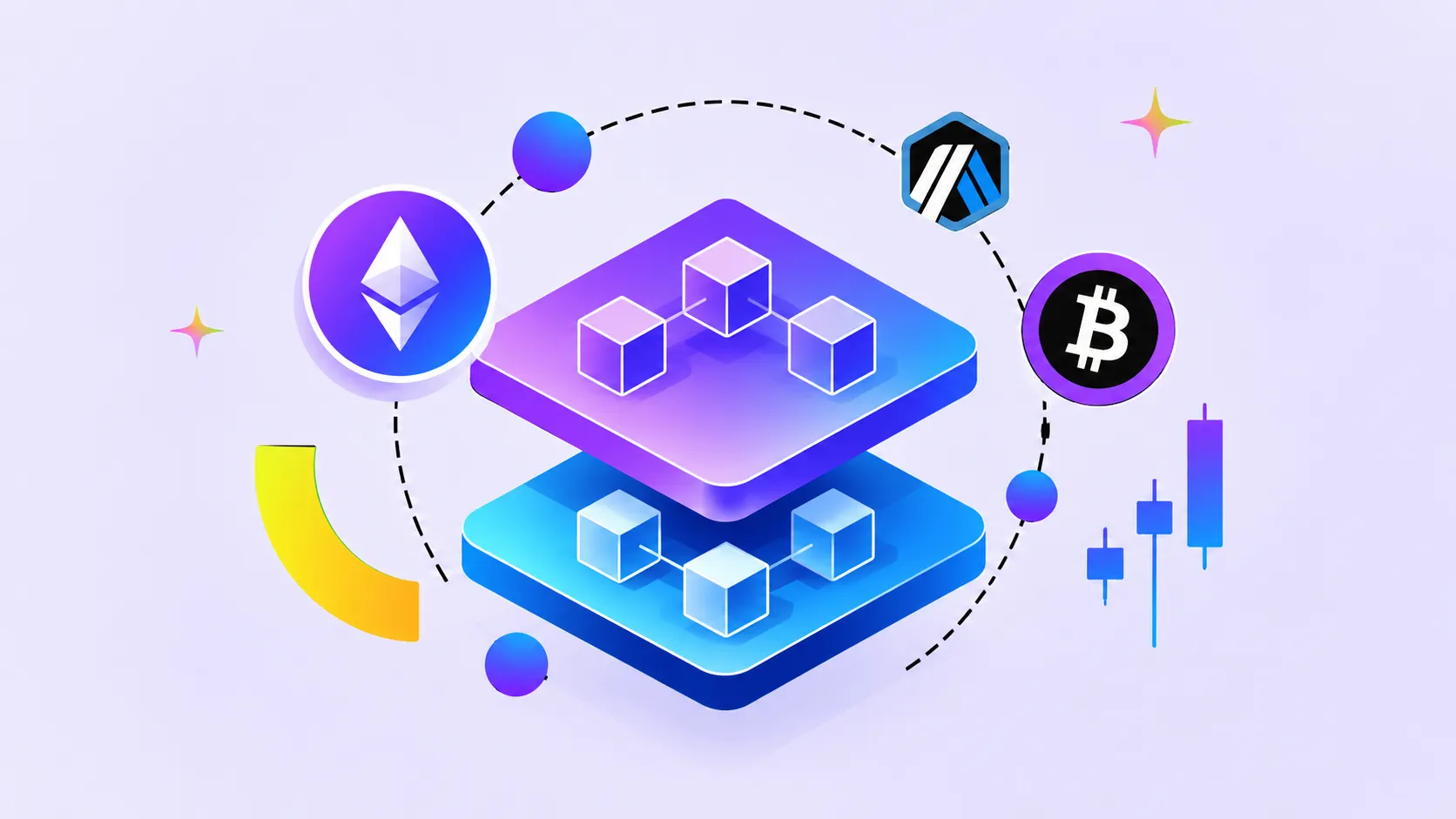
Layer 1 (L1) and Layer 2 (L2) blockchains are two fundamental components of blockchain infrastructure. Layer 1 refers to the underlying blockchain network responsible for processing transactions, maintaining consensus, and securing its ledger. Layer 2 refers to a scaling solution built on top of an existing Layer 1 network to improve transaction capacity, reduce costs, or introduce additional functionality.
Popular Layer 1 blockchains include Bitcoin (BTC), Ethereum (ETH), and Solana (SOL). Examples of Layer 2 solutions include Arbitrum, Optimism, Base, and the Bitcoin Lightning Network.
The main difference between Layer 1 and Layer 2 blockchains is their role in the blockchain ecosystem. Layer 1 provides the foundational infrastructure and security, while Layer 2 increases network capacity by processing activity separately and relying on the underlying blockchain to varying degrees for settlement and security.
At CoinW, we believe understanding these differences is essential for evaluating blockchain technology, comparing cryptocurrency ecosystems, and making informed trading decisions.
Quick Summary
Layer 1 blockchains: Independent blockchain networks that maintain their own consensus mechanisms, transaction histories, and security infrastructure.
Layer 2 blockchains: Scaling solutions that operate above an existing blockchain and use its infrastructure for security or settlement.
Primary difference: Layer 1 establishes the foundation, while Layer 2 extends its capabilities.
Layer 1 examples: Bitcoin, Ethereum, Solana, and Avalanche.
Layer 2 examples: Arbitrum, Optimism, Base, Starknet, and Lightning Network.
Main advantages of Layer 2: Lower transaction costs, greater throughput, and application-specific optimization.
Key risks: Smart contract vulnerabilities, centralized sequencers, bridge security, liquidity fragmentation, and differing security assumptions.
Background: Why Do Blockchains Need Multiple Layers?
Early blockchain networks were primarily designed to provide decentralized and secure systems for transferring digital assets. Bitcoin introduced a decentralized transaction ledger, while Ethereum expanded blockchain functionality through programmable smart contracts.
However, growing adoption created challenges involving transaction throughput, network congestion, and transaction fees.
These challenges are commonly discussed through the blockchain scalability trilemma, which describes the difficulty of simultaneously maximizing decentralization, security, and scalability.
Blockchain developers have pursued two major approaches to improving performance:
Layer 1 scaling: Improving the underlying blockchain through protocol upgrades, consensus optimizations, or changes to network architecture.
Layer 2 scaling: Moving some transaction processing away from the base blockchain while retaining a connection to its security or settlement infrastructure.
Ethereum's scaling strategy illustrates how both approaches can complement each other. The network continues improving its base protocol while supporting rollups that execute transactions outside Ethereum Mainnet.
According to the Ethereum Foundation's scaling documentation, rollups have become a central component of Ethereum's approach to increasing blockchain capacity.
How Do Layer 1 Blockchains Work?
A Layer 1 blockchain operates as an independent distributed network. Its participants maintain a shared ledger, validate transactions, and follow a consensus mechanism that determines which transactions become part of the blockchain's accepted history.
Layer 1 networks generally provide the following functions:
Consensus: Establishing agreement about the valid state of the blockchain.
Transaction execution: Processing asset transfers and, where supported, smart contract operations.
Security: Protecting the network through validators, miners, cryptographic verification, and economic incentives.
Data availability: Making transaction information accessible according to the blockchain's architecture.
Settlement: Establishing the accepted and finalized state of transactions.
Examples of Layer 1 blockchains
Bitcoin (BTC): Bitcoin uses Proof of Work to secure its network and validate transactions. Its architecture prioritizes security, verifiability, and decentralized monetary transfers.
Ethereum (ETH): Ethereum uses Proof of Stake and supports programmable smart contracts. It serves as a foundation for decentralized finance, NFTs, tokenized assets, and numerous Layer 2 networks.
Solana (SOL): Solana is a high-performance Layer 1 blockchain that combines Proof of Stake with a Proof of History-based timing mechanism. Its architecture focuses on high throughput and low transaction costs.
Avalanche (AVAX): Avalanche provides blockchain infrastructure supporting multiple chains and customizable networks. Its architecture is designed to support financial applications and specialized blockchain environments.
How Do Layer 2 Blockchains Work?
Layer 2 solutions improve scalability by handling certain activities outside the underlying Layer 1 blockchain.
Rather than requiring every transaction to be executed directly on Ethereum Mainnet, for example, a Layer 2 rollup can execute many transactions separately and submit the necessary transaction data or cryptographic commitments to Ethereum.
This architecture can distribute settlement and data publication costs across many users, making individual transactions more affordable.
For an Ethereum rollup, the process generally involves:
Transaction submission: A user sends a transaction to the Layer 2 network.
Execution: The Layer 2 processes the transaction using its execution environment.
Batching: Multiple transactions are grouped together for efficient publication or settlement.
Data publication: Relevant transaction data or commitments are submitted to Ethereum according to the rollup design.
Verification and settlement: Ethereum smart contracts and the rollup's proof system determine how transaction results become accepted and finalized.
Not every Layer 2 uses the same architecture. Some rely on optimistic fraud-proof systems, others use zero-knowledge validity proofs, and payment channels use a different model.
Importantly, Layer 2 security is not automatically identical to Layer 1 security. Actual protections depend on implementation details, upgrade controls, proof systems, and the ability of users to exit safely.
Layer 1 vs. Layer 2 Blockchains: Key Differences
The following table compares the main characteristics of Layer 1 and Layer 2 blockchain networks.
| Feature | Layer 1 | Layer 2 |
|---|---|---|
| Primary purpose | Provide base blockchain infrastructure | Extend scalability and functionality |
| Network independence | Independent consensus network | Depends on an underlying blockchain |
| Transaction processing | Directly on the base network | Separate execution or transaction channels |
| Transaction fees | Depend on network design and demand | Often lower than the underlying L1 |
| Scalability | Limited by base protocol capacity | Additional throughput through separate processing |
| Security | Own consensus and validator or miner infrastructure | Uses L1 security with additional assumptions |
| Native assets | Typically has a native asset for fees or incentives | May use the L1 asset or a separate token |
| Examples | Bitcoin, Ethereum, Solana | Arbitrum, Optimism, Base, Starknet |
These differences represent general architectural characteristics rather than universal performance guarantees. A high-performance Layer 1 may offer lower fees than some Layer 2 networks, while a poorly designed Layer 2 may introduce additional security risks.
What Are the Main Types of Layer 2 Scaling Solutions?
Layer 2 technologies use different methods to improve scalability. Understanding these approaches helps explain why networks can differ substantially in fees, transaction finality, and security.
Optimistic Rollups
Optimistic rollups execute transactions outside the base blockchain and submit transaction results to Layer 1. They generally assume submitted state transitions are valid unless challenged through a dispute mechanism.
Examples include Arbitrum (ARB) and Optimism.
Their advantages include compatibility with Ethereum applications and improved transaction throughput. However, withdrawals through canonical bridges may require waiting for a challenge period, depending on the network's design.
Zero-Knowledge Rollups
Zero-knowledge rollups, also called ZK-rollups, use cryptographic validity proofs to demonstrate that state transitions were performed correctly.
These proofs allow the underlying blockchain to verify transaction results without independently repeating every computation.
Examples include Starknet and ZKsync Era.
ZK-rollups can provide efficient verification and strong cryptographic assurances, although proof generation, infrastructure complexity, and network-specific implementation risks remain important considerations.
Payment and State Channels
Payment channels allow participants to conduct multiple transactions without recording every individual payment on the underlying blockchain.
The Bitcoin Lightning Network is a prominent example. Participants can open payment channels using Bitcoin transactions and exchange payments through a network of connected channels.
This approach supports rapid, relatively inexpensive payments, but introduces considerations involving liquidity, routing, channel management, and online monitoring.
Are Sidechains Also Layer 2 Networks?
Sidechains are sometimes grouped with Layer 2 scaling solutions in general discussions, but the distinction is important.
A sidechain typically maintains its own consensus and security infrastructure instead of directly inheriting the security guarantees of the underlying blockchain.
For example, Polygon PoS has historically been described as an Ethereum scaling network, but its security architecture differs from that of an Ethereum rollup.
According to Ethereum's official Layer 2 documentation, distinguishing rollups from independently secured networks is essential when evaluating security assumptions.
Major Layer 1 and Layer 2 Blockchain Projects
Different blockchain projects demonstrate how Layer 1 and Layer 2 architectures serve complementary roles in the cryptocurrency ecosystem.
Ethereum: A Layer 1 Settlement Foundation
Ethereum provides decentralized consensus, smart contract execution, and settlement infrastructure for a large ecosystem of blockchain applications.
Its native asset, ETH, is used to pay transaction fees and support network staking.
Ethereum also supports rollups that use the network for settlement and data availability. This enables applications to process transactions more efficiently without requiring all execution to occur directly on Mainnet.
Users can monitor Ethereum's market performance through CoinW's ETH/USDT spot market.
Arbitrum: An Ethereum Layer 2 Scaling Network
Arbitrum is an Ethereum scaling ecosystem developed by Offchain Labs. Its Arbitrum One network uses optimistic rollup technology to execute transactions while relying on Ethereum for settlement and important security functions.
The ecosystem supports decentralized exchanges, lending protocols, gaming applications, and other Ethereum-compatible smart contracts.
ARB is primarily a governance token. It should not be confused with ETH, which is used to pay transaction fees on Arbitrum One.
For additional background, read the Arbitrum Project Analysis by the CoinW Institute.
Solana: An Alternative Layer 1 Scaling Approach
Solana illustrates a different approach to blockchain scalability. Instead of relying primarily on a rollup-centric architecture, Solana focuses on optimizing execution and throughput within its base network.
Its architecture supports decentralized finance, payments, NFTs, and consumer applications.
Solana demonstrates that Layer 1 improvements and Layer 2 development represent different, potentially complementary approaches to increasing blockchain capacity.
Users interested in the ecosystem can explore the SOL/USDT trading pair on CoinW.
What Are the Advantages and Disadvantages of Layer 1 and Layer 2?
Advantages of Layer 1 Blockchains
Independent security: Base networks establish their own consensus and transaction validation systems.
Direct settlement: Transactions are finalized within the blockchain's native consensus framework.
Network sovereignty: Protocol communities can establish their own economic and governance structures.
Native liquidity: Established networks can support substantial liquidity and application ecosystems.
Disadvantages of Layer 1 Blockchains
Capacity constraints: Decentralized validation can limit transaction throughput.
Network congestion: High demand may increase transaction fees and confirmation delays.
Upgrade complexity: Protocol changes may require coordination across numerous network participants.
Advantages of Layer 2 Blockchains
Lower transaction costs: Batching and separate execution can reduce fees for users.
Higher throughput: More transactions can be processed without requiring equivalent increases in base-layer execution.
Application flexibility: Developers can customize execution environments for specific use cases.
Access to established infrastructure: Well-designed rollups can leverage Ethereum's settlement and security systems.
Disadvantages of Layer 2 Blockchains
Additional technical complexity: Users must understand network selection, bridging, and settlement mechanisms.
Sequencer centralization: Some networks depend on a limited number of operators for transaction ordering.
Bridge vulnerabilities: Cross-chain transfers can introduce smart contract and operational risks.
Liquidity fragmentation: Assets and applications may be distributed across multiple networks.
Withdrawal delays: Certain rollup architectures require challenge periods before canonical withdrawals are finalized.
How Do Layer 1 and Layer 2 Affect Cryptocurrency Transaction Fees?
Transaction fees are among the most noticeable differences between Layer 1 and Layer 2 networks.
On Ethereum Mainnet, users pay gas fees for transaction execution and network resources. Fees vary according to demand and the computational requirements of each transaction.
On an Ethereum rollup, users typically pay fees covering Layer 2 execution and the costs associated with publishing or settling information on Ethereum.
Because these costs can be shared across batches of transactions, Layer 2 transfers are often cheaper than equivalent transactions executed directly on Ethereum Mainnet.
However, transaction fees are dynamic. They depend on network congestion, execution requirements, data publication costs, and the particular Layer 2 architecture.
Users should also distinguish blockchain transaction fees from exchange trading fees, withdrawal fees, and bridging fees. These are separate costs that can affect the total expense of transferring or trading cryptocurrency.
How Do Layer 1 and Layer 2 Affect Crypto Investors and Traders?
Layer 1 and Layer 2 infrastructure can influence cryptocurrency adoption, transaction demand, ecosystem activity, and the utility of associated digital assets.
However, technological improvements do not automatically translate into higher token prices.
At CoinW, we encourage traders to distinguish between the growth of a blockchain network and the economic role of its associated token.
Layer 1 Token Utility
Native Layer 1 assets often support transaction fees, staking, validator incentives, or monetary transfers.
For example, ETH is used for Ethereum transaction fees and staking, while SOL supports fees and staking within the Solana ecosystem.
Network usage may influence demand for these assets, although token supply, market conditions, and economic design also affect their valuations.
Layer 2 Token Utility
Layer 2 tokens can have different economic functions.
ARB is primarily associated with governance in the Arbitrum ecosystem. Similarly, OP supports governance within the Optimism ecosystem.
Not all Layer 2 networks have native governance tokens. Base, for example, uses ETH for transaction fees and does not require a separate native network token.
Consequently, increased activity on a Layer 2 network does not necessarily create direct demand for its governance token.
Monitoring Layer 1 and Layer 2 Markets
Traders can use CoinW to follow crypto live prices, evaluate market movements, and compare assets associated with different blockchain ecosystems.
Relevant indicators include trading volume, token supply, ecosystem adoption, transaction activity, and the sustainability of network fees.
It is important to evaluate these indicators together rather than assuming that greater blockchain throughput guarantees stronger investment performance.
What Are the Main Security Risks of Layer 2 Blockchains?
Although Layer 2 networks are designed to benefit from underlying blockchain infrastructure, their security depends on several additional components.
Smart Contract and Proof-System Risks
Rollups rely on smart contracts and verification mechanisms to manage deposits, withdrawals, and state transitions.
Software vulnerabilities or incorrectly implemented proof systems may compromise these processes.
Sequencer Centralization
Some Layer 2 networks use centralized sequencers to order transactions.
This can improve operational efficiency but may introduce censorship, downtime, or transaction-ordering risks.
The existence of a centralized sequencer does not automatically mean user funds are insecure. The consequences depend on the network's fallback mechanisms and settlement architecture.
Bridge and Withdrawal Risks
Moving assets between Layer 1 and Layer 2 networks may require bridges or specialized withdrawal mechanisms.
Users should verify supported networks, contract addresses, and withdrawal procedures before transferring funds.
Sending assets through an unsupported network can result in inaccessible or permanently lost funds.
Governance and Upgrade Risks
Some Layer 2 systems retain administrative permissions that allow authorized parties to upgrade contracts or modify certain network components.
These controls may help teams respond to emergencies but also introduce additional trust assumptions.
Before interacting with a Layer 2, users should evaluate its security model, decentralization progress, and emergency withdrawal arrangements.
Which Is Better: Layer 1 or Layer 2?
Neither Layer 1 nor Layer 2 is universally better. The appropriate choice depends on the intended application, security requirements, transaction costs, and desired user experience.
Layer 1 networks may be preferable when users prioritize direct settlement, independent consensus, and interaction with foundational blockchain infrastructure.
Layer 2 networks may be preferable for applications requiring frequent transactions, lower fees, or specialized execution environments.
For example, a user making frequent decentralized exchange transactions may benefit from a low-cost Ethereum rollup, while another user may prefer Ethereum Mainnet for direct settlement of a high-value transaction.
The decision should also consider the specific network's maturity, security assumptions, liquidity, and supported applications.
What Is the Future of Layer 1 and Layer 2 Blockchains?
The development of blockchain infrastructure increasingly combines improvements to base-layer protocols with specialized scaling networks.
Ethereum's roadmap includes improvements to data availability, rollup efficiency, and underlying network capacity.
Technologies such as EIP-4844 introduced blob transactions, providing a dedicated form of data storage intended to reduce rollup data publication costs.
Meanwhile, Layer 2 developers continue researching decentralized sequencing, interoperability, zero-knowledge proofs, and more efficient execution environments.
In a March 2026 publication, the Ethereum Foundation emphasized an evolving relationship between Layer 1 and Layer 2 networks. Ethereum's base layer is increasingly positioned as a resilient settlement and liquidity foundation, while Layer 2 networks provide additional scalability, customization, and specialized services.
This direction suggests that Layer 1 and Layer 2 technologies will continue evolving together rather than competing exclusively to replace one another.
However, the long-term success of individual networks will depend on actual adoption, sustainable economics, interoperability, and security.
How to Explore Layer 1 and Layer 2 Cryptocurrencies on CoinW
CoinW provides access to cryptocurrency markets associated with major blockchain ecosystems.
Research the underlying technology: Understand whether a project operates as a Layer 1 blockchain, Layer 2 scaling solution, or another infrastructure category.
Evaluate token utility: Determine whether the token is used for network fees, staking, governance, or other purposes.
Review market information: Compare price movements, liquidity, and trading volume.
Explore available markets: Users can access the BTC/USDT market for Bitcoin exposure or the ARB/USDT market for Arbitrum's governance token.
Manage risk: Consider volatility, market liquidity, tokenomics, and the possibility of losing invested capital.
Availability of trading pairs and services may vary by jurisdiction and market conditions.
FAQs About Layer 1 and Layer 2 Blockchains
What is the main difference between Layer 1 and Layer 2?
Layer 1 is an independent blockchain that provides consensus, transaction validation, and security. Layer 2 is a scaling system that processes activity separately while relying on an underlying blockchain for certain security or settlement functions.
Is Ethereum a Layer 1 or Layer 2 blockchain?
Ethereum is a Layer 1 blockchain. It also serves as the underlying settlement and security network for numerous Layer 2 rollups.
Is Solana a Layer 1 or Layer 2 blockchain?
Solana is a Layer 1 blockchain with its own consensus architecture, validators, and native asset, SOL.
Is Arbitrum a Layer 2 blockchain?
Yes. Arbitrum One is an Ethereum Layer 2 optimistic rollup designed to improve transaction throughput and reduce execution costs while using Ethereum for settlement and important security functions.
Are Layer 2 transactions always cheaper than Layer 1 transactions?
No. Layer 2 transactions are often cheaper than equivalent transactions on their underlying Layer 1, but fees depend on network demand, execution complexity, and the particular blockchain architecture.
Are Layer 2 blockchains as secure as Layer 1?
Not necessarily. Well-designed Layer 2 systems can inherit substantial security guarantees from their underlying Layer 1, but smart contracts, sequencers, governance permissions, and proof mechanisms may introduce additional risks.
Do all Layer 2 blockchains have their own tokens?
No. Some Layer 2 ecosystems have governance tokens, while others use the underlying Layer 1 asset for transaction fees without issuing a separate native token.
Can Layer 1 and Layer 2 blockchains work together?
Yes. Layer 1 networks provide foundational security and settlement, while Layer 2 networks extend transaction capacity and support specialized applications. Their architectures are designed to complement each other.
What is the difference between a Layer 2 and a sidechain?
A Layer 2 rollup derives important security guarantees from its underlying blockchain, while a sidechain generally relies on its own independent consensus and security infrastructure.
Conclusion
Layer 1 and Layer 2 blockchains play complementary roles in the development of decentralized infrastructure.
Layer 1 networks provide the consensus, security, and settlement foundations necessary for blockchain applications. Layer 2 solutions extend these capabilities by improving transaction efficiency, reducing costs, and enabling specialized execution environments.
As blockchain technology develops, understanding the differences between these architectures will become increasingly important for developers, investors, and everyday cryptocurrency users.
At CoinW, we encourage users to evaluate both the technical capabilities of blockchain networks and the economic characteristics of their associated tokens before making investment decisions.
References / Sources
Ethereum Foundation: What Is Layer 2?
Ethereum Foundation: Blockchain Scaling Documentation
Ethereum Foundation: Optimistic Rollups
Ethereum Foundation: How L1 and L2s Can Build the Strongest Possible Ethereum
CoinW Institute: Arbitrum Project Analysis
CoinW: Cryptocurrency Prices and Market Data
Disclaimer: This article is for educational purposes only and does not constitute financial or investment advice. Cryptocurrency trading involves substantial risk, including the potential loss of capital. Users should conduct independent research before making financial decisions.
You May Also Like
What Is a Layer 2 Blockchain? A Beginner's Guide to Using L2 Networks
Learn how to use Layer 2 blockchains, including Arbitrum, Optimism, and Base. Discover how L2 transactions, gas fees, bridges, and withdrawals work.
Crypto Mining Explained: How Miners Secure the Blockchain
Learn how crypto mining works, how miners validate transactions, and how Proof of Work secures blockchain networks like Bitcoin.
Understanding Deflationary Models: Buyback, Burn & Community Governance
Explore how CoinW's CWC buyback-and-burn model supports long-term ecosystem development and how token holders participate in non-binding community votes on token listings, platform features, and other improvements.