Types of Layer 2 Blockchains: Rollups, State Channels, and More
What Are the Types of Layer 2 Blockchains?
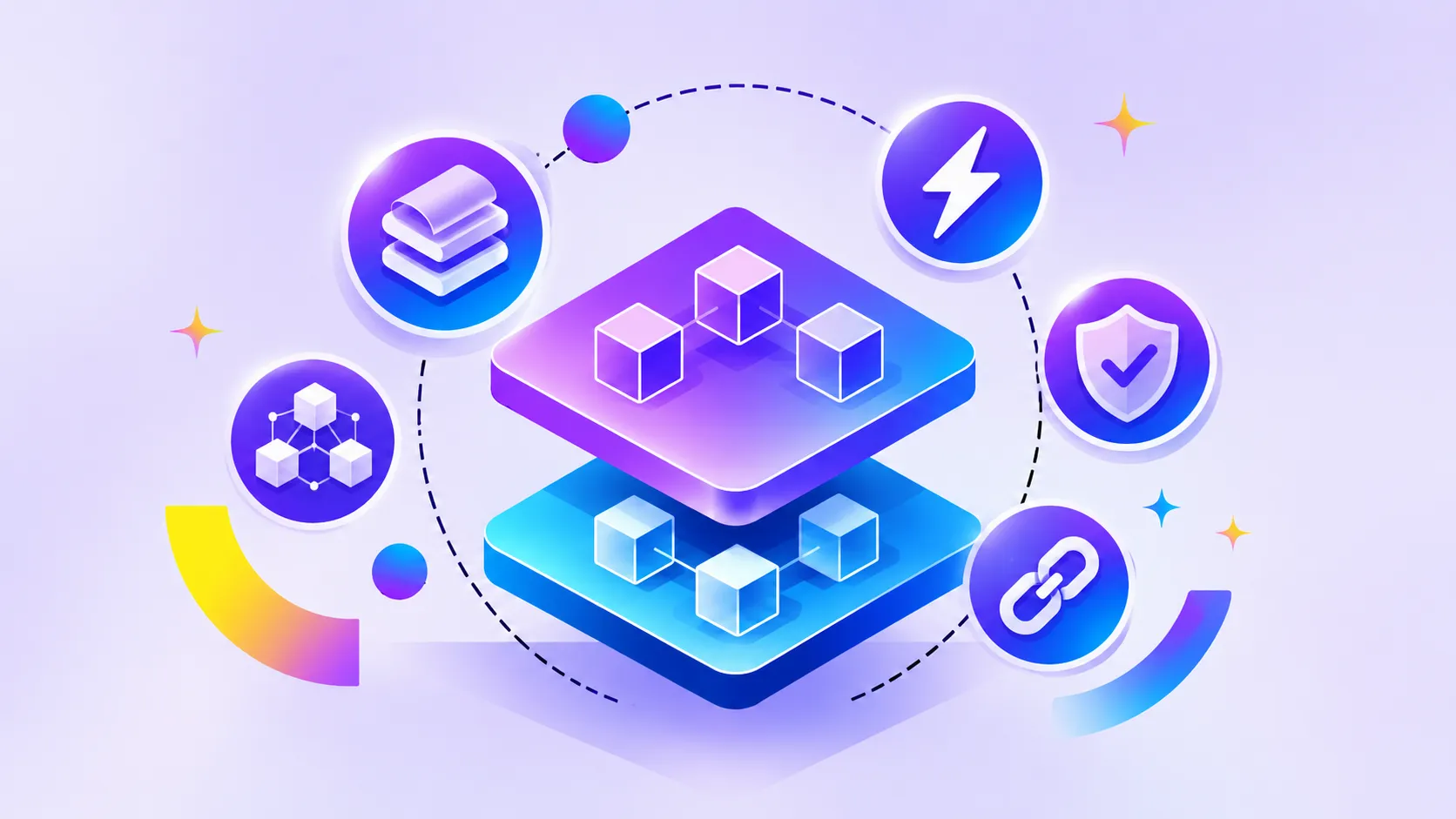
Layer 2 (L2) blockchains are scaling solutions designed to improve the transaction capacity, efficiency, and accessibility of existing Layer 1 (L1) blockchains by processing activity outside the underlying network while relying on it for important security or settlement functions.
The main types of Layer 2 scaling solutions include optimistic rollups, zero-knowledge rollups (ZK-rollups), state channels, and payment channels. Related scaling architectures include Plasma chains, validiums, and volitions, which introduce different approaches to transaction verification and data availability.
Sidechains are also frequently discussed alongside Layer 2 technologies. However, they are not generally considered true Layer 2 solutions under a strict technical definition because they rely on independent consensus mechanisms rather than directly inheriting the security of their underlying blockchain.
Popular examples of Layer 2 networks and protocols include Arbitrum, Optimism, Base, Starknet, ZKsync, and the Bitcoin Lightning Network. Each uses a different technological approach to addressing blockchain scalability challenges.
Readers unfamiliar with blockchain infrastructure can first explore our guide to the differences between Layer 1 and Layer 2 blockchains.
At CoinW, we believe understanding the different types of Layer 2 blockchains is essential for evaluating cryptocurrency ecosystems, identifying technological opportunities, and recognizing the risks associated with emerging blockchain infrastructure.
Quick Summary
Optimistic rollups: Process transactions outside Layer 1 and use fault proofs or dispute mechanisms to challenge incorrect state transitions.
Zero-knowledge rollups: Use cryptographic validity proofs to verify batches of transactions on the underlying blockchain.
State channels: Enable participants to exchange signed state updates offchain and use Layer 1 for settlement and dispute resolution.
Payment channels: A specialized form of channel technology primarily designed for cryptocurrency transfers and micropayments.
Plasma chains: An early blockchain scaling architecture that uses child chains, cryptographic commitments, and withdrawal mechanisms.
Validiums: Use validity proofs while maintaining transaction data outside the underlying blockchain.
Volitions: Hybrid architectures that combine onchain and offchain data availability options.
Sidechains: Independent blockchains connected to other networks through bridges, with their own security infrastructure.
Main benefits: Lower transaction costs, greater throughput, reduced congestion, and improved application scalability.
Key risks: Smart contract vulnerabilities, centralized operators, data availability failures, bridge risks, and liquidity fragmentation.
Background: Why Are There Different Types of Layer 2 Blockchains?
Traditional blockchain networks must balance transaction processing capacity with decentralization and security. Because distributed networks require participants to verify information and maintain agreement over blockchain state, increasing transaction throughput can introduce additional technical challenges.
Bitcoin introduced decentralized digital payments, while Ethereum expanded blockchain functionality through programmable smart contracts. As adoption increased, developers began exploring ways to accommodate greater transaction demand without requiring every operation to be executed directly on the underlying blockchain.
Different Layer 2 architectures emerged because blockchain applications have different requirements. A cryptocurrency payment network may prioritize rapid transfers, while a decentralized finance (DeFi) ecosystem may require complex smart contract execution and shared liquidity.
Layer 2 scaling solutions attempt to address these requirements by optimizing one or more of the following blockchain functions:
Execution: Processing transactions and calculating changes to blockchain state.
Settlement: Establishing the accepted outcome of transactions and resolving disputes.
Data availability: Ensuring that information required to verify or reconstruct blockchain state remains accessible.
Verification: Establishing whether transactions and state transitions comply with protocol rules.
These functions can be distributed differently depending on the architecture. To understand how they operate at the underlying blockchain level, explore our article on the types of Layer 1 blockchains and their architectures.
How Are Layer 2 Blockchains Classified?
Layer 2 scaling solutions are primarily classified according to how they verify transactions, where they publish transaction data, how users recover their assets, and which security guarantees they obtain from the underlying blockchain.
A network's transaction speed alone does not determine whether it qualifies as a Layer 2 blockchain. Its relationship with the underlying Layer 1 network is equally important.
| Classification | What It Describes | Examples |
|---|---|---|
| Transaction verification | How transaction correctness is established | Fault proofs, validity proofs, participant signatures |
| Data availability | Where information required to reconstruct network state is published | Layer 1, external data providers, channel participants |
| Settlement model | How transaction outcomes become enforceable | Rollup contracts, channel contracts, withdrawal mechanisms |
| Execution environment | How transactions and applications are processed | EVM, specialized virtual machines, payment protocols |
| Application focus | The primary activities supported by the system | DeFi, payments, gaming, NFTs, trading |
These classifications are not mutually exclusive. For example, a Layer 2 network can simultaneously use validity proofs, Ethereum-based data availability, a specialized execution environment, and a general-purpose application ecosystem.
What Are Rollups in Blockchain?
A blockchain rollup is a scaling architecture that executes transactions outside the underlying blockchain, aggregates their results, and publishes information required for verification and state reconstruction to Layer 1.
Instead of requiring the base blockchain to execute every individual transaction, rollups distribute computation across a separate execution environment and use Layer 1 infrastructure to enforce important security guarantees.
Rollups have become central to Ethereum's scaling strategy. Developments such as blob-based data publication allow rollups to use Ethereum for data availability without relying exclusively on traditional transaction calldata.
How Do Rollups Work?
Transaction submission: Users submit transactions to the rollup network.
Transaction ordering: A sequencer or another ordering mechanism determines the sequence in which transactions are processed.
Offchain execution: Transactions are executed within the rollup environment rather than directly on Layer 1.
Transaction aggregation: Multiple operations are combined to reduce the amount of information that must be published to the base blockchain.
Data publication and verification: The rollup publishes relevant data and state commitments to Layer 1, where its proof or dispute mechanism establishes the validity of state transitions.
Settlement: Transaction outcomes become enforceable through the underlying blockchain according to the rollup's protocol rules.
The two main categories of rollups are optimistic rollups and zero-knowledge rollups. Their fundamental difference lies in how they establish the correctness of transactions.
1. Optimistic Rollups
Optimistic rollups are Layer 2 scaling solutions that provisionally accept submitted state transitions unless they are successfully challenged through a dispute mechanism.
The term optimistic refers to the assumption that submitted results are correct unless evidence demonstrates otherwise. Rather than requiring a cryptographic validity proof for every batch, optimistic rollups rely on mechanisms that allow incorrect results to be identified and disputed.
How Do Optimistic Rollups Work?
Transactions are processed within the Layer 2 execution environment, and the information needed to verify the resulting state is published to the underlying blockchain.
If an incorrect state commitment is submitted, an eligible participant can challenge it through the rollup's dispute system. Fault proofs, also historically referred to as fraud proofs, allow the underlying protocol to determine whether the disputed computation was performed correctly.
Optimistic rollups commonly include a challenge period before certain state commitments or withdrawals become fully enforceable. For some major implementations, canonical withdrawals to Ethereum may require approximately seven days, although the exact duration depends on the protocol.
Examples of Optimistic Rollups
Arbitrum (ARB): Arbitrum One uses optimistic rollup technology to support Ethereum-compatible smart contracts, decentralized applications, and DeFi ecosystems.
Optimism (OP): OP Mainnet uses optimistic rollup architecture and is associated with the OP Stack, a framework for developing blockchain networks.
Base: An Ethereum Layer 2 network built using the OP Stack that supports Ethereum-compatible applications and digital asset transfers.
Advantages of Optimistic Rollups
Support for general-purpose smart contract applications.
Compatibility with Ethereum development tools in many implementations.
Reduced execution costs compared with equivalent Layer 1 transactions.
Ability to use Ethereum's data availability and settlement infrastructure.
Disadvantages of Optimistic Rollups
Potentially lengthy canonical withdrawal periods.
Reliance on functioning dispute mechanisms and participants capable of identifying incorrect commitments.
Potential transaction censorship or disruption associated with centralized sequencing.
Additional smart contract, bridge, and governance risks.
2. Zero-Knowledge Rollups (ZK-Rollups)
Zero-knowledge rollups, commonly known as ZK-rollups, are Layer 2 scaling solutions that use cryptographic validity proofs to demonstrate that batches of transactions have been executed according to protocol rules.
Unlike optimistic rollups, ZK-rollups establish the correctness of submitted state transitions through mathematical verification rather than relying primarily on a challenge period.
The use of zero-knowledge proof technology does not automatically make transactions private. Many ZK-rollups use these cryptographic systems for computational verification and scalability rather than transaction confidentiality.
How Do ZK-Rollups Work?
Users submit transactions to the Layer 2 network.
Transactions are executed and grouped into batches outside Layer 1.
A prover generates a cryptographic proof demonstrating that the resulting state transition satisfies the protocol's rules.
The validity proof, state commitment, and required data are submitted to the underlying blockchain.
A verification contract checks the proof and accepts the corresponding state update if the required conditions are satisfied.
This architecture allows the underlying blockchain to verify extensive offchain computation without repeating every individual transaction.
What Are ZK-SNARKs and ZK-STARKs?
Validity proof systems are an important component of ZK-rollup architecture. Two widely discussed categories of cryptographic proof systems are ZK-SNARKs and ZK-STARKs.
ZK-SNARKs: Zero-Knowledge Succinct Non-Interactive Arguments of Knowledge. These proof systems are designed to enable efficient verification through compact cryptographic proofs. Trusted setup requirements depend on the specific construction.
ZK-STARKs: Zero-Knowledge Scalable Transparent Arguments of Knowledge. These systems do not require a traditional trusted setup and are designed to support scalable verification.
Different proof systems introduce different trade-offs involving proof size, computational requirements, verification costs, and cryptographic assumptions.
What Is a zkEVM?
A zero-knowledge Ethereum Virtual Machine, or zkEVM, is an execution environment designed to support Ethereum-compatible computation while generating cryptographic proofs that demonstrate correct execution.
Depending on the implementation, zkEVM technology can help developers deploy existing Ethereum applications within validity-proof-based scaling environments with varying degrees of compatibility.
Examples of ZK-Rollups
Starknet (STRK): An Ethereum scaling network that uses STARK-based validity proofs and a specialized execution environment based on Cairo.
ZKsync (ZK): An ecosystem developing validity-proof-based blockchain scaling infrastructure, including the ZKsync Era network.
Scroll: An Ethereum scaling network designed around zkEVM technology and compatibility with Ethereum applications.
Advantages of ZK-Rollups
Cryptographic verification of state transitions.
No conventional optimistic fraud-proof challenge period for verified state updates.
Potential to reduce the amount of information published to Layer 1 through efficient data encoding.
Support for scalable cryptocurrency payments and increasingly sophisticated blockchain applications.
Disadvantages of ZK-Rollups
Potentially resource-intensive proof generation.
Complex cryptographic infrastructure and development requirements.
Potential reliance on centralized sequencing or proving infrastructure.
Withdrawal and finalization delays associated with proof generation, submission schedules, and bridge design.
Optimistic Rollups vs. ZK-Rollups: What Is the Difference?
The main difference between optimistic rollups and ZK-rollups is their transaction verification mechanism. Optimistic rollups use disputable state commitments, while ZK-rollups require cryptographic validity proofs to establish the correctness of state updates.
| Feature | Optimistic Rollups | ZK-Rollups |
|---|---|---|
| Verification mechanism | Fault proofs and disputes | Cryptographic validity proofs |
| Transaction execution | Offchain | Offchain |
| Data availability | Underlying Layer 1 | Underlying Layer 1 |
| Challenge period | Generally required | Not required for validity verification |
| Canonical withdrawals | Often subject to multi-day delays | Dependent on proof and bridge processing |
| Technical complexity | Dispute resolution infrastructure | Cryptographic proving infrastructure |
| Ethereum compatibility | Commonly EVM-compatible | Depends on execution environment |
| Transaction privacy | Not inherently private | Not inherently private |
| Examples | Arbitrum One, OP Mainnet, Base | Starknet, ZKsync Era, Scroll |
Neither rollup category is universally superior. Actual performance, security, transaction costs, and withdrawal times depend on individual network implementations and their operational infrastructure.
3. State Channels
State channels are offchain scaling protocols that allow a defined group of participants to interact repeatedly without publishing every individual transaction to the underlying blockchain.
Participants maintain an agreed state by exchanging digitally signed messages. The base blockchain remains available to enforce settlement and resolve disputes if participants cannot reach an agreement.
Unlike rollups, state channels do not necessarily maintain a separate, publicly accessible blockchain. They are better understood as Layer 2 protocols for specific interactions between participants.
How Do State Channels Work?
Channel creation: Participants establish a channel using an onchain contract or another enforceable funding mechanism.
Initial state: Channel participants agree on the starting conditions and, where necessary, commit funds.
Offchain interaction: Participants exchange signed updates representing changes to the channel's state.
Channel closure: The final agreed state is submitted for settlement when the channel is closed.
Dispute resolution: If a participant submits an outdated or disputed state, the underlying blockchain can enforce the channel's rules.
What Are State Channels Used For?
Repeated interactions between predefined participants.
Blockchain-based games and turn-based applications.
Conditional transfers and digital agreements.
Real-time interactions requiring minimal onchain settlement.
Advantages and Limitations of State Channels
State channels can deliver rapid interactions with minimal recurring onchain costs. They can also keep intermediate activity outside the public blockchain ledger.
However, participants may need to lock funds in advance, maintain access to signed state information, and monitor potential disputes. Their application models are generally less flexible than shared execution environments such as general-purpose rollups.
4. Payment Channels
Payment channels are a specialized form of channel-based scaling designed primarily for transferring digital assets between participants.
Rather than broadcasting each payment to the underlying blockchain, participants update an agreed allocation of funds within the channel. These updates can subsequently be enforced through the base blockchain when necessary.
Bitcoin Lightning Network
The Bitcoin Lightning Network is one of the best-known examples of payment-channel technology. It enables users to transfer Bitcoin (BTC) through a network of interconnected payment channels.
Users do not necessarily need a direct channel with every recipient. Payments can be routed through intermediate participants when a suitable route with sufficient liquidity is available.
The Lightning Network uses Bitcoin's underlying transaction rules to support enforceable channel balances and settlement mechanisms.
What Are the Benefits of Payment Channels?
Rapid cryptocurrency payments.
Reduced need for individual onchain transactions.
Support for small-value transfers and micropayments.
Potential improvements in payment efficiency for merchants and digital services.
Payment channels also introduce limitations involving channel liquidity, routing reliability, operational availability, and the cost of establishing or closing channels.
5. Plasma Chains
Plasma is an early blockchain scaling framework that uses secondary chains, commonly known as child chains, connected to an underlying blockchain.
Plasma chains process activity separately and periodically submit cryptographic commitments to the root blockchain. Users rely on specialized withdrawal procedures, dispute mechanisms, and transaction proofs to protect their assets.
Plasma was an important development in the history of Ethereum scaling because it explored how computation and transaction activity could be distributed across secondary networks without placing every operation on Ethereum Mainnet.
How Do Plasma Chains Work?
Users deposit assets into a contract on the underlying blockchain.
Transactions are processed within a Plasma child chain.
Cryptographic commitments representing child-chain activity are published to the root blockchain.
Users rely on transaction information and withdrawal proofs to recover assets.
Disputes can be handled according to the Plasma implementation's exit rules.
What Are the Limitations of Plasma?
Traditional Plasma implementations face challenges related to limited onchain data availability, complex withdrawal procedures, user monitoring requirements, and the possibility of congestion if many participants attempt to withdraw simultaneously.
Supporting general-purpose smart contracts also proved difficult in many early Plasma designs. Consequently, Ethereum's scaling ecosystem increasingly adopted rollup-based architectures.
Plasma remains relevant as a historical and technical foundation for understanding the development of offchain execution, asset recovery mechanisms, and blockchain scaling.
6. Validiums
Validiums are blockchain scaling systems that use cryptographic validity proofs to verify state transitions while maintaining the data needed to reconstruct those transitions outside the underlying blockchain.
Validiums resemble ZK-rollups in their use of validity proofs. Their principal difference is the location and security model of data availability.
How Do Validiums Work?
Transactions are executed outside Layer 1, and a validity proof is generated to establish that the resulting state transition complies with protocol rules.
The underlying blockchain verifies the proof, while relevant transaction or state data is maintained through an external availability mechanism. Depending on the architecture, this may involve a data availability committee or another specialized infrastructure provider.
Validium vs. ZK-Rollup
The main difference between a validium and a ZK-rollup is that a ZK-rollup publishes sufficient state reconstruction data to its underlying Layer 1, while a validium relies on an external data availability mechanism.
Keeping data outside Layer 1 can reduce publication costs and support greater transaction capacity. However, it introduces additional assumptions about whether users can access the information required to verify balances, initiate withdrawals, or recover assets.
A valid state transition does not necessarily guarantee that the corresponding transaction data remains accessible. This distinction is fundamental to understanding validium security.
What Are Validiums Used For?
High-frequency trading applications.
Blockchain gaming ecosystems.
NFT marketplaces and digital asset platforms.
Applications that prioritize low transaction costs and high processing capacity.
Although validiums are often grouped with Layer 2 networks, they introduce additional data availability assumptions that distinguish them from conventional Ethereum rollups.
7. Volitions
Volitions are hybrid scaling architectures that combine characteristics of ZK-rollups and validiums by offering different data availability options within a validity-proof-based system.
Depending on the implementation, users or applications may be able to select whether relevant transaction data is published to the underlying blockchain or maintained through an external availability mechanism.
This approach allows different activities to use different cost and security models without necessarily requiring entirely separate execution environments.
How Do Volitions Differ from Rollups and Validiums?
| Feature | ZK-Rollup | Validium | Volition |
|---|---|---|---|
| Verification | Validity proofs | Validity proofs | Validity proofs |
| Data availability | Layer 1 | External mechanism | Multiple availability options |
| Data publication costs | Includes Layer 1 publication | Potentially lower | Depends on selected mode |
| Security assumptions | Layer 1 availability and proof system | Proof system and external availability | Depends on selected mode and system design |
| Primary advantage | Layer 1 data availability guarantees | Reduced data publication requirements | Flexible cost and availability models |
Volitions illustrate how scaling architectures can combine multiple approaches rather than relying on a single security and data availability model for every transaction.
8. Sidechains: Are They Really Layer 2 Blockchains?
A sidechain is an independent blockchain connected to another blockchain through a bridge or interoperability mechanism.
Sidechains typically maintain their own validators, consensus rules, transaction histories, and security infrastructure. They can support faster or cheaper transactions by adopting different network parameters from the blockchain to which they are connected.
However, sidechains are not generally considered true Layer 2 blockchains because they do not directly inherit the underlying network's consensus security in the same manner as conventional rollups.
How Do Sidechains Work?
Users generally transfer assets between a main blockchain and a sidechain through bridge infrastructure. Once assets are available on the sidechain, transactions are processed according to its independent protocol rules.
The security of assets transferred through this architecture depends on the sidechain's consensus mechanism, bridge contracts, validator behavior, and other implementation-specific protections.
Examples commonly associated with sidechain architectures include Polygon PoS, Gnosis Chain, and SKALE networks.
Sidechains vs. Layer 2 Rollups
The defining difference is security inheritance. Rollups use the underlying blockchain to enforce important validity, dispute resolution, and data availability guarantees. Sidechains primarily depend on their own consensus and security systems.
Being compatible with Ethereum or maintaining a bridge to Ethereum does not automatically make an independent blockchain an Ethereum Layer 2.
Comparison of Layer 2 Blockchain Types
Different scaling solutions prioritize different combinations of transaction efficiency, application flexibility, verification, and data availability.
| Scaling Solution | Verification Model | Data Availability | Main Use Cases | Main Limitation |
|---|---|---|---|---|
| Optimistic rollups | Fault proofs | Layer 1 | DeFi, smart contracts, trading | Challenge periods |
| ZK-rollups | Validity proofs | Layer 1 | DeFi, payments, general applications | Proof generation complexity |
| State channels | Signed state updates and disputes | Channel participants | Repeated interactions, games | Participant and liquidity constraints |
| Payment channels | Signed payment commitments | Channel participants | Payments, micropayments | Channel liquidity and routing |
| Plasma | Commitments and exit disputes | Primarily offchain | Asset transfers | Complex exits and data availability |
| Validiums | Validity proofs | External mechanism | Trading, gaming, digital assets | External availability assumptions |
| Volitions | Validity proofs | Onchain or external | Flexible application ecosystems | Architectural complexity |
| Sidechains | Independent consensus | Sidechain network | General-purpose applications | Independent security assumptions |
Rollups and channel-based protocols are commonly recognized as Layer 2 technologies. Plasma, validiums, and volitions introduce different or hybrid security assumptions, while sidechains represent a separate category of blockchain scaling infrastructure.
Why Is Data Availability Important for Layer 2 Blockchains?
Data availability refers to whether the information needed to independently reconstruct and verify blockchain state can be accessed by network participants.
Transaction verification and data availability are closely related but distinct concepts. A cryptographic proof may establish that a state transition is correct without ensuring that users possess the information required to reconstruct that state.
This distinction explains why ZK-rollups and validiums can use similar cryptographic verification systems while offering different security guarantees.
Layer 1 Data Availability
Conventional rollups publish relevant transaction or state reconstruction data to the underlying blockchain. Ethereum rollups can use calldata or dedicated blob infrastructure to make this information available according to Ethereum's protocol rules.
Blob data has a limited retention period at the protocol level, so long-term historical access may also depend on archival infrastructure.
External Data Availability
Some scaling systems use external availability committees or specialized blockchain infrastructure to reduce data publication costs. These mechanisms introduce different dependencies and security assumptions from native Layer 1 data availability.
Projects such as Celestia (TIA) and Avail (AVAIL) develop specialized infrastructure for data availability within modular blockchain ecosystems.
These projects should not automatically be classified as Ethereum Layer 2 rollups. Their primary role is providing infrastructure that other blockchain systems can use.
What Is the Role of Sequencers, Provers, and Challengers?
Modern Layer 2 blockchains frequently rely on specialized infrastructure to order transactions, establish computational correctness, and communicate with their underlying blockchain.
Sequencers
A sequencer is responsible for determining the order in which transactions are processed within a rollup. Sequencers can provide rapid preliminary confirmations and improve transaction processing efficiency.
Centralized sequencing can introduce risks involving censorship, service interruptions, and control over transaction ordering.
Provers
Provers generate cryptographic validity proofs demonstrating that offchain computation satisfies the rules of a validity-proof-based scaling system.
Proof generation can require significant computational resources, depending on the proof system and execution environment.
Challengers
Challengers monitor state commitments in optimistic systems and initiate disputes when incorrect results are identified.
The effectiveness of this model depends on whether disputes can be initiated and resolved according to the protocol's security requirements.
Layer 1 Verification and Settlement Contracts
Rollups commonly use smart contracts on their underlying blockchain to manage state commitments, verification procedures, deposits, and withdrawals.
The design, upgradeability, and security of these contracts directly influence the protections available to users.
Major Contributions and Impact of Layer 2 Technologies
Layer 2 technologies have expanded the range of activities that blockchain networks can support by making it possible to distribute transaction execution across multiple environments.
Improving Blockchain Scalability
By processing activity outside the underlying blockchain, Layer 2 networks can reduce competition for base-layer execution capacity and distribute transaction processing requirements.
Expanding Decentralized Finance
Lower transaction costs can make decentralized exchanges, lending protocols, liquidity provision, and other DeFi applications more accessible. Users may be able to interact with protocols more frequently without incurring the same execution costs as comparable Layer 1 transactions.
Supporting Blockchain Gaming and Digital Ownership
Games and digital asset platforms may require frequent, low-value interactions that are difficult to accommodate economically on congested base-layer networks.
Rollups, state channels, and validium-based architectures provide alternative environments for processing in-game transactions, NFT transfers, and other digital ownership activities.
Enabling Cryptocurrency Payments
Payment channels and rollup networks can make cryptocurrency transfers more practical for merchants, digital services, and users requiring frequent transactions.
How Do Layer 2 Blockchains Influence the Crypto Industry?
Layer 2 networks have encouraged the development of interconnected blockchain ecosystems in which execution environments, settlement networks, data availability providers, and application developers perform specialized functions.
This development has also created new cryptocurrency assets associated with network governance, transaction processing, staking, and ecosystem incentives.
However, the success of a Layer 2 blockchain does not automatically translate into increased demand for its associated token. Some ecosystems use Ethereum (ETH) for transaction fees while maintaining separate governance tokens.
Others may incorporate their own tokens into network operations or economic security mechanisms. The relationship between network adoption and token utility must therefore be evaluated individually.
Traders can monitor crypto live prices on CoinW while researching the technological infrastructure, adoption trends, and tokenomics associated with different Layer 2 ecosystems.
What Are the Main Risks of Layer 2 Blockchains?
Although Layer 2 solutions can improve blockchain scalability, they introduce technical and operational risks that differ according to their architecture.
1. Smart Contract Risk
Errors in verification contracts, bridge contracts, withdrawal mechanisms, or other protocol components can result in financial losses or prevent users from accessing their assets.
2. Sequencer Centralization
Networks that rely on a single transaction sequencing operator may experience censorship, transaction delays, or interruptions if that operator becomes unavailable.
3. Data Availability Risk
Systems relying on external data availability mechanisms may face difficulties if essential state information becomes inaccessible, even when the correctness of a submitted state transition has been established.
4. Bridge Risk
Transferring assets between Layer 1 and Layer 2 networks often requires bridge infrastructure. Vulnerabilities in bridge contracts, verification mechanisms, or administrative permissions can expose users to financial losses.
5. Withdrawal and Liquidity Risk
Different scaling architectures provide different withdrawal procedures. Users may encounter challenge periods, proof-related delays, insufficient channel liquidity, or limitations in external bridge services.
6. Governance and Upgrade Risk
Some Layer 2 networks allow designated administrators, security councils, or governance mechanisms to modify important protocol components. The scope of these permissions and the safeguards surrounding upgrades can materially affect network security.
7. Token Market Risk
Cryptocurrencies associated with Layer 2 networks remain exposed to market volatility, token supply changes, competition, regulatory developments, and changes in ecosystem demand.
Which Type of Layer 2 Blockchain Is Best?
There is no universally best type of Layer 2 blockchain. The appropriate scaling architecture depends on the intended application, security requirements, transaction frequency, and acceptable operational trade-offs.
| Use Case | Potentially Suitable Architecture | Main Consideration |
|---|---|---|
| Ethereum-compatible DeFi | Optimistic rollups or zkEVM rollups | Application compatibility and liquidity |
| Validity-proof-based applications | ZK-rollups | Cryptographic verification and proof infrastructure |
| Bitcoin micropayments | Payment channels | Routing and channel liquidity |
| Repeated peer-to-peer interactions | State channels | Participant availability and dispute protection |
| High-frequency gaming | Rollups, validiums, or state channels | Low costs and application requirements |
| Flexible data availability | Volitions | Balance between cost and availability guarantees |
| Independent application infrastructure | Sidechains | Independent consensus and bridge security |
Users should evaluate individual networks rather than assuming that every implementation within a particular category offers identical security, performance, or decentralization.
For practical guidance on wallets, bridging, transaction fees, and network selection, explore our beginner's guide to Layer 2 blockchains.
What Is the Future of Layer 2 Blockchains?
The future of Layer 2 blockchain technology is likely to be influenced by improvements in cryptographic verification, decentralized infrastructure, interoperability, and the efficiency of data availability systems.
Decentralized Sequencing
Developers are exploring sequencing architectures that distribute transaction ordering responsibilities across multiple participants. These approaches aim to reduce individual operator dependencies and improve censorship resistance.
More Efficient Validity Proofs
Improvements in cryptographic proof systems, recursive proofs, and specialized computing infrastructure could reduce verification costs and improve the efficiency of validity-proof-based blockchains.
Modular Blockchain Infrastructure
Specialized execution, settlement, and data availability networks may allow developers to create blockchain environments tailored to specific application requirements.
These architectures can provide greater flexibility, although they may also increase the complexity of evaluating security dependencies.
Interoperability Between Layer 2 Networks
As more scaling networks develop, connecting fragmented applications, assets, and liquidity becomes increasingly important.
Improved messaging protocols, interoperability infrastructure, and network abstraction could make interactions between blockchain ecosystems easier for users.
Progressive Decentralization
The long-term security of Layer 2 networks will depend partly on their ability to reduce reliance on privileged operators, strengthen independent verification, and provide reliable mechanisms for users to recover assets.
Scalability improvements alone are unlikely to determine which Layer 2 ecosystems achieve sustainable adoption. Security, usability, liquidity, interoperability, and application development will also play important roles.
FAQs About the Types of Layer 2 Blockchains
1. What are the main types of Layer 2 blockchains?
The main types of Layer 2 scaling solutions are optimistic rollups, zero-knowledge rollups, state channels, and payment channels. Related scaling architectures include Plasma, validiums, and volitions. Sidechains are generally classified separately because they rely on independent security mechanisms.
2. What is a Layer 2 rollup?
A Layer 2 rollup processes transactions outside the underlying blockchain and publishes information required for verification and state reconstruction to Layer 1. Rollups increase processing capacity while retaining important security guarantees from the base network.
3. What is the difference between optimistic rollups and ZK-rollups?
Optimistic rollups use state commitments that can be challenged through fault-proof mechanisms. ZK-rollups use cryptographic validity proofs to demonstrate the correctness of state transitions before the corresponding updates are accepted.
4. What is the difference between rollups and state channels?
Rollups provide shared execution environments that aggregate and verify activity from multiple users. State channels allow a defined group of participants to exchange signed updates privately between themselves and use the underlying blockchain when settlement or dispute resolution is necessary.
5. Is the Bitcoin Lightning Network a Layer 2 blockchain?
The Bitcoin Lightning Network is a Layer 2 payment protocol built on Bitcoin. It uses interconnected payment channels rather than operating as a separate blockchain with its own public transaction ledger and consensus mechanism.
6. Are sidechains considered Layer 2 blockchains?
Not under a strict security-based definition. Sidechains maintain independent consensus mechanisms, while conventional Layer 2 rollups obtain important verification and security guarantees from their underlying blockchain.
7. What is the difference between a validium and a ZK-rollup?
Both architectures use validity proofs. However, ZK-rollups publish the data required to reconstruct network state to Layer 1, while validiums rely on external data availability mechanisms.
8. What is a volition in blockchain technology?
A volition is a hybrid validity-proof-based scaling architecture that provides multiple data availability options, allowing different activities to use rollup-style or validium-style availability models depending on the implementation.
9. Is Arbitrum an optimistic rollup or a ZK-rollup?
Arbitrum One is an optimistic rollup. Other networks within the broader Arbitrum ecosystem may use different configurations, including alternative data availability mechanisms.
10. Is Starknet a ZK-rollup?
Yes. Starknet is an Ethereum scaling network that uses STARK-based validity proofs to verify offchain transaction execution.
11. Are ZK-rollups private?
Not necessarily. Zero-knowledge proof technology can support privacy-preserving applications, but many ZK-rollups primarily use cryptographic proofs to verify computation rather than conceal transaction details.
12. Which type of Layer 2 blockchain is the fastest?
There is no fixed answer. Performance depends on transaction complexity, network demand, hardware, sequencing infrastructure, proof generation, and settlement requirements. Preliminary transaction confirmation speed should also be distinguished from final Layer 1 settlement.
13. Are Layer 2 blockchains as secure as Layer 1?
Not necessarily. Layer 2 solutions can inherit important security guarantees from their underlying blockchain, but additional infrastructure, smart contracts, data availability mechanisms, and governance permissions may introduce further risks.
14. Do all Layer 2 blockchains have their own cryptocurrency?
No. Some Layer 2 ecosystems issue governance or utility tokens, while others use the cryptocurrency of their underlying blockchain for transaction fees without requiring a separate native network token.
15. Do Layer 2 blockchains replace Layer 1 blockchains?
No. Layer 2 technologies complement underlying blockchains by extending their capabilities. Conventional Layer 2 systems continue to depend on Layer 1 infrastructure for important security, verification, or settlement functions.
Conclusion
Layer 2 blockchains represent an important development in the evolution of blockchain infrastructure. By processing transactions outside underlying networks, scaling solutions can improve transaction efficiency, expand application capacity, and reduce the cost of interacting with decentralized ecosystems.
Optimistic rollups and ZK-rollups provide shared execution environments with different transaction verification mechanisms. State channels and payment channels optimize repeated interactions between participants, while Plasma, validiums, and volitions explore alternative approaches to scalability and data availability.
Sidechains also contribute to the broader blockchain scaling ecosystem, although their independent consensus mechanisms distinguish them from conventional Layer 2 solutions.
The most important considerations when evaluating different types of Layer 2 blockchains include their verification mechanisms, data availability guarantees, settlement procedures, decentralization, and ability to protect user assets.
At CoinW, we encourage users to understand the technological foundations of cryptocurrency ecosystems before trading associated digital assets or transferring funds between blockchain networks.
References / Sources
Ethereum.org: Ethereum Scaling Solutions
Ethereum.org: What Is Layer 2?
Ethereum.org: Optimistic Rollups
Ethereum.org: Zero-Knowledge Rollups
-
-
Ethereum.org: Validium and Volition Scaling Models
-
Lightning Network: Official Project Website
Arbitrum: Official Developer Documentation
Optimism: Official Documentation
Starknet: Official Project Website
ZKsync: Official Project Website
Celestia: Modular Blockchain and Data Availability Infrastructure
Avail: Official Project Website
Risk Disclaimer: Cryptocurrency trading and blockchain interactions involve financial and technical risks, including market volatility, smart contract vulnerabilities, bridge failures, data availability issues, and potential loss of assets. This article is provided for educational purposes only and does not constitute financial or investment advice.
You May Also Like

What Is CWL? A Complete Guide to CoinW’s Proof of Trade, Mining and CWC Airdrops
Discover CWL, CoinW’s ecosystem growth credential based on Proof of Trade. Learn how CWL mining works, how eligible trading drawdowns generate contributions, how membership acceleration increases mining rates, and how users can participate in phased airdrops from the dedicated 10 million CWC reward pool.
Types of Layer 1 Blockchains: Architecture and Consensus Explained
Explore the different types of Layer 1 blockchains, including Proof of Work, Proof of Stake, monolithic, modular, and sharded architectures. Learn how consensus mechanisms, execution models, and network design influence blockchain security, scalability, decentralization, and performance.
Layer 1 vs. Layer 2 Blockchains: Key Differences Explained
Learn the key differences between Layer 1 and Layer 2 blockchains, how they work, and how networks like Ethereum, Solana, and Arbitrum compare in scalability, security, and transaction fees.